WELCOME TO RACHEL’S FICTION WRITING AND REVIEWS BLOG
This is where Rachel keeps you up to date with her novels and stories and also shares reviews, highlights and extracts from other authors.

A Rat, a Skull, and a Murder That History Never Solved
On This Day: The Death of William Longespée, Third Earl of Salisbury. 7th March 1226
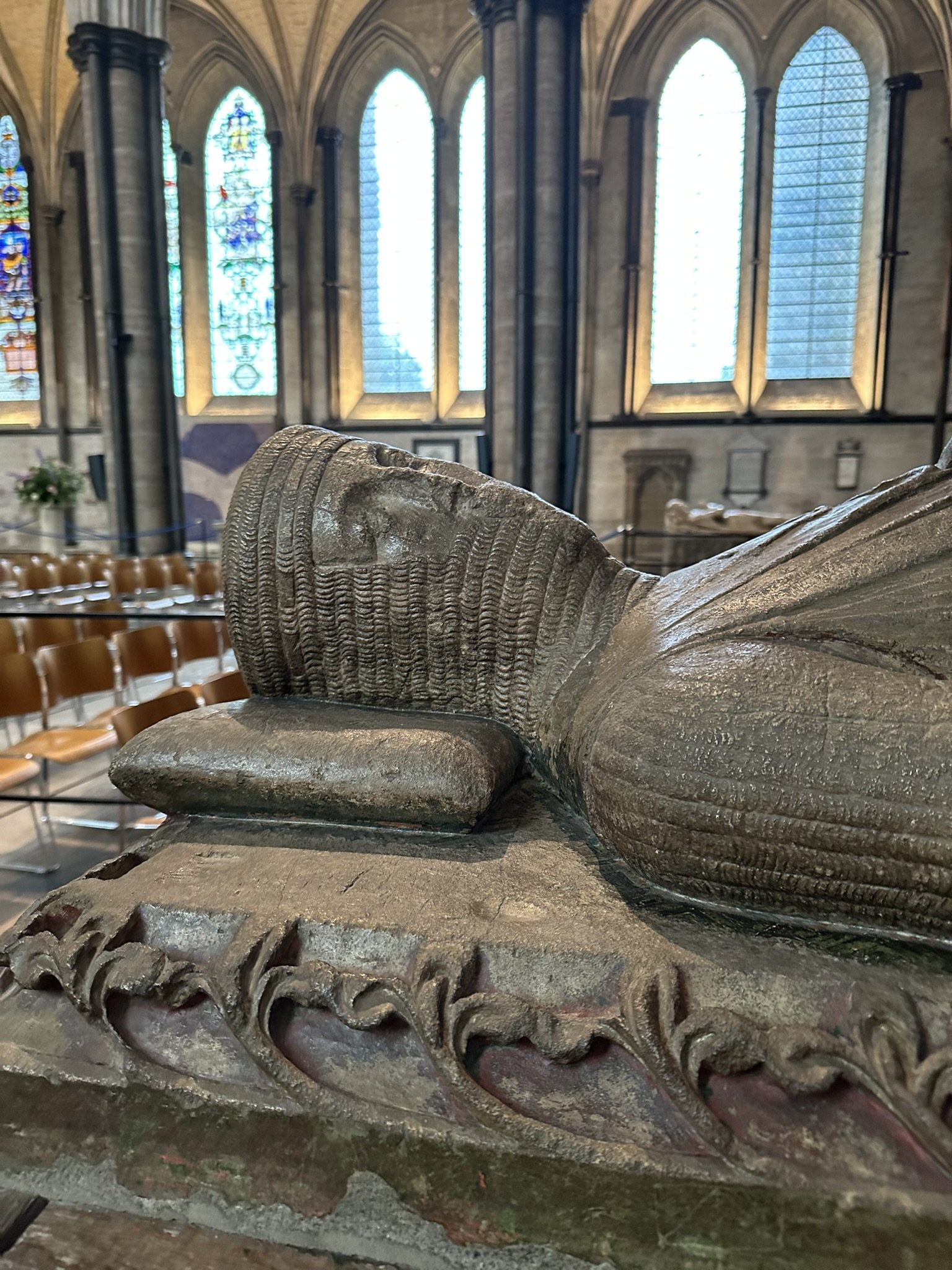
William Longespée’s Tomb at Salisbury Cathedral
When they opened the tomb, they found a rat. And not just any rat, but a dead one, curled inside a man's skull, centuries after both had gone into the dark. And when investigators ran the chemical analysis, the results sent a chill down historians’ spines.
Arsenic.
This is the story of William Longespée, Earl of Salisbury: soldier, crusader, half-brother to a king, and the death that eight hundred years of history has never been able to explain.
The King's Bastard Who Rose to Power
Born around 1176 as the illegitimate son of King Henry II, Longespée had no business becoming one of the most powerful men in England. But he did.
Through marriage to Ela of Salisbury, he became Earl and acquired one of the great titles of the realm. But he didn't coast on it; he fought, he commanded, and he mostly won.
His military career contained at least two moments that changed the course of history.
The Destruction of the French Fleet
In May 1213, King Philip II of France was massing an invasion fleet near the port of Damme, in what is now Belgium. The ships stretched across the harbour; hundreds of vessels, loaded with supplies, troops, and the ambition to bring England to its knees.
Longespée led the English fleet across the Channel to meet them.
What followed was less a battle than a systematic destruction. The English found the French fleet largely undefended as many of the ships sat at anchor with skeleton crews while the main force was raiding inland. Longespée's men fell upon them, seized what they could carry, and burned much of the rest.
It was one of the most decisive naval actions of the entire medieval period, and Philip's planned invasion collapsed. England, which had looked dangerously exposed, was suddenly safe.
Longespée had just saved the kingdom, and was hailed a hero.
He did it again four years later.
In 1217, with the young Henry III barely clinging to his throne, a French prince was being supplied and reinforced by sea. Longespée commanded the English fleet at the Battle of Sandwich, intercepting the French supply convoy in the Channel and destroying it with ruthless efficiency.
The strategy was brutally effective. Without reinforcement, the French campaign collapsed, and Henry III kept his throne.
His success (and probably his arrogance) meant he made enemies; powerful ones, in high places.
The Enemy You Already Know
One of those enemies was Nicola de la Haye; the indomitable castellan of Lincoln Castle, the woman who held the city against all odds and shaped the fate of England. But Nicola and Longespée were not allies. They were rivals, moving through the same treacherous political landscape from opposite sides.
It went further than politics. Longespée held the wardship of Nicola's granddaughter, Idonea. He’d essentially bought her wardship and betrothal to his son from John when she was captured during the Baron’s Revolt.
In the medieval world, controlling a child's wardship meant controlling their future, their inheritance, their marriage prospects. It was power over everything that mattered.
Nicola was not happy. What happens between them next is covered in the third novel in my Nicola de la Haye series, Lady of England.
A Storm at Sea. Then Something Worse.
In early 1226, Longespée's ship was wrecked.
He survived, battered, exhausted, exposed to the sea, and made his way to Salisbury. It was the obvious explanation when he fell ill shortly afterwards and died: a man weakened by shipwreck, a body pushed past its limits; the kind of death that happened all the time in the thirteenth century.
On 7 March 1226, he died.
His body was carried into the new cathedral at Salisbury, which was still rising from the water-meadows, still smelling of fresh stone and lime, and buried with the honours due an earl.
A model of Salisbury Cathedral still under construction, as it was when Longespée was buried there
But the rumours started almost immediately.
The Poison Rumours
William Longespée may well have been murdered by Hubert de Burgh with arsenic
The official verdict was illness, but the unofficial verdict was murder.
Suspicion gathered around Hubert de Burgh, the formidable royal justiciar who had long tangled with Longespée in the brutal politics of Henry III's court. In a world where power changed hands fast and rivals had everything to gain, poisoning wasn't paranoia. It was a reasonable fear.
But there was no proof. The rumours circulated, faded, and were eventually filed away under unsolved.
Then, in 1791, during a major reordering of Salisbury Cathedral, the tomb was opened.
The Rat and the Skull
When Longespée’s tomb was opened, an eerie detail emerged: a rat skeleton trapped inside the earl’s skull. Later testing revealed arsenic in the rat’s bones, giving chilling new life to the medieval whispers that the great earl had been poisoned.