What Languages Did Jews Speak in Medieval England?

Medieval jews in the ‘Mahzor of Worms’, a Jewish prayer book in early Yiddish
Jews in medieval England spoke several languages, depending on their origin, education, gender, and social role. In twelfth-century England, many Jewish families used Anglo-Norman French or Judaeo-French as an everyday language; Hebrew and Aramaic for prayer and scholarship; and, among some German-origin Jews, an early form of Yiddish. They also lived alongside Middle English speakers, even if English was not always the language of the Jewish home.
My upcoming novel, Lady of the Castle, the second in the Nicola de la Haye series, is set in the turbulent England of the 1180s and 1190s, which features not only political intrigue, Richard the Lionheart, the Third Crusade, the king’s ransom and the betrayal of Prince John, but also some incredibly dramatic and heartbreaking events in relation to the Jewish community.
My Jewish characters—Bella; her scholar husband Berechiah haNakdan; their children Leon and Licoricia (all featured already as side characters in Lady of Lincoln); and the formidable Hannah of York (based on a real woman)—inhabit a multilingual world that mirrors the complexity of their position in medieval English society: rooted, cultured, and perpetually precarious.
Zarephatic and the Language of the Conquerors
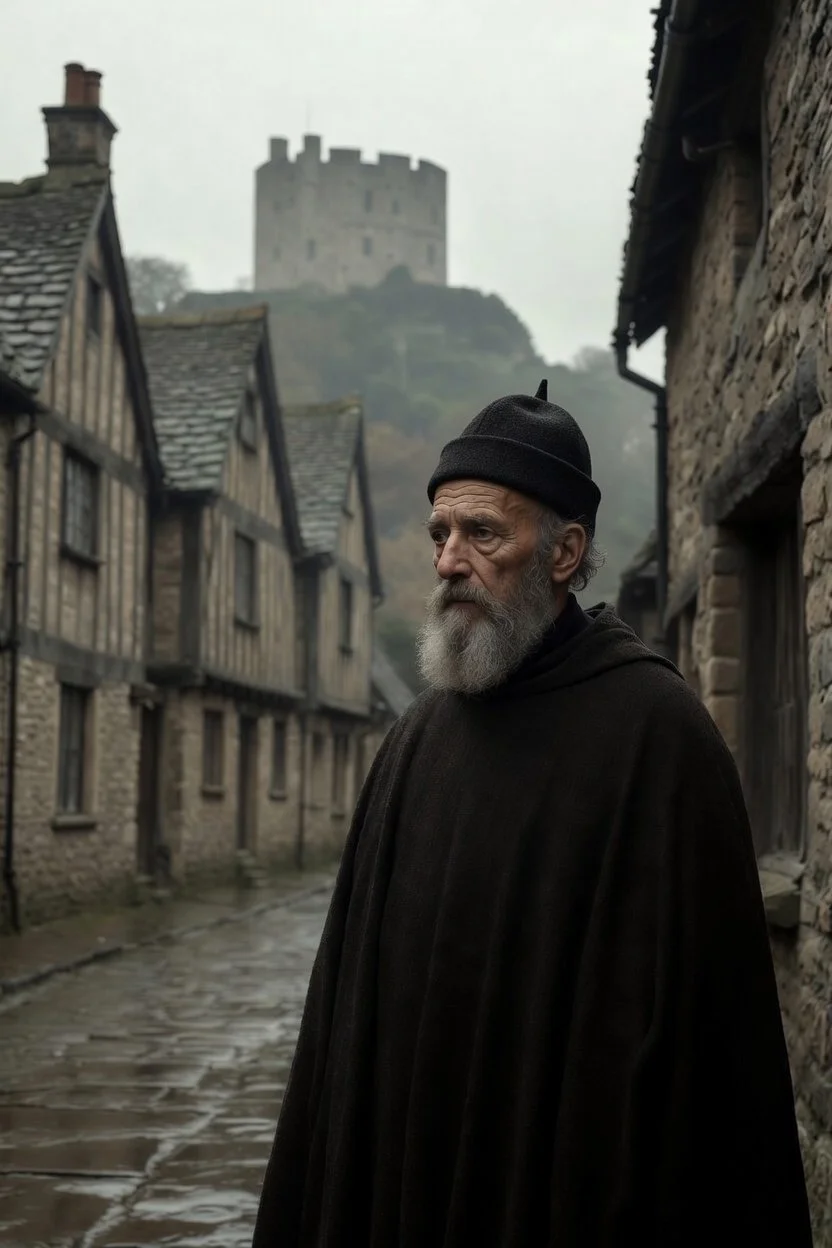
Jews first came to England from Normandy with William the Conqueror
The Jews of twelfth-century England had arrived, for the most part, in the wake of the Norman Conquest of 1066. William brought them from Rouen; they came as financiers, traders, and scholars, and they brought their vernacular language with them. That language was based on Old French—or more precisely, the Norman variant of it—and it remained the everyday spoken tongue of most English Jews throughout the twelfth century.
This variety of Jewish French is sometimes called Zarephatic (from Tzarfat, the Hebrew name for France) or Judaeo-French. It was not simply French with a few Hebrew loanwords sprinkled in. Like all Jewish vernaculars, it had its own vocabulary, idiom, and flavour, drawing on Hebrew and Aramaic for religious and communal concepts while remaining largely intelligible to its French-speaking neighbours. Scholars such as Rashi of Troyes, who died in 1105, used this language prolifically in his biblical and Talmudic commentaries, glossing difficult Hebrew and Aramaic terms in Zarephatic so that his readers—French-speaking Jews across the Rhineland and northern France—could follow. Some of those glosses survive in the manuscripts, tiny windows onto a lost vernacular.
In England, Jewish communities were concentrated in towns with strong Norman connections such as London, Lincoln, York, Norwich, and Winchester. These were also the towns where Anglo-Norman French was the prestige language of the castle and the court. Jewish merchants doing business with barons, bishops, and royal officials needed to speak French, and, unlike the Saxon English the Norman elite ruled, they had it—not as a foreign tongue labouriously acquired but as the language of home.
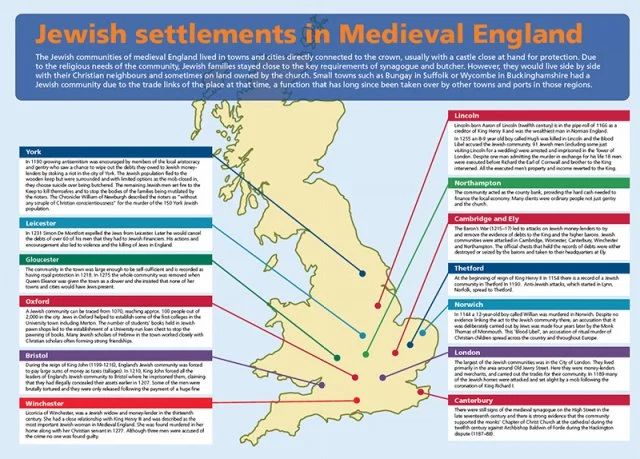
Jewish settlements in medieval England (click for more)
In Lady of the Castle, Bella's family reflects this French-speaking norm. Berechiah haNakdan—a real historical figure, the great translator and fabulist who rendered scientific and philosophical works from Arabic and Latin into Hebrew—moves fluently between Hebrew scholarship and the French-inflected world of English commerce. Rabbi Yom Tov, the brilliant real-life rabbi who will later meet his terrible end at York Castle’s tower (now known as Clifford Tower), speaks with "a soft French accent". These men are Norman Jews as much as they are English ones, their culture rooted in the communities of Rouen and the Île-de-France as much as in the streets of York.
The Sacred Tongue: Hebrew and Aramaic
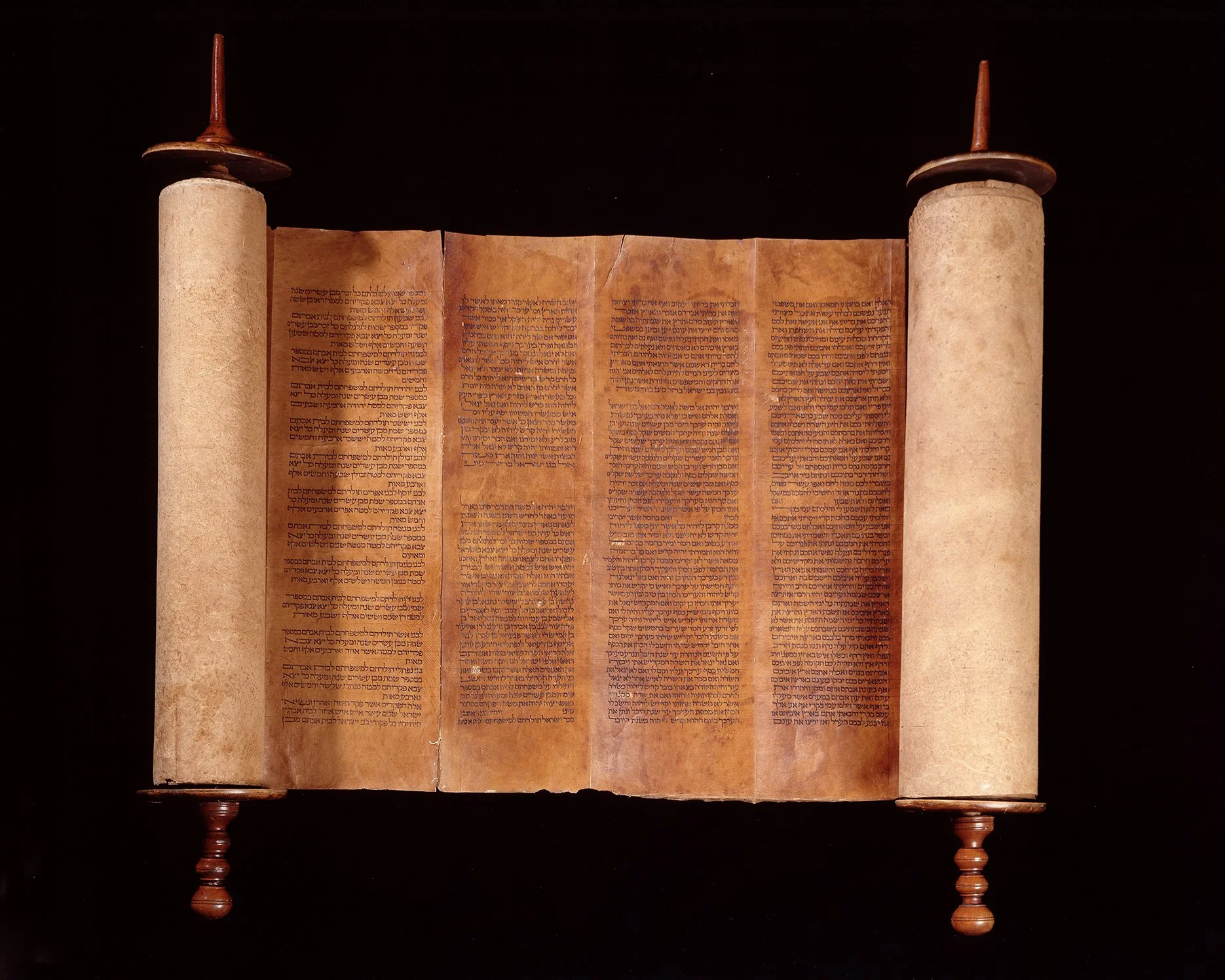
A Hebrew Torah Scroll
Alongside the vernacular, Hebrew was the constant thread running through every Jewish life. It was the language of Torah, of prayer, of the synagogue service. Every Jewish man was educated in it to at least a basic level; learned men like Berechiah lived inside it.
But Hebrew in this period was rarely a spoken vernacular—it was a prestige written and liturgical language, reserved for scholarship, prayer, legal documents, and correspondence between communities. The responsa literature—the vast body of legal questions and answers exchanged by rabbis across medieval Europe—was conducted almost entirely in Hebrew and Aramaic, the twin scholarly languages of rabbinic tradition. When Berechiah translated Greek science and Arab philosophy for his Christian patrons, he worked through these languages, rendering texts from Arabic into Hebrew, or from Hebrew into Latin and French.
The Germanic Tongue: Early Yiddish

Early Yiddish text in the Mahzor of Worms, 1272
Here is where the story becomes more interesting—and where Hannah comes in. I really enjoyed researching this, as modern-day Yiddish is such a fun, expressive language!
Not all of England's Jews had arrived from Normandy. Some were Sephardi, coming from Spain and Italy. There was thought to be a Sephardi synagogue in Lincoln; hence, I chose for Aaron (Bella’s father) to be a Jew of Spanish origin in Lady of Lincoln.
But the late twelfth century also saw increasing movement of Jews from the Rhineland communities of Germany: from Mainz, Worms, and Speyer, the great Kehillot Shum whose traditions shaped Ashkenazi Judaism. These communities spoke a different Jewish vernacular entirely: an early form of Yiddish, rooted in Middle High German rather than French, enriched with Hebrew, Aramaic, and traces of the Romance languages the communities had passed through on their migrations.
This distinction matters enormously for understanding medieval Jewish England. Bella herself observes it sharply:
"This is England, yet so many Jewish women in York don't speak English, or even French."
The women she has in mind are German-origin Jews, and their tongue is Germanic, not Romance. It was a real divide within the community, not merely a fictional convenience.
So how did I choose which Yiddish words I could use in the novel?
The answer, as so often in historical fiction, came down to etymology.
Whenever I wanted Bella or another Germanic-origin Jew to use a fun Yiddish word, I checked the etymology (word origin). Modern Yiddish is about three-quarters Germanic, around a tenth Hebrew/Aramaic, around a tenth Slavic/Eastern European, with a small older Romance/French-Italian residue, because the language evolved from those who spoke Hebrew and Aramaic travelling to the Rhineland, from there to other parts of Europe too, and only after Western Europe became difficult or impossible, on to Eastern Europe.
So, in summary, Yiddish began as a language with Hebrew, Jewish-French, Jewish-Italian, and German dialect elements, then absorbed Slavic elements after Jews settled in Eastern Europe. The European Parliamentary Research Service similarly describes Yiddish as a Germanic language whose vocabulary is mostly medieval Germanic, with Slavonic additions, residual Romance vocabulary, and a rich Hebrew/Aramaic religious layer.
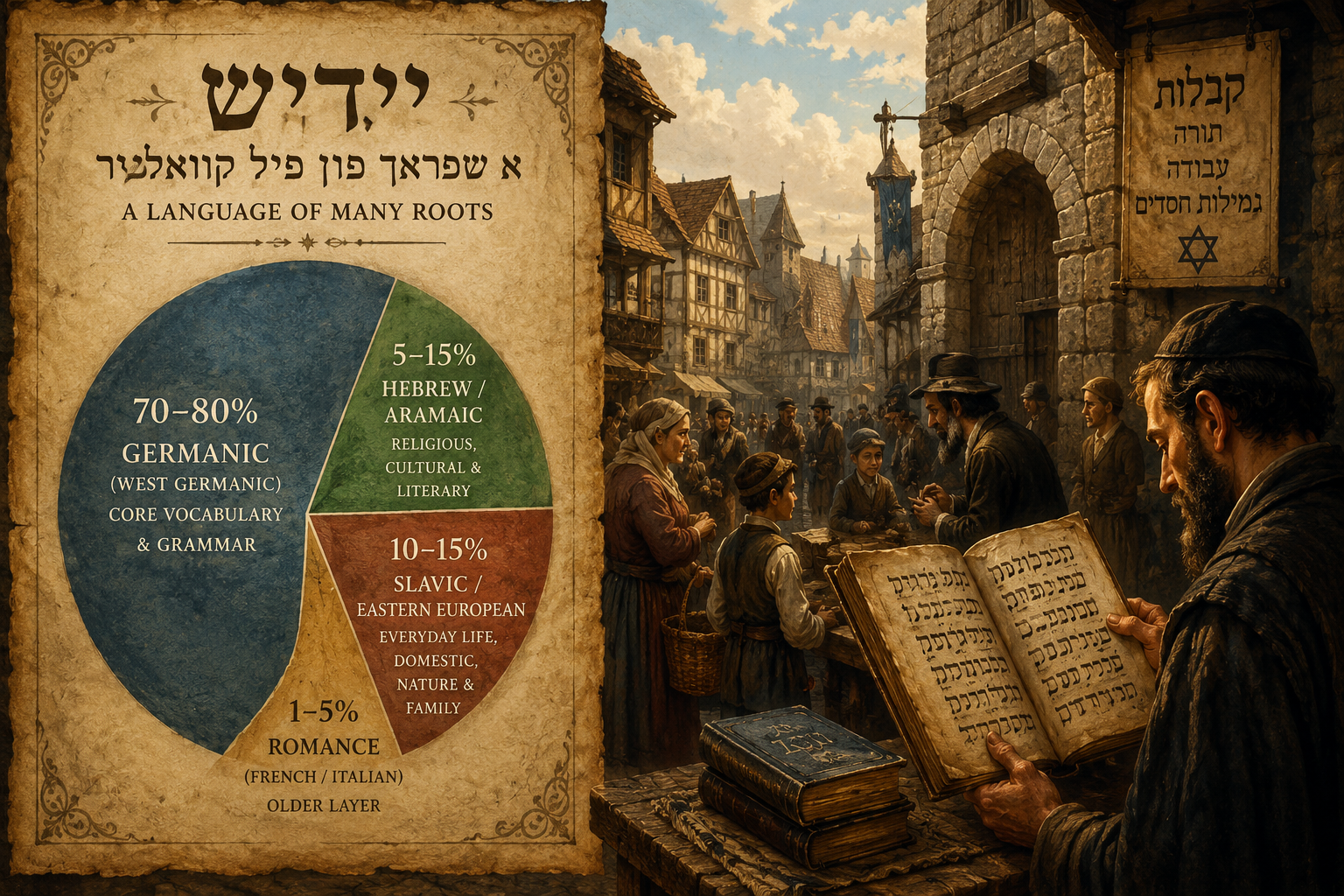
The origins of the modern Yiddish language
So my answer: check the etymology of the word. If it was Hebrew/Aramaic, German, French, or Italian, then it was safe to use. If it derived from an Eastern European language, it was too modern for the 12th century. Imprecise, but legitimate.
Hannah—Bella's formidable, warm-hearted, sharp-tongued friend—is one of these Germanic Jews. Her speech carries the flavour of the Rhineland communities, and it colours her idiom. When Manasser at the Stamford fair greets Turstin with "Mein freynd. Shalom," he is doing the same thing: code-switching between a recognisably Germanic vernacular and Hebrew in a single breath. The Yiddish words Hannah uses: 'tsuris' (trouble, suffering), 'shmuck', 'kvetching', 'alte kacker’—these are not the words of Zarephatic-speaking Anglo-Norman Jews; they belong to a different linguistic stream, flowing from the Rhine Valley westward.
English: the Language of the Majority
And then there was English—or rather, Middle English, the evolving vernacular of the non-Norman majority. Most Jewish women in York, Bella worries, didn't speak it. This is historically plausible: in 1190, the social world of a Jewish community was largely self-contained. Daily business was conducted in French with the Norman ruling class, in Hebrew within the community, and in the Germanic vernacular among those from the Rhineland. English was the language of peasants, servants, and the lower orders—people with whom Jewish merchants and moneylenders had less daily contact, but ultimately, these English speakers were their neighbours, and to get on and understand each other, the more pragmatic members of the community understood its importance.
Bella's response to her own observation is characteristic: she proposes running an English class, enlisting Licoricia to help her teach the women.
A World of Many Layered Tongues
What strikes me most, having spent years immersed in this material, is how normal this multilingualism was—and how it was simultaneously a source of community strength and social vulnerability. To be able to move between Hebrew, French, and English was to be educated, cosmopolitan, and useful to the people who needed your financial and intellectual skills. To be overheard speaking a language no one else understood was to be accused of conspiracy, foreignness, and threat.
When the crowd at the Stamford fair turns hostile and a woman cries out, "Priest, why're you talking to them in that strange tongue?", she is expressing something that goes beyond linguistic curiosity. The strangeness of Jewish speech—its Hebrew cadences, its foreign vowels—was one of the things that made Jewish communities visible targets. It marked them as ‘other’, even when they had been born in England, even when, as Licoricia says with heartbreaking simplicity,
"We were born here."
Lady of the Castle is a novel about power, loyalty, and what it costs to hold your ground in a world that wants to take it from you. Nicola de la Haye, hereditary constable of Lincoln Castle, holds her titles as someone fluent in the language of the castle and the court—Anglo-Norman French—but she is also proud of her Saxon roots and is popular with her English-speaking guards.
Bella and her family hold theirs in a different set of languages: the Hebrew of Torah and scholarship, the French of commerce, and the early Yiddish Germanic vernacular from some who saw the Rhineland as ‘the old country’.
Lady of the Castle, the second novel in the Nicola de la Haye series, is forthcoming. The first novel, the Amazon #1 bestseller, Lady of Lincoln, is available now, and you can buy a copy here.
Sign up for Rachel’s newsletter to get updates on her upcoming novels.

Lady of Lincoln is the Coffee Pot Book Club Book of the Year