Seeds of the Pomegranate by Suzanne Uttaro Samuels
The Coffee Pot Book Club Blog Tour
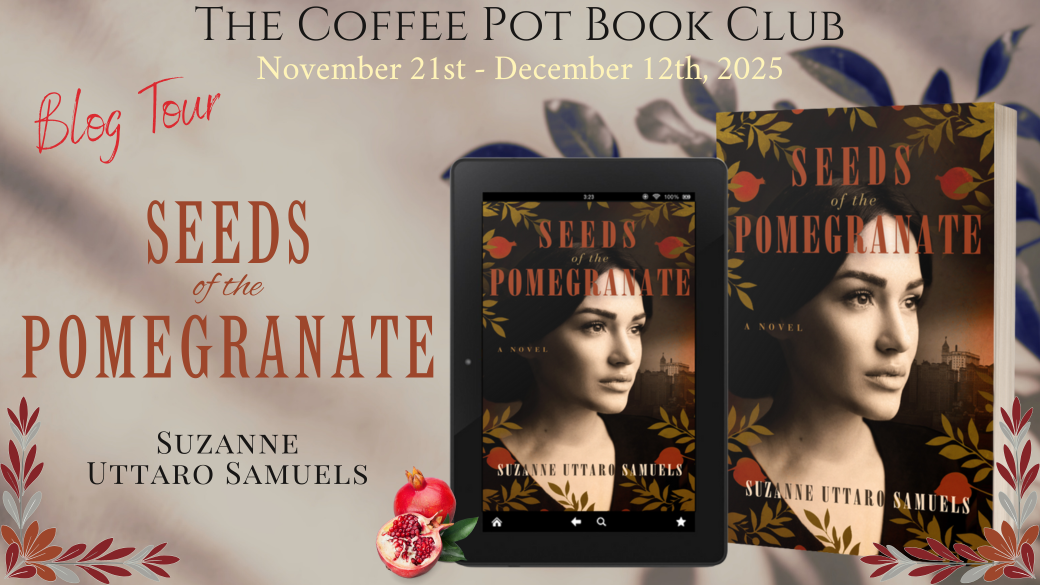
Seeds of the Pomegranate by Suzanne Uttaro Samuels
I’m very pleased to be hosting Seeds of the Pomegranate on the blog tour today, a novel not just in the historical Fiction genre, but also women’s fiction, immigrant (Sicilian, no less…) fiction, heritage fiction, and gangland crime fiction!!
I’ve got an excerpt from the author (see below), but first, the blurb:
A gritty story of a woman learning to survive in 20th century Gangland New York
In early 20th-century Sicily, noblewoman Mimi Inglese, a talented painter, dreams of escaping the rigid expectations of her class by gaining admission to the Palermo Art Academy. But when she contracts tuberculosis, her ambitions are shattered. With the Sicilian nobility in decline, she and her family leave for New York City in search of a fresh start.
Instead of opportunity, Mimi is pulled into the dark underbelly of city life and her father’s money laundering scheme. When he is sent to prison, desperation forces her to put her artistic talent to a new use—counterfeiting $5 bills to keep her family from starvation and, perhaps, to one day reclaim her dream of painting. But as Gangland violence escalates and tragedy strikes, Mimi must summon the courage to flee before she is trapped forever in a life she never wanted.
From Sicily’s sun-bleached shores to the crowded streets of immigrant New York, Seeds of the Pomegranate is a story of courage, art, and the women who refused to disappear.
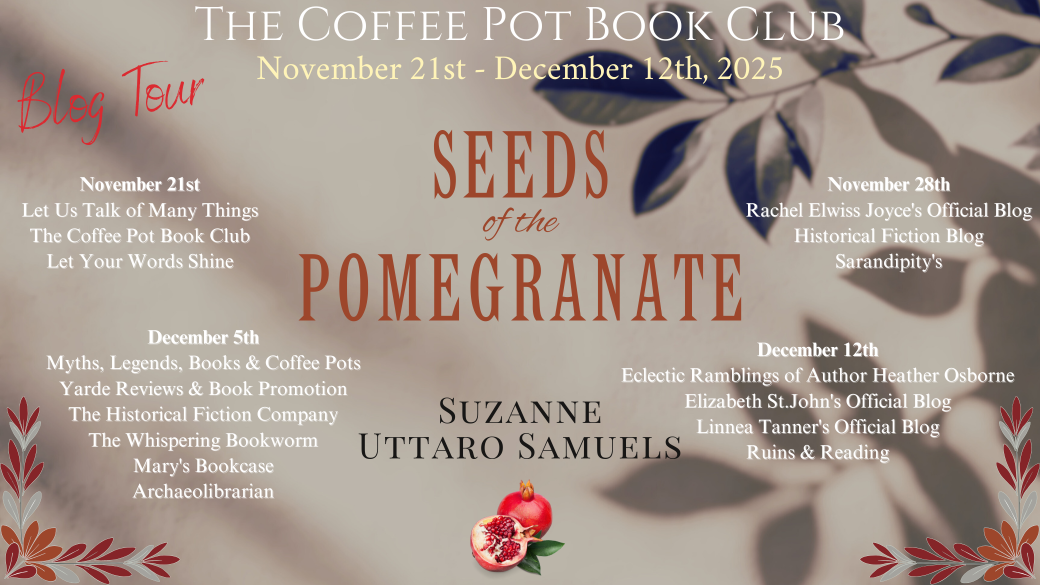
Click the image to see the full blog tour
The Excerpt (Number 2 if you’re following the full tour)
I walked quickly to the hotel. It was just two blocks away, but by the time I got there, I was struggling to catch my breath. Like Teo on that last day, the small voice inside whispered, gasping for air at the top of the loft ladder.
In the apartment, Nonna was packing, a handwritten list on the bed beside her valise. She’d brought only a few things to Palermo—a blouse, a pair of bloomers and stockings, her prayer book and rosary. Too few items, I thought, to warrant a list. I told her Monsieur wanted to speak with us. She looked at me grimly. Nonna didn’t like surprises.
“Has there been trouble?” she asked gravely.
I told her I didn’t think so. Nonna went down on her knees and prayed, for what, I didn’t know. When she stood, she pulled on her black woolen shawl. Together, we made our way toward Monsieur’s private studio. Monsieur’s assistant ushered us into the room. My teacher was standing at the center, next to a large canvas covered with sheeting.
Out of respect for Nonna’s title, Monsieur bowed deeply to her. He ushered her to a chair near the window, then motioned for me to join him at the canvas.
“I’ve asked you here to show you this.” He drew off the sheeting. “It’s Henri Matisse’s latest. The Joy of Life.”
There is a saying in Sicilian: Colpo di Fulmine. To be struck by the thunderbolt. Looking at that painting, that’s how I felt.
Heavy brushstrokes of bold, contrasting colors. In the background, some figures danced in a circle; others played flutes or gathered flowers. In the front, several figures reclined. Two of these lay together on the indigo and aqua grass, their limbs entwined.
“What do you think?” Monsieur asked.
I didn’t know what to say.
Monsieur laughed. “I was speechless, too.”
“It’s like Seascape,” I said finally, thinking of the Matisse painting that Monsieur had displayed when we’d begun to study modern art. A cliff. The sea. A simple composition, but the majesty and power of the ocean were unmistakable.
“Do you remember what the critics said when they saw that painting?”
I nodded. How could I forget? One said that the work was like “a pot of paint flung in the face of the public.” Another said that it was the work of a “wild beast,” heedless of color theory or even simple aesthetics. At the time, I felt sorry for Matisse.
Monsieur stood close to me. “An artist who is trying to do something new will always face criticism,” he said.
I looked at the composition before me. The Joy of Life. A riot of clashing colors: blues against oranges, greens alongside purples. The lovers in the foreground: the woman, with her enormous red and peach breasts; her much smaller partner behind. All around, figures moved joyously or made music or planted seeds. This was the joy of living. I’d felt it when I was with Teo, our limbs entwined, breathing together, our inhales and exhales perfectly in sync.
Dear Teo. I’d assumed we’d attend the Academy together. We wouldn’t marry: serious artists—especially women—didn’t marry. But we could work alongside each other. Like Mary Cassatt and Edgar Degas, or Rosa Bonheur and Anna Klumpke. Maybe eventually, we’d share a home. My godfather, Zio Vito, promised he’d be my patron, like a modern-day Medici. He’d been the one to convince Mamma to let me study in Monsieur’s atelier. She’d worried that I’d be molested, or worse, seduced.
But there had been no molestation. When Teo laid down the oilcloth, I went to him willingly. No seduction, either. Unless it was that Teo had introduced me to a pleasure so profound that when he left, it was like a part of me died. In the months since he’d been gone, I woke in the night, my fingers probing those forbidden places, desperate to experience again what I’d felt with him.
Monsieur’s voice brought me back to the present. “What do you think Matisse wants us to see here?”
I took in the painting, my eyes moving from one figure to the next. The dancers. The gardeners. The musicians. The reclining couple. “It’s a circle,” I said, finally.
Smiling, Monsieur nodded. “Why do you think Matisse composed the piece this way?”
Suddenly, I saw. “It’s the seasons. The cycle of life.”
Monsieur gently touched his fingertips to the lovers in front. “Winter.” He moved on to the other figures. “Spring. Summer. Fall.”
I motioned toward the large reclining woman. “She’s like Persephone.”
For the first time, Nonna turned her head toward us. All those statues she’d shown me and my sisters, tucked into alcoves and ancient temples in Girgenti and the hill towns. The goddess Persephone. Worshiped long before the Greeks or Romans had taken Sicily. Her red and blush pomegranate, its seeds ensuring her return to the Underworld each fall. Her emergence above ground in the spring, bringing new life.
“Yes,” Monsieur said. “Persephone’s a popular subject for artists. Though this depiction is unusual. Isn’t it?”
I nodded. In every Renaissance or Baroque painting or sculpture, the goddess was a victim. Abducted by Hades. Forced down to the Underworld. Tricked to eat those seeds. But the ancient Persephone was no victim: she enjoyed being queen of the Underworld. Not willing to fully relinquish her power and return to earth as Demeter’s dutiful daughter, she ate those seeds.
This was the real story of Persephone. One of power. Choice.
Author Bio:

Suzanne Uttaro Samuels, Author
Suzanne Uttaro Samuels writes about women who defy expectations and the secrets that shape families across generations.
Her debut novel, Seeds of the Pomegranate (Sibylline Press, 2025), follows a young Sicilian noblewoman whose search for freedom and art leads her into the hidden world of counterfeiters in early twentieth-century New York.
A former law professor turned novelist, Suzanne now lives in a lakeside cottage in the Adirondack Mountains with her husband, dog, and two cats. When she’s not writing, she’s exploring old family stories, local history, and the way memory lingers in the places we call home.
Author Links:
Website: www.suzannesamuels.com
Facebook: https://www.facebook.com/suzanne.samuels.12
Instagram: https://www.instagram.com/suzanne.samuels/
Threads: https://www.threads.com/@suzanne.samuels
Bluesky: https://bsky.app/profile/susamuels.bsky.social
Pinterest: https://www.pinterest.com/olduser124646644/seeds/
Book Bub: https://www.bookbub.com/authors/suzanne-uttaro-samuels
TikTok: https://www.tiktok.com/@suzannesamuelswriter
Amazon Author Page: https://www.amazon.com/stores/Suzanne-Uttaro-Samuels/author/B0FF3RY4D7
Goodreads: https://www.goodreads.com/author/show/60004417.Suzanne_Uttaro_Samuels