Soldiers of Christ by Jon Byrne
The Coffee Pot Book Club Blog Tour
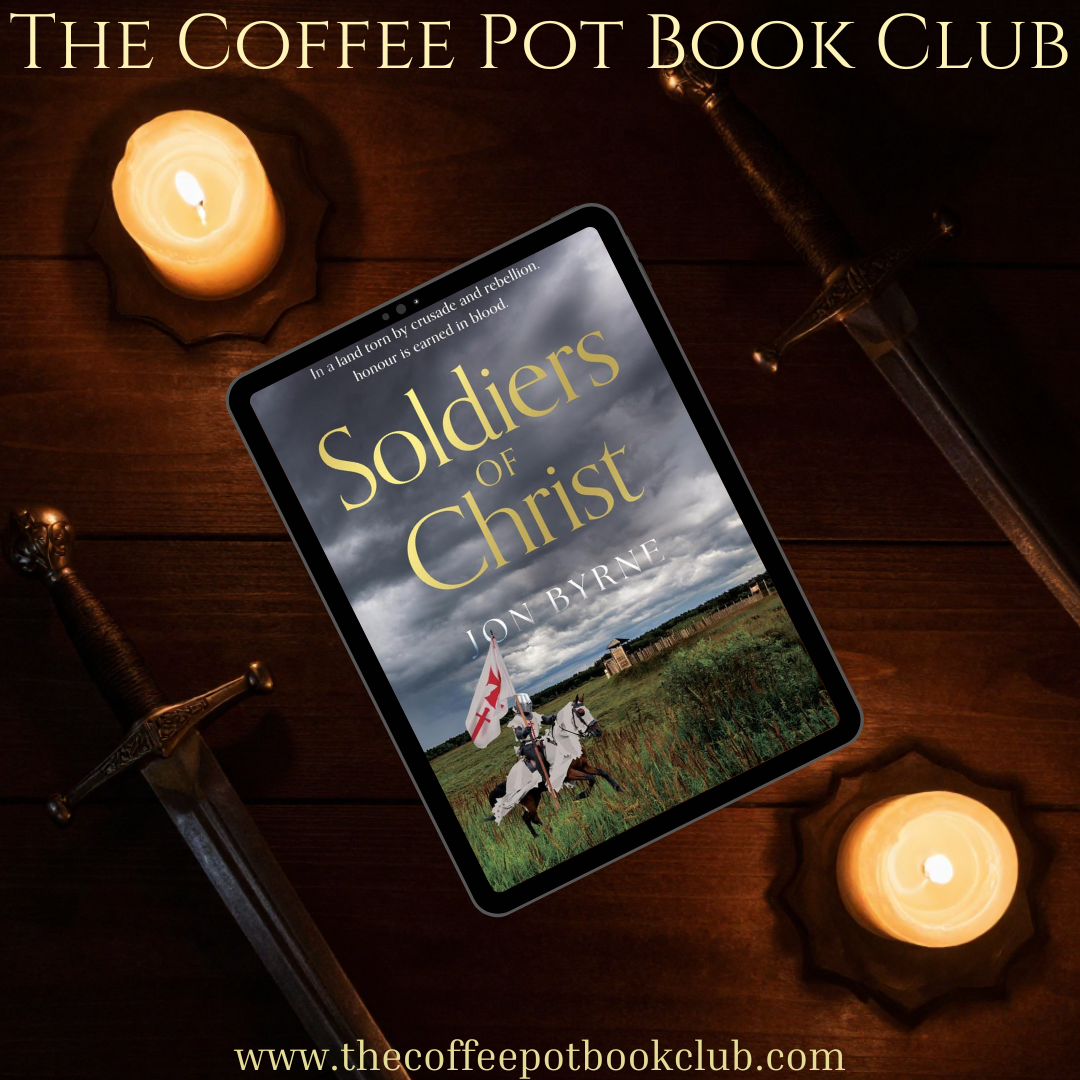
Soldiers of Christ by Jon Byrne
I'm delighted to be hosting a stop on The Coffee Pot Book Club's blog tour for Soldiers of Christ, the second instalment in Jon Byrne's Northern Crusader Chronicles.
My own work has so far kept me firmly rooted in twelfth- and thirteenth-century England and Normandy, so it's a genuine pleasure to stay in the same time period but also step outside that geography and into a frontier I know far less well: the Baltic crusades of the early 1200s. It's a period that rarely gets the attention it deserves, overshadowed as it is by the more famous campaigns to the Holy Land, and yet it's every bit as complex: warrior-monks, fractious tribal politics, a Church that was as much a political force as a spiritual one, and a frontier where loyalty was pragmatic long before it was ideological.
Below you'll find the book description and buy links for Soldiers of Christ, followed by a guest post from Jon on the political world behind the series, and his author profile.
Book Description
In a land torn by crusade and rebellion, honour is earned in blood.
1205. Richard Fitz Simon has fled England after his title was usurped, joining the Livonian Order of Swordbrothers – a German brotherhood of warrior-monks fighting to bring the word of God to the pagan frontier. After slaying the Lithuanian champion at the Battle of Rodenpois, Richard is celebrated by the Order and their Semigallian allies.
Yet his position remains precarious. Jealous rivals question his right to stand among the brotherhood, and his master, Knight-brother Rudolf, is enraged by Richard’s disobedience. When dark secrets from Lübeck resurface, Richard also finds himself at odds with Bishop Albert, head of the Christian mission in Livonia. As he struggles to reconcile faith, duty and identity, he is drawn into a brutal world of suspicion and bloodshed.
Sent on an expedition to build a castle deep in the wilderness, Richard soon sees tensions erupt – and the path he has chosen threatens to destroy everything he has fought to become.
Universal Buy Link: https://books2read.com/u/bz0eaZ
Google Play: https://play.google.com/store/books/details?id=uQnLEQAAQBAJ
Kobo: https://www.kobo.com/gb/en/ebook/soldiers-of-christ-1
Guest Post by the Author
The Political World Behind The Northern Crusader Chronicles
The world of The Northern Crusader Chronicles was shaped by battle and messy, brutal politics. Set during the early thirteenth century in the eastern Baltic, the series draws on a real historical backdrop that is far less familiar than the crusades in the Holy Land, but no less dramatic.
Around 1200, Livonia, covering parts of modern Latvia and Estonia, was not a unified country. Instead, it was a patchwork of tribes: Livonians, Latgalians, Estonians, Curonians, Lithuanians and others. Each group had its own leaders, its own rivalries, and its own interests. There was no central authority to negotiate with or defeat. For incoming crusaders, this made conquest both easier and harder: easier because there was no united resistance, harder because control had to be won piece by piece.
Into this fragmented world came the Latin Church. The Northern Crusades were officially sanctioned holy wars, backed by the papacy, and those who fought in them were granted the same spiritual rewards as crusaders heading to Jerusalem. But it wasn’t all just about faith. The Church in Livonia was also a political force.
The key figure was Bishop Albert von Buxhövden. Arriving in 1200 from northern Germany, he set out to convert the local population and to build a Christian state. One of his first acts was to move the main seat of the bishopric from Uexküll, which was too far up the River Daugava (Düna). His base was the newly founded city of Riga, which quickly became the centre of power in the region. From there, he organised campaigns, negotiated alliances, and encouraged settlement by German merchants and colonists.
Riga quickly grew into a religious centre and became a political and economic hub. Trade along the Daugava brought wealth, and control of that trade became a major incentive for expansion. Merchants, nobles, and knights all had reasons to support the crusade that went beyond religion. Land and profit were powerful motivators.
To help secure these ambitions, Albert founded a military order in 1202: the Livonian Brothers of the Sword (German: Schwertbrüderorden). These men were both monks and warriors, bound by religious vows but trained for war. Unlike temporary crusaders who came and went, the Swordbrothers provided a permanent fighting force that would remain in the winter when most crusaders had already returned to the Holy Roman Empire. They built castles, led campaigns, and held territory.
But like any powerful institution, they had their own ambitions. Tensions between the Swordbrothers and the bishop were common, especially when it came to land and authority. These disputes often had to be settled by the pope himself.
This internal friction is a key part of the political landscape that forms the backdrop to the books. The crusaders were not a united front; they were competing factions with goals that overlapped. The bishops, knights, and settlers all wanted something different.
At the same time, the crusade was effectively a colonial project. German settlers arrived in increasing numbers, establishing towns and farms in conquered lands. Local populations were converted to Christianity, sometimes willingly, often under pressure. and their territories absorbed into a new state. The result was a society in transition, where cultures collided and power structures were constantly being reshaped.
Livonia was also not isolated from the wider world. Other powers had their eyes on the region. The Danish crown launched its own campaigns in Northern Estonia. The Teutonic Order, already active in Prussia, would eventually absorb the Swordbrothers after their defeat at the Battle of Saule in 1236. Meanwhile, to the east, the Russian principalities of Novgorod and Pskov posed an ongoing threat.
All of this created a highly unstable political environment. Alliances shifted frequently. Crusaders might fight alongside one tribal group against another, or negotiate with Orthodox Christian rulers while waging a continuing war on the pagans. Loyalty was often pragmatic rather than ideological.
For the native tribal people, resistance was constant. Conquest was a long process, marked by raiding, repeated uprisings and long campaigns. Even when territories were claimed, they had to be held, and that required force and the building of castles.
This is the world that The Northern Crusader Chronicles brings to life. It is a story of ambition and power. Knights fight for God against the pagans, but also for land and reputation. Churchmen preach salvation while building political authority. Local leaders have difficult decisions to make – to resist, adapt, or collaborate with the Christians, depending on what will keep their people alive the longest.
What makes this setting so compelling to me is its uncertainty and uniqueness. Nothing is secure and all alliances are fragile. The frontier is a place where decisions carry immediate consequences and where the line between religious belief and self-interest is often blurred.
By grounding the narrative in this complex political reality, The Northern Crusader Chronicles offers something more than a tale of medieval warfare. It opens a window onto a lesser-known chapter of history – one defined by conflict, conversion and the clash of cultures on the edge of Christendom.
In the end, the political background of Livonia is what gives the story its depth. It is a world being built and destroyed at the same time, where history is shaped as much by negotiation and rivalry as by the sword.
Author Bio

Jon Byrne Author
Jon Byrne, originally from London, now lives with his German family by a lake in Bavaria with stunning views of the Alps. As well as writing, he works as a translator for a local IT company and occasionally as a lumberjack. He has studied the medieval world for over twenty years, building up a comprehensive personal library and a particular interest in the often-overlooked Northern Crusades.
Soldiers of Christ is Book Two of The Northern Crusader Chronicles, a gritty, historically grounded series focused on realism, moral ambiguity, and the brutal realities of medieval warfare.
Written for readers who value authenticity and atmosphere over romanticised adventure, the novel explores a largely forgotten crusading frontier, culminating in the first of many confrontations in a harsh wilderness of forest and swamp.
Readers who enjoy the historical detail of authors such as Bernard Cornwell, Conn Iggulden, or Ben Kane may find familiar ground here.
Author Links:
Website: https://www.jonbyrnewriter.com/
Facebook: https://www.facebook.com/JonByrneAuthor
Amazon Author Page: https://www.amazon.co.uk/stores/author/B0DJC6PL8D
Goodreads: https://www.goodreads.com/book/show/249448581-soldiers-of-christ