What Love E'er Meant by Janet Wertman
Guest Post from the Author
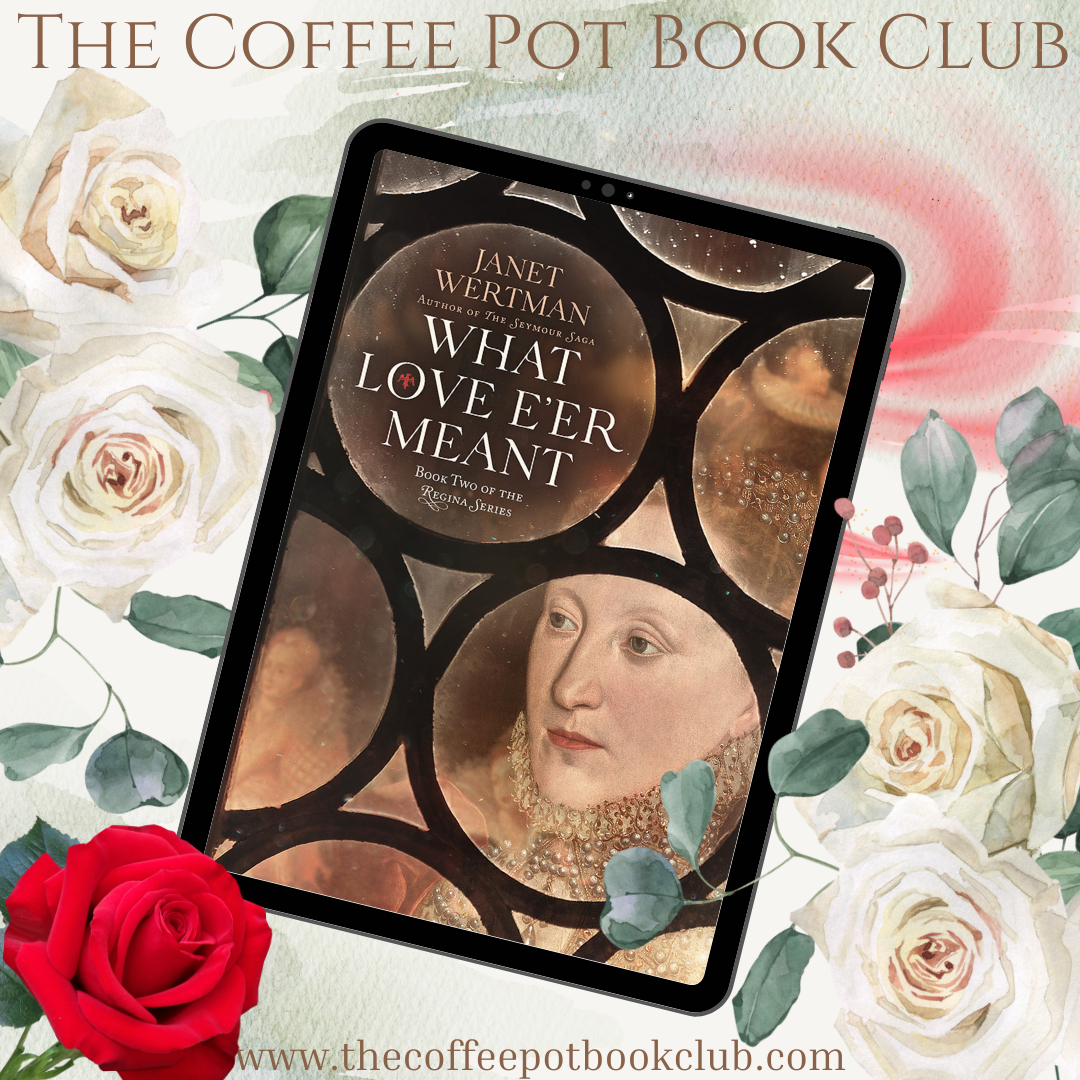
What Love E’er Meant by Janet Wertman
I’m thrilled to be hosting a stop on the blog tour for What Love E’er Meant by Janet Wertman, a tudor historical fiction novel following Elizabeth I’s struggle to balance love and duty. I’ve included the book description and a guest post from the author below.
Book Description
A new queen must prove she deserves the throne God gave her, while the path everyone insists will secure it might cost her everything
Against all odds, Elizabeth Tudor has become Queen of England. Determined to fulfill what she sees as a divine responsibility, she sets out to heal a country ravaged by religious discord, war, and debt – and vindicate the legacy of Anne Boleyn, the mother who did not deserve her fate.
But Elizabeth’s crown is not fully secure: to the Catholic world, her cousin Mary Stuart is the rightful Queen of England and there are rumblings to put her there. Shoring up defenses requires that Elizabeth challenge France’s control of Scotland and Spain’s dominance on the seas, as well as calm internal strife. Above the din of menace, one question dominates all others: who will she marry?
William Cecil, her trusted Secretary of State, urges her to secure an alliance through a strategic match. Robert Dudley, the love of her life, pressures her to choose him. And Mary herself presents a cautionary tale. In the end, Elizabeth chooses not as a woman but as a queen, and learns the sobering truth of sovereignty: to rule is to stand alone.
What Love E’er Meant, the searing second volume in the Regina Trilogy, captures a young queen’s struggle to balance love and power, duty and desire…and the profound cost of choosing crown over heart.
Buy Links:
Amazon & Apple Ebook Buy Link: https://books2read.com/u/4XqdD7
Kobo: https://www.kobo.com/us/en/ebook/what-love-e-er-meant?
Barnes & Noble: https://www.barnesandnoble.com/w/what-love-eer-meant-janet-wertman/1151015402
Guest Post by the Author
Rachel Elwiss Joyce’s Official Blog – would like a guest post on life at the Elizabethan court at the time of your novel.
In Tudor times, every Englishman saw the court of a higher-up as the path to advancement, and strived to get onto the grounds of a palace, to be allowed into its Great Hall or even further, to see and be noticed by the lord and his wife and become a part of their lives. This was the way to rise: service was rewarded. Serving the Queen’s court offered the highest prize of all.
Elizabeth’s Court was the vast machine that sustained her on both political and personal levels: it managed governance, administration, security, religious services, food and entertainment, clothing, transportation, medical care, and countless other necessities. This required hundreds of people – senior nobles and government officials, ladies and gentlemen, and all their attendants (many of whom had attendants of their own). And still more hundreds beneath those to make everything possible: servants, cooks, grooms, laundresses, chaplains, musicians, tailors, craftsmen and many others.
Most importantly, Elizabeth’s court was meant to be experienced publicly – to impress with her hospitality and highlight her majesty to her nobles and foreign ambassadors. A splendid court demonstrated wealth and stability; elaborate ceremonies reinforced hierarchy. Elizabeth understood how to use the spectacle to effect, and people clamored to be part of as much of it as they could.
The most important court activities took place around Elizabeth herself. Access was opportunity, and courtiers would structure their days to attend on her as much as possible. The work of their regular posts was naturally built around the rhythm of court life, with everyone participating in daily religious services and meals (three a day, regardless of your rank, though where you took them could differ). Hunting and hawking, two of the great aristocratic pastimes, provided exercise during the day along with archery, tennis, jousting and other activities added as the spirit struck; while masques, music and dancing provided recreation at night. And of course poetry and drama flourished in the Elizabethan world: she had always enjoyed intellectual pursuits and encouraged them in others.
Elizabeth’s ladies were in the special position of having their regular work involve time spent with the Queen. Indeed, they had the ultimate access, with hours spent with her throughout the day as they completed the dozens of tasks like brushing and mending her garments, reading to her, practicing new dance steps, and of course, seeing to Elizabeth’s toilette. Since being a queen was an extraordinarily visible job, her clothing was far more than a matter of personal taste: her elaborate gowns, ruffs, jewels, wigs, and makeup helped create the image of majesty that she wanted people to see. And that took time. As I noted in What Love Eer Meant,
“Each morning, it took two hours to clean her teeth, fix her hair, make up her face, and don the shaping garments and kirtle. Then another hour to lace up the foreparts and sleeves and add the gown and jewelry. Add two hours for every change of outfit, one to strip back down to her kirtle, one to build her back up. On days when she hunted in the morning and danced at night, she could spend seven hours dressing.”
Small wonder, then, that many ladies found themselves bribed to mediate the requests of courtiers who wanted something, or to share Elizabeth’s opinions and moods so that the men could tailor their own approaches. Because remember: achievement and riches were the whole point of being at court. Another reminder that the practice of “managing up” has been around for hundreds of years…
Author Bio

Janet Wertman Author
Janet Wertman’s critically acclaimed, character-driven historical novels reflect a passion for the Tudor era she had harbored since she stayed up late at age eight to watch The Six Wives of Henry VIII and Elizabeth R.
Her Seymour Saga trilogy (Jane the Quene, The Path to Somerset, The Boy King) took her deep into one of the era’s central families – and now her follow-up Regina series (Nothing Proved and What Love E’er Meant out now, Forever Gloriana to come) explores Elizabeth’s journey from bastard to icon.
She shares interesting takes on the Tudors at www.janetwertman.com and her YouTube channel @TooMuchTudor.
Author Links:
Website: https://janetwertman.com
Facebook: https://www.facebook.com/janetwertmanauthor/
Instagram: https://www.instagram.com/janetwertman/
https://www.instagram.com/toomuchtudor
Bluesky: https://bsky.app/profile/janetwertman.bsky.social
Pinterest: https://www.pinterest.com/janetwertman/
Book Bub: https://www.bookbub.com/profile/janet-wertman
TikTok: https://www.tiktok.com/@janetwertman
YouTube: https://www.youtube.com/@TooMuchTudor
Amazon Author Page: https://www.amazon.com/stores/Janet-Wertman/author/B01CUSMWFA
Goodreads: https://www.goodreads.com/author/show/2028387.Janet_Ambrosi_Wertman