Nicola De La Haye: Castellan, Sheriff and Defender of Lincoln
Born: Probably early to mid-1150s
Died: around November 1230. Buried at Swaton.
Known for: Hereditary lordship of Brattleby; the constableship and defence of Lincoln Castle; serving as first female Sheriff in England (for Lincolnshire); and holding the castle during the civil war and French invasion that culminated in the Battle of Lincoln in 1217.
Nicola de la Haye—also written Nicholaa, Nichola, Nicole or Nicola—was one of the most remarkable secular women of medieval England. She was not a queen or a great countess. Yet for more than half a century she occupied an important position at the heart of Lincolnshire society. She inherited a baronial estate, exercised authority over knights and tenants, issued her own charters, maintained officials and followers, and possessed hereditary rights to the custody of one of England’s most important royal castles: Lincoln Castle.
Nicola also lived through an extraordinary succession of political crises. Her family had already been divided by civil war before she was born. Her uncle Ralph appears to have supported King Stephen during the Anarchy, while her father Richard later served Geoffrey of Anjou, husband of Stephen’s rival Empress Matilda. Nicola’s first husband, William FitzErneis, rebelled against Henry II. Her second husband, Gerard de Camville, supported Prince John against Richard I’s government. Decades later, Nicola and Gerard’s own son Richard joined the baronial opposition to King John before returning to royal allegiance under Henry III.
The familiar image of Nicola as simply and unquestioningly “loyal” therefore needs context. She belonged to a family in which allegiance had repeatedly been tested by competing kings, inherited interests, family relationships and civil war. What appears much more consistent throughout her life is Nicola’s determination to defend the inheritance and responsibilities that had come to her. And again and again, Lincoln Castle stood at the centre of that story.

contents
Why Nicola is important
Origins: Colswein and the de la Haye inheritance
The Anarchy and a family divided
Richard de la Haye and Nicola’s inheritance
William FitzErneis and the rebellion of 1173–74
Matilda FitzErneis and Gerard de Camville
The siege of 1191
King John and Richard de Camville
Magna Carta, civil war and Nicola as sheriff
Richard returns and the siege of 1217
The Battle of Lincoln and aftermath
Nicola the medieval lord
Death, legacy and evidence
Timeline
Bibliography and sources

WHY NICOLA IS IMPORTANT
Nicola de la Haye’s tomb is still to be found in the church at Swaton, Lincolnshire
Nicola is best remembered for defending Lincoln Castle, but her importance goes well beyond military history: her life provides unusually rich evidence for female lordship in medieval England. Moreover, she quite clearly did exceptional things because, unlike most women of her rank, she was mentioned by the chroniclers of the time—and by name.
Medieval women faced significant legal and social restrictions, particularly while married. Yet women could inherit land, transmit hereditary rights and—especially in widowhood—exercise substantial independent authority.
Nicola did all of these things. Professor Louise Wilkinson has identified and analysed thirty-two surviving letters and charters issued by Nicola in The Charters, Letters, and Seal of Lady Nicholaa de la Haye. Those documents show Nicola granting property, rewarding followers, protecting territorial interests and exercising lordship through a recognisable network of knights, stewards, serjeants, attorneys and other dependents. Wilkinson argues that Nicola’s sex did not prevent her maintaining and rewarding a substantial body of male followers who assisted her in exercising her seigneurial responsibilities.
The chronicles make Nicola visible in moments of crisis, but her own documents reveal something broader. The sieges made her famous, the charters show us why she possessed the authority to command through them, and the fact that she was trusted by men—including kings—shows the type of woman she was.

ORIGINS: COLSWEIN AND THE DE LA HAYE INHERITANCE
An inheritance with English and Norman roots
Nicola’s ancestry combined two very different traditions.
Her paternal family, the de la Hayes, took their name from La Haye-du-Puits in the Cotentin peninsula of Normandy.
Nicola’s paternal grandfather, Robert de la Haye, belonged to a Norman family associated with royal service. A foundation record relating to Boxgrove Priory described Robert as a consanguineus—a kinsman—of Henry I, although the precise relationship has never been established.
But Robert’s marriage brought a substantial Lincolnshire (Saxon) inheritance into the family when he married Muriel, daughter of Picot and granddaughter of Colswein of Lincoln.
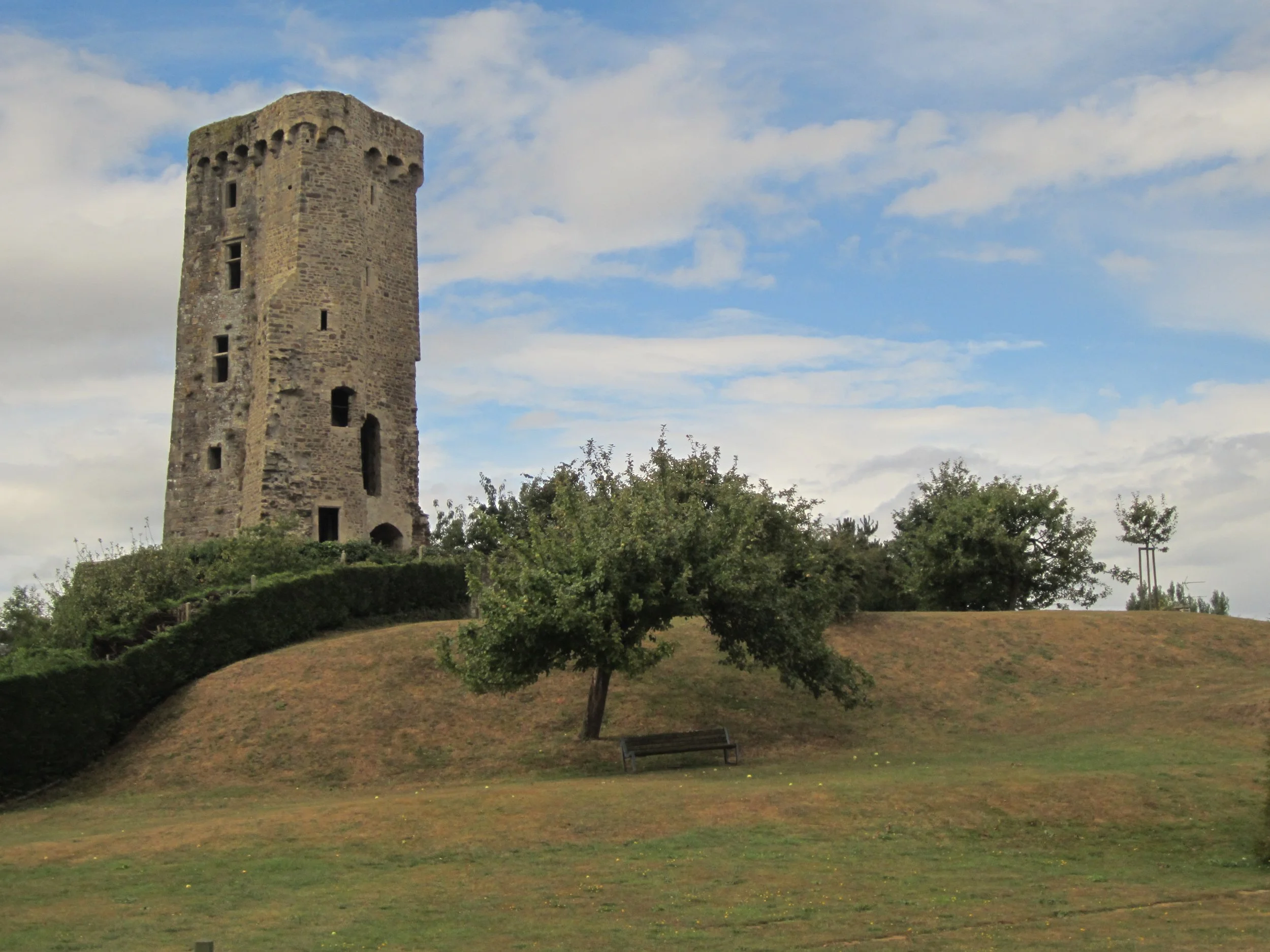
The Donjon of the Castle at la Haye du Puits , Normandy
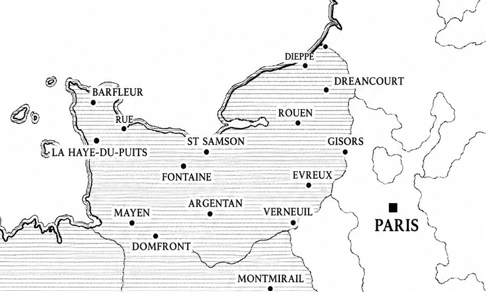
La Haye du Puits in Normandy
Colswein of Lincoln
Colswein is one of the most intriguing figures in Nicola’s ancestry. In Domesday Book in 1086, he was one of Lincolnshire’s major tenants-in-chief, holding an estate assessed at more than 100 carucates as well as additional subtenancies. His holdings included Brattleby, which would later become the centre of Nicola’s barony. The Prosopography of Anglo-Saxon England’s Domesday profile for Colswein is particularly important because it corrects an older and frequently repeated version of his story.
Colswein is sometimes described as one of only a tiny number of Anglo-Saxon barons who simply retained a great pre-Conquest estate under William the Conqueror, but that is not what the Domesday evidence shows. The estates Colswein held as tenant-in-chief in 1086 had belonged to more than thirty different holders before the Conquest. Colswein himself does not appear clearly as their pre-Conquest owner. PASE therefore concludes that his great fief looks much more like a post-Conquest royal creation, perhaps associated with administrative service under William I.
What did Colswein do that so pleased the Conqueror?
We will probably never know the details.
One possibility is that Colswein served as town-reeve of Lincoln, which would make his story arguably more remarkable rather than less, for instead of simply surviving the Conquest with an existing estate intact, a man with an English or Anglo-Scandinavian name appears to have risen to exceptional prominence under the new Norman regime.
His estate passed through his son Picot (a good Norman name, suggesting a desire to integrate with the new ruling elite), and Picot’s daughter Muriel, Nicola’s grandmother.
From Colswein to the de la Haye barony
The continuity between Colswein’s estate and Nicola’s later inheritance is unusually strong. Historian J. C. Holt examined it in “The Carta of Richard de La Haye, 1166”. He concluded that the de la Haye barony was almost entirely composed of the fief Colswein held at the time of the Domesday survey.
The broad descent was: Colswein, father of Picot. Picot was father of Muriel, who was mother of Richard de la Haye (senior), who in turn was father of Nicola and her sisters
So although Nicola carried a Norman surname, a substantial part of the Lincolnshire power she eventually exercised descended through the female line from one of the most important native (Saxon or Anglo-Norse) landholders established in Lincolnshire after the Norman Conquest, with the surviving map of Colswein’s Domesday holdings showing estates spread widely across the county, including Brattleby, Riseholme, Fillingham, Barlings, Cammeringham, Faldingworth, Swaton, Horbling and Billingborough.

THE ANARCHY AND A FAMILY DIVIDED
Robert de la Haye, Muriel and Lincoln Castle
Muriel married Robert de la Haye, bringing the Lincolnshire inheritance into the Norman de la Haye family, and Robert became associated with the custody of Lincoln Castle.
The castle itself belonged to the Crown, so the de la Hayes did not own Lincoln Castle outright. In fact, in the early phases, this castle was shared between the constable (castellan, or keeper), and the bishop. The bishop later moved out. What the de la Haye family possessed was a hereditary or quasi-hereditary right to the constableship and custody of the royal fortress, and that distinction would become enormously important in Nicola’s later life.
The Anarchy
Henry I died in 1135. Although he had previously required his leading men to recognise his daughter, the Empress Matilda, as his heir, his nephew Stephen of Blois seized the English throne. The resulting struggle is traditionally known as ‘the Anarchy’.
Lincoln Castle became one of its principal prizes, and Nicola’s own family appears to have been divided.
Ralph de la Haye: a supporter of Stephen
Nicola’s uncle Ralph de la Haye, younger brother of her father Richard, appears to have supported King Stephen.
In Normandy in 1141, while Matilda’s husband Geoffrey of Anjou was advancing through the duchy, Ralph reportedly held out against him at La Roque near Montchaton. The nineteenth-century Battle Abbey Roll preserves a colourful story of Ralph’s eventual surrender.
“Ralph, the younger of the two brothers, took Stephen's part against Geoffrey of Anjou, and gallantly fought his battle in Normandy, till, in 1141, the tide of fortune turned against him, and he was forced to fly for refuge to his castle of La Roque, near Montchaton, then deemed altogether impregnable. But the triumphant Count pursued him thither, besieged his fastness, and reduced him to such dire extremity that, according to a form of capitulation that M. de Gerville assures us was then by no means uncommon, he had to give himself up "in the most humiliating posture" (crawling on all fours?) with a saddle on his back.”
The precise details of that humiliation are less secure than the underlying political point: Ralph had been resisting Geoffrey’s advance on Stephen’s side.
Why was Ralph witnessing the Earl of Chester’s charters?
This is where the evidence becomes very interesting… Ranulf, Earl of Chester, and his half-brother William de Roumare seized Lincoln Castle around 1140 and subsequently aligned themselves with Empress Matilda. Their possession of the fortress contributed directly to the (First) Battle of Lincoln in February 1141, when King Stephen himself was captured.
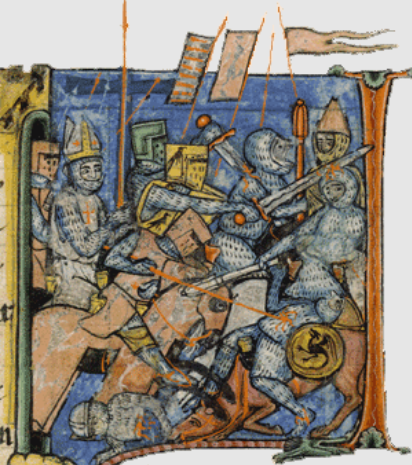
King Stephen was captured at the First Battle of Lincoln (1141)
Yet Ralph de la Haye later appears prominently among the witnesses to several of Ranulf’s charters. At first sight, it would be easy to assume that Ralph must therefore have joined Chester’s faction. But specialist charter analysis suggests something very different. Historian R. H. C. Davis examined the evidence in “Geoffrey Barraclough and the Lure of Medieval Charters”. He specifically identified Ralph de la Haye and Baldwin fitz Gilbert as staunch supporters of King Stephen. He argued that the relevant Ranulf charters probably belong to around 1145–46, when the Earl of Chester had been reconciled with Stephen. Davis even suggested that trusted royal supporters such as Ralph may have been conspicuously present around Ranulf partly to keep watch on a notoriously unreliable earl.
That interpretation is important. Ralph’s presence among Ranulf’s charter witnesses should not be treated as proof that Ralph supported Matilda, but provides evidence of the opposite.
Who did Ranulf of Chester take Lincoln Castle from?
There is another tempting family story that requires caution. Later evidence confirms that Nicola’s grandfather Robert de la Haye had held the constableship of Lincoln Castle. It would therefore be easy to assume that Ranulf of Chester and William de Roumare personally tricked Robert and Muriel de la Haye (Ranulf’s own parents) out of the castle.
The evidence does not quite allow us to say that, but we can probably say that Robert de la Haye possessed the family connection with Lincoln Castle; his exercise of that office was disrupted during the Anarchy; but we cannot prove that Robert and Muriel personally were the couple from whom Chester and Roumare seized the fortress.
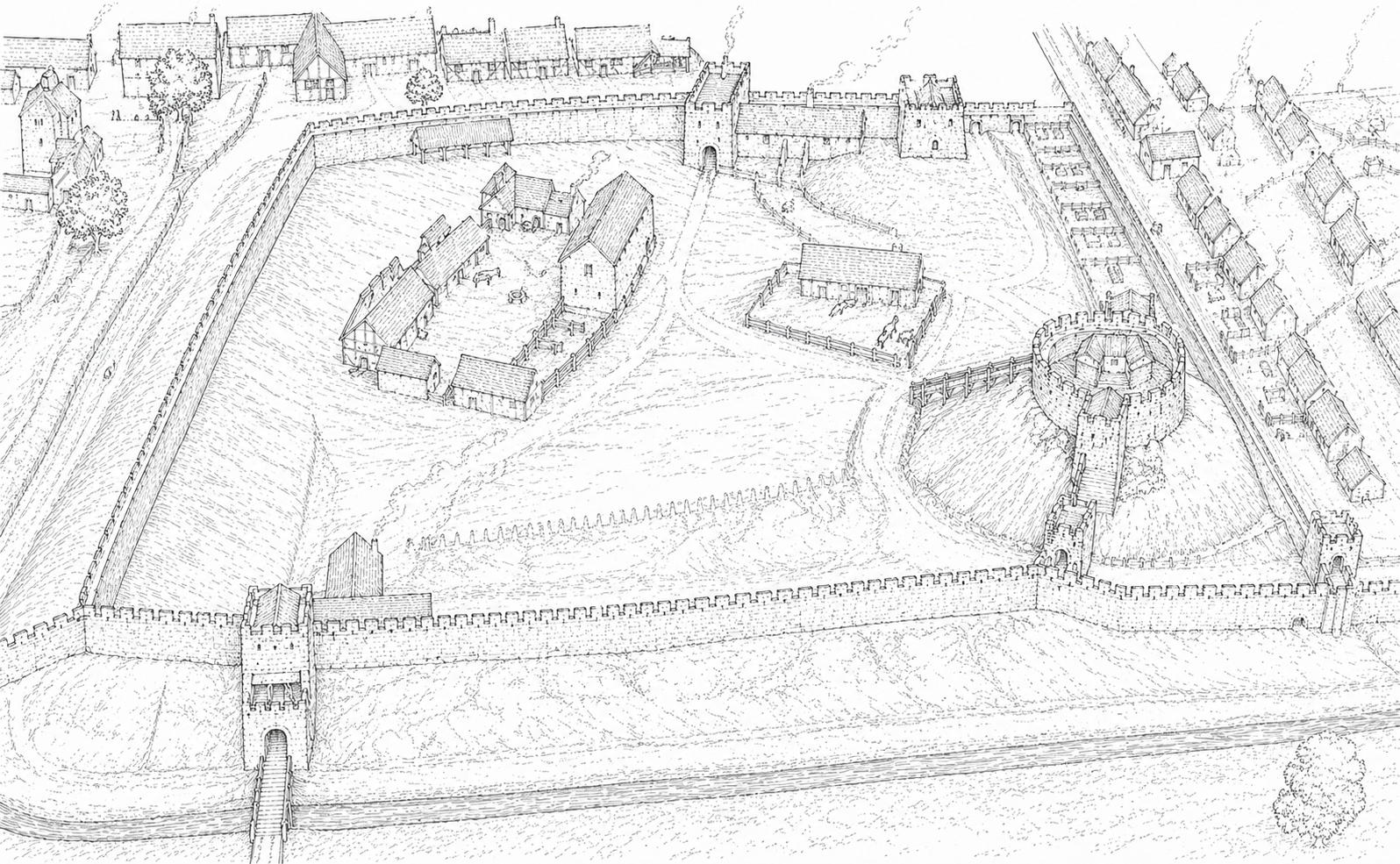
Lincoln Castle in 12th Century
Richard de la Haye appears on the other side
Ralph’s elder brother Richard de la Haye—Nicola’s father—appears to have followed a very different course. By around 1144 Richard appears in acts associated with Geoffrey of Anjou, after Geoffrey had established control over much of Normandy. More significantly, surviving documentary evidence gives Richard an administrative role in Geoffrey’s government. One writ orders that, if disputed land was not surrendered, Richard de la Haye was to determine the matter according to Geoffrey’s assize. That places Richard within the Angevin administration.
The family therefore seems to have divided: Ralph de la Haye: supporter of Stephen, and Richard de la Haye: serving Geoffrey of Anjou (the Empress Matilda’s husband).
That is far more revealing than treating “the de la Hayes” as a single political faction. Long before Nicola was born, her family already knew what it meant for civil war to divide loyalties.

RICHARD DE LA HAYE AND NICOLA’S INHERITANCE
Henry II restores Richard to Lincoln
Stephen died in 1154 and the English throne passed to Henry II, son of Empress Matilda and Geoffrey of Anjou.
Richard de la Haye prospered under the new regime. Between about 1155 and 1158, Henry II confirmed Richard in the Lincolnshire lands formerly held by his father Robert and explicitly confirmed his possession of the constableship and custody of Lincoln Castle. Richard was therefore not simply a local landholder. He held a royal office of significant military importance.
Richard’s 1166 barony
Richard’s 1166 Carta is one of the most important surviving records for the family. The return described his military tenants and stated that: five carucates of land were reckoned as one knight.
J. C. Holt considered this unusual enough to devote an entire academic article to it. The surviving return lists tenants associated with places that continued to appear in the de la Haye honour, including Ingleby, Faldingworth, Sudbrooke, Pickworth, Newton and Ashby. Richard was assessed for twenty knights’ fees in 1166, although by the early 1170s his heirs were generally being assessed for sixteen.
Nicola’s birth and the three heiresses
Richard married Matilda, usually identified as Matilda de Vernon. The Vernon connection is probable, although some details of her precise ancestry depend upon later reconstruction rather than an explicit statement in the surviving charter evidence.
Richard and Matilda had three daughters:
Nicola / Nicholaa
Gila / Gille / Julia
Isabella / Isabel
Nicola’s exact year of birth is unknown, but a date somewhere in the early or middle 1150s is reasonable. She is frequently described as Richard’s eldest daughter, but the evidence does not securely establish the sisters’ exact birth order.
Richard died around 1169, leaving the three women as co-heiresses.
Nicole of Nicole
If Nicola was born in the mid-1150s, she could well have been born around the time that Richard took up office at Lincoln. The interesting fact was that the Normans called Lincoln “Nicole”, and Nicola’s father (being a French-speaking Anglo-Norman) would have probably called her by the French version of her name: “Nicole”.
Was Nicola called Nicole after the city of Nicole (Lincoln)? It seems too coincidental not to be true.
Dividing England and Normandy
The de la Haye inheritance extended across England and Normandy. Eventually Nicola came to control the principal English inheritance, while her sisters and their husbands retained much of the Norman property. The exact date at which the final division was agreed remains uncertain, but it proved remarkably practical: when King John lost Normandy in 1204, many Anglo-Norman families were suddenly forced to choose between estates on opposite sides of the Channel. The de la Haye sisters had already largely separated theirs, although there was some rearrangement (in the form of land swaps) after 1204.

WILLIAM FITZERNEIS AND THE REBELLION OF 1173–74
Nicola’s first marriage: William FitzErneis
Nicola’s first husband, William FitzErneis, is often reduced to little more than a name in genealogies, but his political career deserves considerably more attention.
William belonged to a family with Anglo-Norman royal connections. This fascinating series, “Selected case-studies of Anglo-Norman families” has attempted to reconstruct the FitzErneis lands and family tree, along with that of du Hommet, which Nicola’s sister Julia married into.
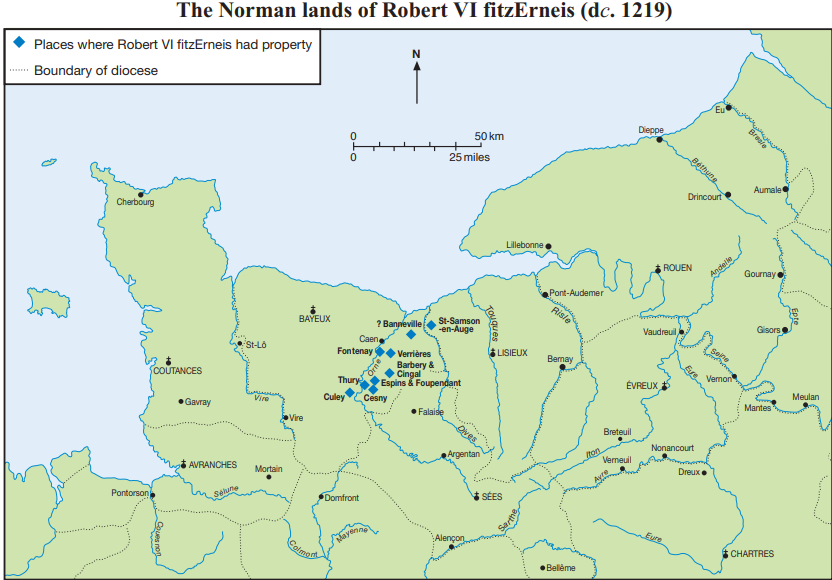
William and his brother Eudo FitzErneis had been associated with the household of William FitzEmpress, Henry II’s younger brother. After William FitzEmpress’s death, members of that household appear to have moved into the orbit of Henry II’s eldest son, Henry the Young King. In 1173 that became politically explosive.
1173–74: Nicola’s husband becomes a rebel
Henry II had arranged for his eldest surviving son to be crowned during his own lifetime. The result was the unusual situation of a crowned Young King who had royal status but little independent power. In 1173, Henry the Young King rebelled against his father. His brothers Richard and Geoffrey joined him; so did their mother Eleanor of Aquitaine, Louis VII of France, the counts of Flanders and Boulogne and numerous nobles on both sides of the Channel.
And among the Young King’s adherents were Eudo FitzErneis and William FitzErneis. he Northamptonshire Record Society’s Facsimiles of Early Charters explicitly identifies Eudo FitzErneis, William FitzErneis and their nephew Robert among those who joined the rebellion of Henry II’s sons in 1173. William is also listed as an early rebel in the Itinerary of Henry II.
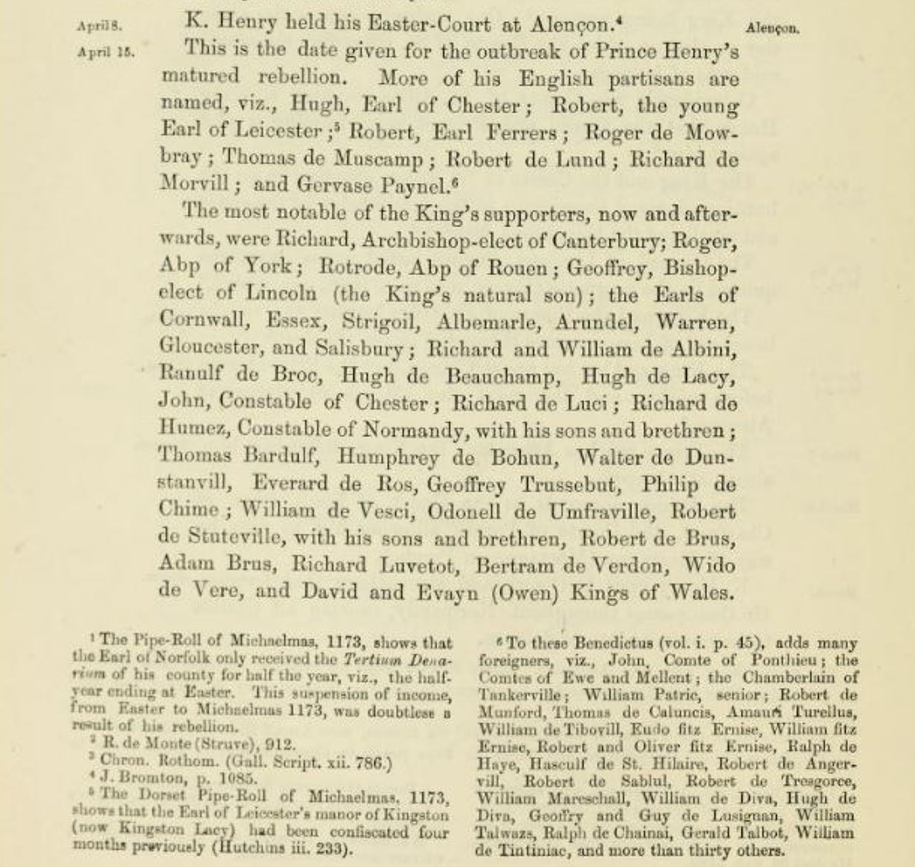
The Itinerary of Henry II records William FitzErneis and his family as early rebels
So Nicola’s first husband was not simply caught up in the conflict. He chose the Young King’s side against Henry II.
Ralph de la Haye changes sides too
Nicola’s uncle Ralph demonstrates perfectly why “loyal” and “rebel” are dangerous permanent labels in medieval politics. During the Anarchy he had supported Stephen against the Angevin cause. Thirty years later, Ralph supported an Angevin prince—Henry the Young King—against Henry II.
And Ralph appears to have been considerably more than an ordinary rebel knight. The Gesta Regis Henrici Secundi places a Ralph de la Haye among the important rebels captured at Dol in Brittany in 1173. Roger of Wendover later describes the Young King preparing to send Ralph de la Haye with an army to England. Wendover also records forces under Ralph leaving England once Henry II’s position recovered.
There was more than one Ralph de la Haye within the extended family, so the identification cannot be completely certain, but Nicola’s uncle was alive and active in this period and already had a military career, so it is therefore reasonable to describe the rebel commander as probably Nicola’s uncle Ralph.
What happened at Lincoln Castle?
This is one of the most intriguing gaps in Nicola’s early life. William FitzErneis was a rebel, yet Lincoln Castle is not recorded as a rebel stronghold during the revolt of 1173–74. Henry II’s illegitimate son Geoffrey, bishop-elect of Lincoln, was able to raise royalist forces in Lincolnshire.
So what happened?
William may never have attempted to use Nicola’s hereditary castle rights for the rebellion. The Crown may have installed another custodian. Or Nicola herself may have resisted the use of her inheritance on behalf of her husband’s faction. There is no surviving evidence that allows us to choose between those possibilities, which is exactly the kind of silence where historical fiction can ask a question, but history must leave the answer open.
Nicola’s Sister Julia’s Family Fights Against Nicola’s Husband
Nicola’s sister Julia de la Haye—also recorded as Gila or Gille—married Richard du Hommet, a member of one of the most powerful administrative families in Normandy. Richard’s grandfather, also Richard du Hommet, was Constable of Normandy and one of Henry II’s most important officers. During the Great Rebellion of 1173–74, when Henry’s sons rose against him, the elder Richard du Hommet remained firmly loyal to Henry II and helped lead the king’s forces in Normandy. The rebellion therefore divided Nicola’s own extended family: Nicola was then married to William FitzErneis, who supported the Young King and is recorded among the rebels, while her sister Julia was married into the du Hommet family, which fought for the Old King. Nicola’s husband and her sister’s husband’s family were, quite literally, on opposing sides of the conflict.
The rebellion fails
Henry II eventually defeated the coalition. Eudo FitzErneis and their nephew Robert were captured and imprisoned at Falaise. William’s movements during parts of the conflict are less clear, but Ralph’s rebel forces eventually withdrew.
By 1174 the Young King had reconciled with his father, and somehow William FitzErneis survived the rebellion, and was not held captive (but his brothers and nephew were). He, however, died in about 1178, leaving Nicola as a widow.

MATILDA FITZERNEIS, GERARD DE CAMVILLE, AND NICOLA’S CAMVILLE CHILDREN
Nicola and William’s daughter: Matilda
Nicola and William had a daughter, Matilda (Tilly in my novels). As heiress, Matilda inherited a debt that William FitzErneis had taken out with Aaron of Lincoln.
Later royal financial records also show Nicola spending substantial sums to control her daughter’s marriage. In 1194, (when she was not in favour with the crown - see later), Nicola offered King Richard I 300 marks for permission to marry her daughter to a man of her own choosing, provided he was not one of the king’s enemies. Matilda then married William de Guînes/ William de Gisnei. The episode shows a very different side of Nicola: she was not commanding soldiers, but using money, law and royal administration to influence her daughter’s future.
Gerard de Camville
After William’s death, Nicola married Gerard de Camville. The marriage had taken place by 1185 and probably considerably earlier. Gerard belonged to another well-connected Anglo-Norman family with experience in royal service. He and his father had stayed loyal during the 1173-4 rebellion.
But one point is essential: Gerard’s authority over Lincoln Castle came through Nicola. In 1189, shortly after Henry II’s death, Richard I confirmed Gerard and Nicola in Nicola’s inheritance in England and Normandy, and also made Gerard Sheriff of Lincoln. The charter explicitly included the constableship of Lincoln Castle as it had been held by her father Richard and her grandfather Robert: the hereditary chain was clear.
Gerard’s brother (Richard de Camville) would go on to serve as King Richard’s admiral for the Third Crusade, and would even be the co-governor of Cyprus.
Gerard’s father (also a Richard de Camville), the Baron of Middleton (now known as Middleton Stoney) in Oxfordshire, died in Italy escorting Princess Joan (King Richard’s sister) to her marriage in Sicily.
Nicola and Gerard’s children
Nicola and Gerard appear to have had several children. Their best-documented son was Richard de Camville (yes, another one!), who became their heir and later married Eustachia Basset. They also probably had another son, Thomas de Camville, although very little is known about him.
There is also evidence for a Nicholaa de Camville, probably another of their children and presumably named after her mother. The surviving evidence for the younger members of the family is fragmentary, so her precise relationship cannot be regarded as completely certain.
In my novels, Thomas appears as Tommy, while the younger Nicholaa de Camville is Colette.

THE SIEGE OF 1191
Nicola enters the chronicles
Richard I left England for the Third Crusade. His government was dominated by his chancellor and justiciar, William Longchamp. Gerard became one of Longchamp’s opponents and aligned himself with Richard’s younger brother John, Count of Mortain.
Longchamp demanded Lincoln Castle. Gerard refused, then left Lincoln to join John’s faction and entrusted the fortress to Nicola.
Longchamp brought forces against it, and for the first time, a contemporary chronicler noticed Nicola because of something she herself did.
Richard of Devizes wrote:
“Gerard was with the earl; and his wife Nicholaa, proposing to herself nothing effeminate, defended the castle like a man.”
The wording reflects medieval assumptions about female courage. The historical fact beneath it is straightforward: Nicola commanded the defence of Lincoln Castle.
Royal financial evidence indicates that soldiers associated with the siege were paid for around forty days. There is no reliable evidence that Nicola personally fought with sword, bow or crossbow, but commanding a medieval castle required something more important.: she had to organise the garrison, secure gates, maintain watches, manage supplies, enforce discipline and decide whether the fortress would resist or surrender.
Gerard trusted her to do this, the garrison accepted her authority, and the castle held.
The cost of rebellion
Gerard and Nicola had chosen the losing political faction, and after Richard’s authority was restored, Gerard paid heavily to recover royal favour. He was accused of treason, and could well have been hung. His eventual financial penalty reached the enormous sum of 2,000 marks, once again demonstrating that Nicola’s family did not possess some simple tradition of automatic royal loyalty.
Her uncle had supported Stephen, her father had served Geoffrey of Anjou, her uncle and first husband had rebelled against Henry II, her second husband opposed Richard I’s government.
Medieval allegiance was personal, political and conditional.

KING JOHN AND RICHARD DE CAMVILLE (THE SON)
King John restores the Camvilles
When John became king in 1199, Gerard returned to favour, again serving as Sheriff of Lincolnshire, and Nicola and Gerard continued to exercise authority over the de la Haye estates and Lincoln Castle.
John knew exactly what Gerard and Nicola had done for him in 1191, and what had been rebellion against Richard’s government may well have become a qualification for favour under the new king.
Nicola and Gerard’s son: Richard de Camville
Nicola and Gerard had a son and heir, another Richard de Camville. In my novels, he is called Dickon. Richard married Eustachia Basset, daughter and heiress of Gilbert Basset and widow of Thomas de Verdon, Gerard having paid the enormous sum of £1,000 for Eustachia’s wardship and the right to arrange her marriage to his son.
Richard followed his parents in loyalty to John. At least at first. By 1206, Richard was participating in royal service. A legal case involving Richard and Eustachia had to be postponed because Richard was absent on the king’s service.
Richard and Eustachia had a daughter: Idonea de Camville, who would ultimately inherit both the Camville estates and much of Nicola’s de la Haye inheritance.
Another generation rebels
The political pattern repeated itself. By 1215, King John’s government had provoked major baronial opposition, and on 2 May 1215, Richard de Camville was still being summoned to royal service at Wallingford.
Whether he obeyed is not known, but thereafter his position changed sharply. His castle at Middleton Stoney passed into royal custody, his daughter Idonea was also in the king’s custody, and in April 1216, John granted Idonea’s marriage to his half-brother William Longespée, Earl of Salisbury, for Longespée’s eldest son. The lands Idonea inherited through her mother were also placed under Longespée’s control.
The surviving evidence fits that conclusion closely: Richard’s castle had been taken (and later slighted), his daughter and heiress was in royal custody, her valuable marriage and maternal inheritance were being disposed of by the Crown. Richard himself was, however, alive.
That is entirely consistent with forfeiture following rebellion.
Nicola and her son on opposite sides
This makes the First Barons’ War intensely personal for Nicola. Nicola remained loyal to King John, whilst her own son appears to have joined the barons rebelling against him.
For Nicola, civil war was therefore not merely something happening beyond the walls of Lincoln, but a division in her immediate family.

MAGNA CARTA, CIVIL WAR AND NICOLA AS SHERIFF
Magna Carta and civil war
The baronial crisis culminated in Magna Carta at Runnymede in June 1215, but the settlement failed almost immediately, with John securing its annulment from Pope Innocent III.
The barons returned to war, and eventually they offered the English crown to Prince Louis of France, who landed in England in May 1216.
Large areas of the country fell under his influence: London accepted him, many of John’s leading nobles deserted, and Lincoln became strategically vital.
Nicola prepares Lincoln Castle
John knew that Lincoln had to be held. In April 1215, Nicola was ordered to receive crossbows for the strengthening of the fortress. The distinction between Lincoln city and Lincoln Castle was crucial. The castle possessed its own independent defences, so an enemy could control the city while failing to control the fortress.
And that is exactly what happened.
1216: the city falls, the castle holds
Rebel forces under Gilbert de Gant (recognised by Prince Louis as Earl of Lincoln) occupied Lincoln.
Nicola remained in the castle. The rebels could dominate the city and still fail to control its most important military stronghold. Nicola thought strategically and secured a truce through a money payment, reminding us that that military command was not simply about fighting (Alfred the Great himself bought time to fight the Vikings by buying them off with Danegeld on numerous occasions).
A successful castellan knew that their chief duty was to preserve the fortress; and that’s what Nicola did.
John trusts Nicola as a political intermediary
John’s confidence in Nicola extended beyond the castle walls. He authorised men in Lincolnshire who wished to return to royal allegiance to do so through Nicola de la Haye and Robert de Gaugy.
She was functioning as a royal political intermediary as well as a castellan.
Nicola offers John the keys
One of the most memorable stories about Nicola survives through testimony recorded later.
During one of John’s visits to Lincoln, Nicola came before him with the castle keys.
She explained that she was a woman of great age who had endured so many labours and anxieties in the fortress that she wished to surrender the burden.
John refused.
He ordered her to retain the castle.
Whether Nicola genuinely intended to retire or whether the exchange functioned partly as a public reaffirmation of her hereditary rights cannot be known.
But John’s decision is unmistakable.
At a moment when his kingdom was disintegrating, he trusted Nicola to keep Lincoln Castle.
Sheriff of Lincolnshire
On 18 October 1216, John appointed Nicola de la Haye and Philip Marc jointly to the shrievalty of Lincolnshire.
John died almost immediately afterwards at Newark.
Nicola is often described as England’s first female sheriff.
The safest formulation is that she is the earliest known woman formally appointed to exercise an English shrievalty in her own right.
This was not an honorary title.
The sheriff was one of the Crown’s principal local officials, responsible for royal justice, finance, administration and enforcement.
Nicola was exercising that office in a county partly controlled by the enemy.

RICHARD (THE SON) RETURNS AND THE SIEGE OF 1217
Richard returns to the king’s peace
John’s death changed the political landscape.
His heir Henry III was nine years old.
William Marshal became guardian of the young king and leader of the royalist government.
The new regime pursued reconciliation rather than John’s policy of escalating punishment.
Magna Carta was reissued in Henry’s name.
Former rebels were encouraged to abandon Louis and return to royal allegiance.
Richard de Camville appears to have done exactly that.
On 12 February 1217, Henry III’s government issued royal protection for Lady Nicola de la Haye and Richard de Camville her son, together with their lands, affairs and possessions.
The sequence is revealing.
In 1216, Richard’s castle had been taken and his daughter was in royal custody.
By February 1217, Richard and his possessions were explicitly protected by Henry III’s government.
The most obvious conclusion is that Richard had returned to the king’s peace.
He belongs within the wider group of former rebels who returned to royal allegiance after John’s death.
Richard’s death
Richard died in 1217.
His daughter Idonea became his heir.
His rebellion had already produced consequences that would outlive him.
The Crown had placed Idonea’s marriage in the hands of William Longespée.
That decision would later entangle Nicola in one of the most difficult political struggles of her old age.
The siege intensifies
Meanwhile the war continued.
Lincoln Castle remained surrounded by territory controlled by rebel and French forces.
French reinforcements eventually arrived under Thomas, Count of Perche.
Nicola remained in command.
The Annals of Dunstable recorded:
“At Lincoln they besieged the castle, in which a noble woman, named Nicola, defended herself manfully.”
The History of William Marshal was warmer.
When Peter des Roches, Bishop of Winchester, entered the castle shortly before the relief battle, the poem called Nicola a worthy lady, identified her explicitly as the castellan, and described her joy on hearing that help was approaching.

THE BATTLE OF LINCOLN AND AFTERMATH
20 May 1217: the Battle of Lincoln
William Marshal’s royalist army approached Lincoln in May.
The survival of the castle transformed his tactical position.
Marshal did not have to assault a completely enemy-controlled city from outside.
He possessed a secure royalist fortress within the defensive complex.
Peter des Roches reached Nicola and brought news that relief was coming.
Royalist forces could then exploit access connected with the castle’s defences during the attack.
The resulting Battle of Lincoln on 20 May 1217 was one of the decisive engagements of the First Barons’ War.
The Count of Perche was killed.
Many leading English rebels were captured.
The Franco-rebel army collapsed.
The victorious troops then subjected Lincoln to a notorious sack remembered as the “Lincoln Fair”.
Militarily, however, the battle transformed the war.
After another major royal victory at sea near Sandwich in August, Louis’s cause became untenable.
Peace followed.
Did Nicola save England?
Not alone.
No single person won the Battle of Lincoln.
William Marshal commanded the royal army.
Peter des Roches played an important tactical role.
Ranulf of Chester, Falkes de Bréauté and numerous other royalists contributed.
Nicola also depended upon the soldiers and servants who held the castle with her.
But her contribution was strategically important.
If Lincoln Castle had fallen before Marshal arrived, his tactical situation would have been very different.
Nicola’s achievement was not defeating the enemy army.
It was preserving the fortress until the army capable of defeating that enemy arrived.
Did Nicola de la Haye save Magna Carta?
This claim also requires care.
Nicola had supported King John.
John had repudiated the 1215 Magna Carta.
So Nicola was not fighting “for Magna Carta” in the modern constitutional sense.
But after John’s death, Henry III’s minority government reissued Magna Carta in 1216 and again in 1217.
The historically defensible connection is:
Nicola held Lincoln Castle.
Its survival helped make the royalist victory possible.
That victory helped secure Henry III’s throne.
Henry III’s government reissued Magna Carta as part of the political settlement.
Lincoln Castle now houses an original 1215 Magna Carta [https://www.lincolncastle.com/].
Victory—and immediate displacement
Only days after the battle, Nicola lost the shrievalty and control of the castle.
The beneficiary was William Longespée, Earl of Salisbury.
Longespée also controlled Nicola’s granddaughter Idonea’s wardship and marriage.
For Nicola this was not merely the loss of a Crown appointment.
Her family had claimed custody of Lincoln Castle for generations.
She fought back.
Nicola versus William Longespée
At the great council of October 1217, Nicola protested and asserted her hereditary claim.
The royal government ordered Lincoln Castle restored to her.
Longespée ultimately recovered the wider shrievalty, but Nicola regained the fortress.
The conflict did not end there.
In 1219, the royal government again ordered that Nicola, her lands and her people should be protected from interference.
By this stage, Nicola was no longer defending her inheritance principally with soldiers.
She was using law, petitions and political pressure.

NICOLA THE MEDIEVAL LORD
We should not turn Nicola into a modern saint. She was a medieval lord operating with a harsh political system.
During the First Barons’ War, the Crown confiscated the property of rebels, and Nicola benefited from some of those forfeitures. One belonged to William of Huntingfield, an important rebel. After peace was restored, Huntingfield sued Nicola for more than £273 in chattels that he claimed she had taken. The dispute reached the justices at Lincoln in 1218. Nicola resisted the claim. In the end, Huntingfield accepted only thirty marks. Louise Wilkinson uses this episode at the opening of her study of Nicola’s charters because it neatly demonstrates Nicola’s formidable defence of her interests [https://www.jstor.org/stable/jj.20261314.10].
Nicola could be courageous and protective. She could also be extremely hard-headed about property.
Nicola the landholder
The chronicles concentrate on war, but Nicola’s charters reveal what she did for most of her adult life: govern land. Her inheritance included a wide network of manors, knightly fees, rents, mills and other rights, and at her death, properties associated with the barony included places such as:
Brattleby
Swaton
Spanby
Billingborough
Horbling
Dembleby
Newton
Pickworth
Kirkby Underwood
Ashby
Marston
Willoughby
Faldingworth
Scawby
Ingham
Riseholme
Fillingham
Ingleby
That geographical spread helps explain why Nicola was important politically. She was not simply “the woman in the castle”, she was embedded throughout Lincolnshire society.
The men who served Nicola
Louise Wilkinson’s work on Nicola’s charters makes it possible to reconstruct part of her personal following, her ‘familiares’.
Repeated witnesses include men from the Newton, Angevin, Sutton, Griffin, Ashby and Stixwould families. Particularly important were:
William of Newton senior and William of Newton junior
Robert Griffin
Jordan of Ashby de la Launde
Nicholas of Sutton
Roger of Stixwould
and later James de Bakepuz.
Some of these families had connections with the de la Haye honour over several generations. This is important because Nicola’s power did not mean doing everything herself; and no male baron did that either. Lordship depended upon getting other people to serve, obey and represent you, and Nicola succeeded in doing precisely that.
Nicola’s seal
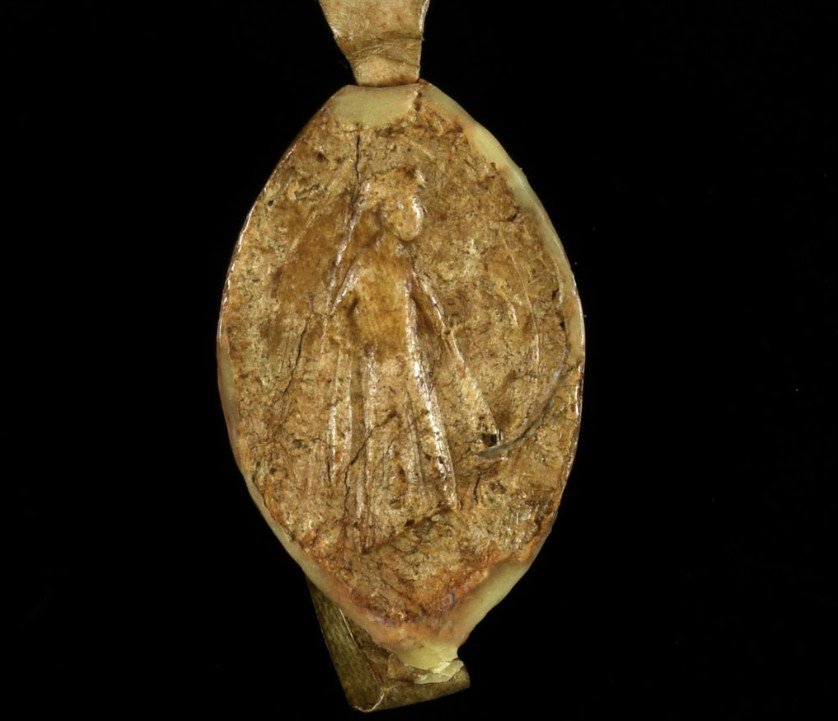
One of the most personal surviving objects connected with Nicola is her seal. The National Archives reproduces a surviving impression associated with Nicola’s charter, catalogue reference DL 25/2890.
It is particularly interesting because Nicola does not depict herself as a warrior. Instead, she appears as an aristocratic woman with a hawk or falcon.
Male chroniclers praised Nicola by saying she acted “like a man”, but Nicola’s own representation of herself did nothing of the sort: She used the visual language of elite female status.
She did not need to make herself symbolically male in order to exercise authority.
What did her enemies think?
Not everyone admired her.
The French-side Anonymous of Béthune described Nicola as:
“a very cunning, bad-hearted and vigorous old woman.”
It is hostile—but revealing.
Her enemies remembered her because she was effective.
To the History of William Marshal, she was the worthy lady holding the castle.
To the men trying to take it, she was cunning, vigorous and deeply troublesome.

DEATH, LEGACY AND EVIDENCE
Nicola’s later years
Nicola remained active long after 1217. She continued administering her estates, issuing charters and defending her position at Lincoln.
She survived William Longespée, who died in 1226.
Only in extreme old age did the responsibilities she had carried begin to pass to the next generation.
Nicola’s death and Idonea’s inheritance
Nicola died in November 1230. Her granddaughter Idonea de Camville, daughter of Richard, inherited the principal de la Haye estates. Idonea’s husband, William Longespée the younger, performed homage for the lands falling to her.
The estates that had descended from Colswein through Picot, Muriel, Richard and Nicola therefore passed into another family through yet another woman, a fitting ending to the history of an inheritance repeatedly preserved through female descent.
A century of divided loyalties
Looking back across Nicola’s family reveals a striking pattern.
During the Anarchy, her uncle Ralph appears to have supported Stephen while her father Richard served Geoffrey of Anjou.
In 1173–74, Ralph changed sides and became a military commander in the Young King’s rebellion against Henry II.
Nicola’s first husband William FitzErneis joined the same rebellion.
Her second husband Gerard de Camville later opposed Richard I’s government on behalf of Prince John.
Then, during the First Barons’ War, Nicola’s own son Richard de Camville appears to have rebelled against King John before returning to royal allegiance under Henry III.
Nicola herself remained one of John’s steadfast supporters and then transferred that allegiance to the government of his young son.
There was therefore nothing inevitable about Nicola’s loyalty.
Every generation made political choices.
Often they chose differently from one another.
Perhaps the most consistent thread in Nicola’s own life was something more personal than loyalty to any dynasty: the defence of the inheritance and responsibilities entrusted to her.
That meant land. It meant tenants and followers. And above all, it meant Lincoln Castle.
Evidence, uncertainty and legend
Was Nicola born in 1150?
We do not know.
A birth in the early to mid-1150s is a reasonable estimate.
Was Nicola definitely Richard de la Haye’s eldest daughter?
Not certainly. She was one of three co-heiresses. Their exact birth order is not securely established.
Did Colswein simply retain his Anglo-Saxon barony after 1066?
No.
The PASE Domesday evidence shows that most of his great 1086 estate had belonged to numerous different people before the Conquest.
Was Ralph de la Haye on Empress Matilda’s side?
The stronger evidence suggests not. R. H. C. Davis identifies him as a staunch supporter of Stephen.
Why did Ralph witness Ranulf of Chester’s charters?
Probably because the relevant charters belong to the period after Ranulf had been reconciled with Stephen.
Was Richard de la Haye also a supporter of Stephen?
The evidence points in a different direction: Richard appears in Geoffrey of Anjou’s administration in Normandy.
Was Robert de la Haye personally tricked out of Lincoln Castle?
Possibly, but it cannot be demonstrated from the surviving evidence.
Was William FitzErneis a rebel?
Yes. The Northamptonshire Record Society explicitly identifies William and Eudo FitzErneis among the adherents of the Young King’s rebellion. This is also recorded in Henry II’s itinerary (see above).
Was Ralph de la Haye also a rebel in 1173–74?
A Ralph de la Haye certainly occupied an important military position in the Young King’s forces. It is very likely, though not absolutely certain, that this was Nicola’s uncle.
Did Nicola keep Lincoln loyal against William FitzErneis?
We do not know. Lincoln’s absence from the rebel strongholds is intriguing but does not prove Nicola personally opposed her husband.
Did Richard I personally besiege Nicola in 1191?
No. Richard was on crusade. The siege was conducted by his government under William Longchamp.
Did Nicola personally fight on the walls?
No surviving source says so. She commanded the defence.
Was Nicola England’s first female sheriff?
She is most safely described as the earliest known woman formally appointed to exercise an English shrievalty in her own right.
Was Nicola’s son Richard a rebel?
The evidence strongly indicates that he was. His castle and daughter came into royal custody while he remained alive.
Did Richard return to the royalist side?
Yes, almost certainly. By 12 February 1217, Henry III’s government had taken Richard and Nicola under explicit royal protection.
Did Nicola save England?
Not alone, but her defence of Lincoln Castle was nevertheless strategically important to the royalist victory. if she hadn’t held out under siege, then things may have turned out very differently.
Did Nicola save Magna Carta?
Not directly, but her defence helped preserve the government that subsequently reissued it.

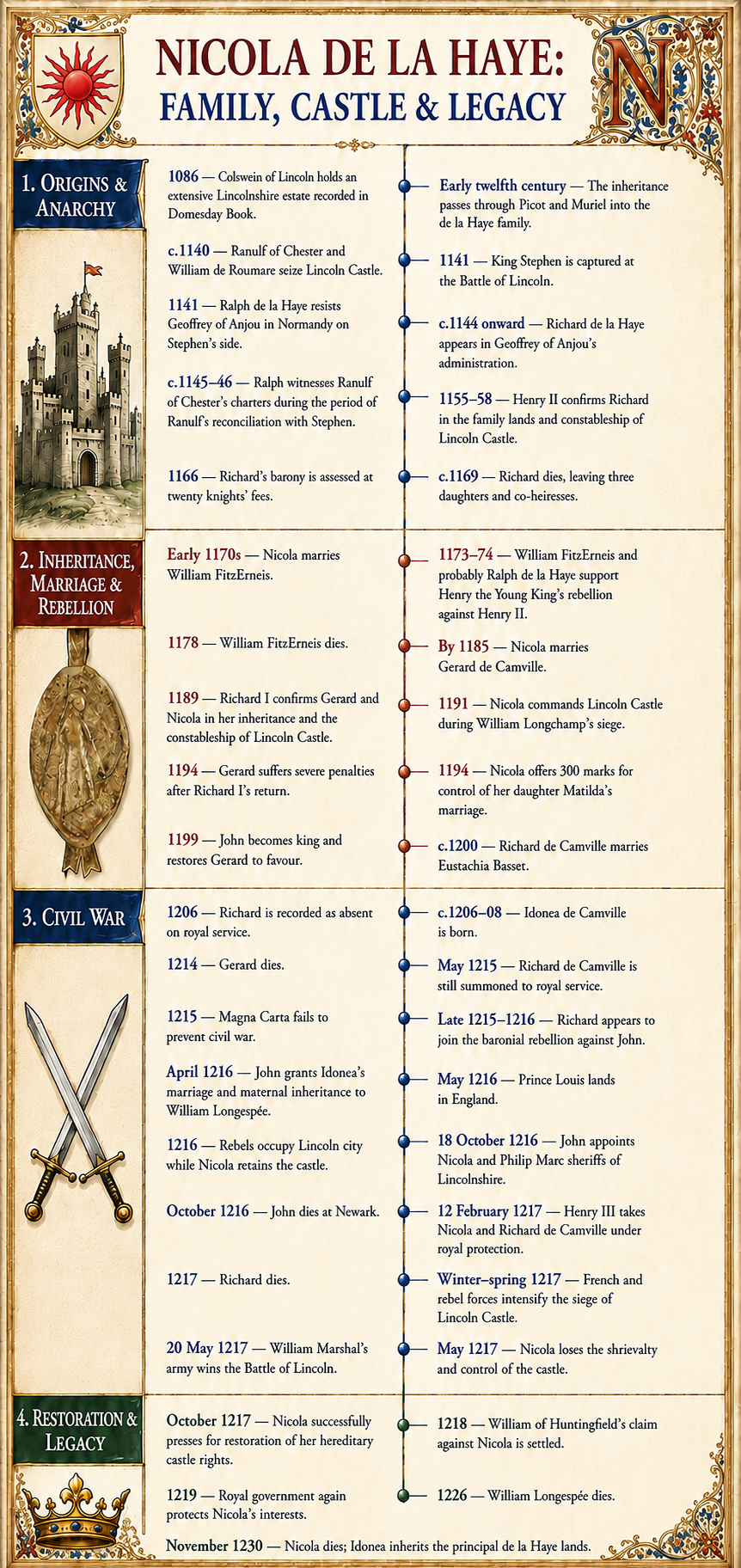
NICOLA DE LA HAYE TIMELINE

BIBLIOGRAPHY AND SOURCES
Primary and edited medieval sources
Richard of Devizes. Chronicle of the Times of King Richard I.
Principal narrative source for Nicola’s defence of Lincoln Castle in 1191.
Roger of Howden. Gesta Regis Henrici Secundi and Chronica.
Important contemporary evidence for the rebellion of 1173–74.
Roger of Wendover. Flores Historiarum / Flowers of History.
The Annals of Dunstable.
Important for Nicola’s defence of Lincoln in 1217.
The History of William Marshal.
Essential for the relief of Lincoln Castle and the Battle of Lincoln.
Orderic Vitalis. The Ecclesiastical History.
Important for Lincoln Castle and the Anarchy.
The Pipe Rolls of Henry II, Richard I and John.
Important fiscal evidence for the de la Haye and Camville families, William FitzErneis and the siege of 1191.
The Red Book of the Exchequer.
Includes the surviving summary of Richard de la Haye’s 1166 carta.
The Patent Rolls and Close Rolls.
Essential for Nicola’s royal appointments, Richard de Camville, Idonea, William Longespée and the First Barons’ War.
The Testa de Nevill / Book of Fees.
Important for the descent of the de la Haye estates.
Barraclough, Geoffrey, ed. The Charters of the Anglo-Norman Earls of Chester, c.1071–1237.
Important for Ralph de la Haye’s appearances among the Earl of Chester’s charter witnesses.
Modern academic scholarship
Davis, R. H. C. “Geoffrey Barraclough and the Lure of Medieval Charters.”Journal of the Chester Archaeological Society 71, pp. 23–34. - Particularly important for interpreting Ralph de la Haye’s political allegiance and his appearances in Ranulf of Chester’s charters. Davis identifies Ralph as a staunch supporter of Stephen.
Holt, J. C. “The Carta of Richard de La Haye, 1166: A Note on ‘Continuity’ in Anglo-Norman Feudalism.” English Historical Review 84, no. 331 (1969), pp. 289–297. - The key specialist study of Richard de la Haye’s barony and its descent from Colswein’s Domesday estate.
Wilkinson, Louise J. Thirteenth-Century Women in Lincolnshire. PhD thesis, King’s College London, 1999. - A major study of Nicola’s property, family, political career and status as a female landholder.
Wilkinson, Louise J. “The Charters, Letters, and Seal of Lady Nicholaa de la Haye (d. 1230), Lord, Castellan, and Sheriff.” In Lincoln Readings of Texts, Materials, and Contexts. Arc Humanities Press, 2024. - The strongest recent study of Nicola’s surviving documentary acts, her followers and her exercise of lordship.
Stenton, F. M., ed. Facsimiles of Early Charters from Northamptonshire Collections.Northamptonshire Record Society. - Important for William and Eudo FitzErneis and their involvement in the Young King’s rebellion.
Prosopography of Anglo-Saxon England. “Colswein 1 - Important for reconstructing Colswein’s Domesday estate and correcting the older idea that he simply retained a pre-Conquest barony.
Carpenter, David. The Minority of Henry III. - Essential for the political settlement after John’s death and the government under William Marshal.
Johns, Susan M. Noblewomen, Aristocracy and Power in the Twelfth-Century Anglo-Norman Realm. - Important context for female inheritance and aristocratic authority.Strickland, Matthew. Henry the Young King, 1155–1183.
Important for the rebellion of 1173–74.
Sanders, I. J. English Baronies: A Study of Their Origin and Descent, 1086–1327. - Useful for the descent and scale of the Brattleby honour.
Hill, J. W. F. (1948). Medieval Lincoln. Cambridge: Cambridge University Press.
Power, Daniel, and Tony Moore. The ‘Lands of the Normans’ in England (1204–1244), Humanities Research Institute, University of Sheffield, 2007, ‘Selected Case-Studies of Anglo-Norman Families’.
Heritage and archival resources
The National Archives — Medieval Seals, including Nicola de la Haye’s surviving seal, catalogue reference DL 25/2890.
Further reading
Huscroft, Richard. Tales from the Long Twelfth Century.
Connolly, Sharon Bennett. King John’s Right Hand Lady: The Story of Nicholaa de la Haye.
THE NOVELS AND THE HISTORY
Nicola de la Haye in my novels
The historical Nicola de la Haye inspired my novels Lady of Lincoln, Lady of the Castle, Lady of England, and Lady of the Mantle.
The novels imagine what surviving medieval records cannot tell us: private conversations, emotions, relationships and motives.
“Dickon”, for example, is my fictionalised version of Nicola and Gerard’s historical son Richard de Camville. His personality and his relationship with his parents are imagined. His marriage to Eustachia Basset, his daughter Idonea, his apparent rebellion against King John and his subsequent return to the king’s peace are rooted in the surviving historical evidence.
Similarly, the private relationship between Nicola and William FitzErneis is necessarily fictional, but his participation in the Young King’s rebellion is not.
That distinction—between what the records preserve and what a novelist must imagine—is at the heart of the series.