Lincoln's Lost Castle: The Rise and Fall of Thorngate
The fortress was a real force in the Anarchy but erased in the peace that followed
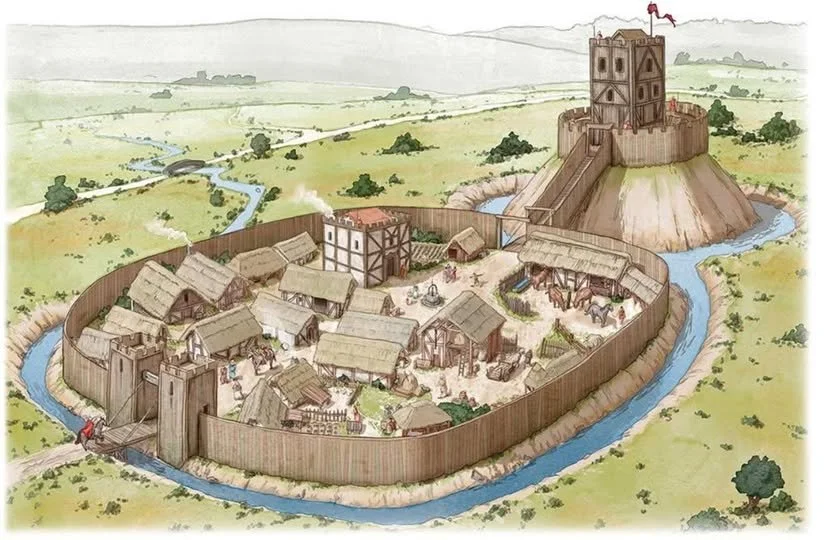
Thorngate Castle in Lincoln would have been a timber castle, probably with a motte and, being close to Brayford Pool and the Witham, bound to have had a moat rather than a dry ditch
Everyone who climbs Steep Hill in Lincoln has seen Lincoln Castle. It stands where William the Conqueror planted it in 1068, high on the old Roman upper city, its twin mottes and curtain wall commanding the whole plain. It is one of the best-preserved castles in England, and it still does the Crown's work — the Crown Court sits there to this day.
Almost nobody knows that Lincoln once had a second castle.
Down by the river, at the vulnerable (from a defensive point of view) south-eastern corner of the lower city, there stood for perhaps two or three generations a fortress called Thorngate Castle — castellum de Tornegat. It was not royal like Lincoln Castle (which at one time housed the sheriff, the constable/ castellan, and the bishop). Thorngate belonged to a family, held in their own right, and it existed in a state of quiet tension with the great royal castle on the hill. And then, in the space of a decade, it was pledged away as a bargaining chip in a civil war and demolished so completely that today we cannot even say for certain where it stood.
This is the story of that lost castle: of the family who held it, the war that consumed it, the forced marriages and shifting loyalties tangled around it, and the arguments that still divide historians about where it was and who really controlled it. It is, in miniature, the story of the whole terrible period we call ‘the Anarchy’ — and, as so often, it is a story with a woman at its centre whom history has almost entirely forgotten.
A castle we can barely see
Let me be honest with you from the outset, because this castle demands honesty. Thorngate is one of the great ghosts of Lincoln's medieval townscape. Where Lincoln Castle is massively documented and still standing, Thorngate survives in the thinnest of parchment traces.
The name castellum de Tornegat occurs, so I can gather, securely in just one document — of 1141 — and, uncertainly, in a second, of 1151. Everything else we know we have had to reconstruct by reading those two fragments against the very well-documented lives of the family who held the castle and the war that destroyed it.
The foundational modern work is C. W. Foster's appendix "Thorngate and the Condet family," published in the Registrum Antiquissimum of the Cathedral Church of Lincoln (Lincoln Record Society, vol. 27, 1931), where the surviving references are transcribed and discussed. Sir Francis Hill built on this in his classic Medieval Lincoln (Cambridge, 1948). Everything written since — the antiquarian gazetteers, the local newspaper features, the heritage-database entries — ultimately descends from those two scholars. So when I give you personalities and drama below, understand that I am doing what any careful historian must: lighting the castle from the edges, by the lives that surrounded it.
What kind of castle was it?
it was almost certainly timber castle — a motte-and-bailey or a ringwork, raised banks crowned with a wooden palisade and tower. I’m also fairly sure it would have had a moat, being close to or in the vicinity of Brayford Pool and the River Witham. This is precisely why nothing survives, and why it could be "demolished" so completely and so fast. Had there been stone in it — entirely possible, given how easily Lincoln's abundant Roman masonry could be robbed and reused — those stones would themselves have been carried off for later building in the city. The archaeological consensus classes Thorngate as a probable timber castle.
The date is contested, and here I want to correct a claim you will find repeated online. A popular local account argues for a foundation before 1100 — even in the late 1080s — on the reasoning that the first known lord, Robert de Condet, is said to have been "born within the castle," and his birth is variously dated as early as 1096. Treat that with real caution. It rests entirely on genealogists' guesses about a birth date, and those genealogies are notoriously unreliable and self-contradictory. The professional castle-studies tradition — Foster, Hill, D. J. C. King's Castellarium Anglicanum, D. F. Renn's Norman Castles of Britain — treats Thorngate asa castle of the Anarchy: built or refortified in the turbulent years around 1135–41, which fits its first secure appearance in the record in 1141.
Foster raised one tantalising possibility worth holding onto: that Thorngate may have been something more substantial than a hasty war-castle — a private urban castle held by a major baron outside the official power structure of the county, comparable to Montfichet's Tower or Baynard's Castle in London. A great family's fortress, planted inside a royal city, in permanent implicit rivalry with the Crown's castle on the hill. Keep that image in mind. It is the key to everything that follows.
The world that made it: the Anarchy
To understand why a private castle appeared in Lincoln, and why it was so casually destroyed, you have to understand the moment.
When Henry I died in December 1135, he left no legitimate son — only a daughter, the Empress Matilda, whom the barons had sworn to accept as queen. They broke that oath almost at once. Henry's nephew, Stephen of Blois, seized the throne, and England slid into nearly two decades of intermittent civil war so savage that a chronicler famously wrote that "Christ and His saints slept." This is the Anarchy: a war of sieges and shifting allegiances, in which over-mighty barons built private castles by the score and sold their loyalty to whichever side offered more.
Lincoln became one of the most fiercely contested places in the whole war, and the reason has a name: Ranulf de Gernon, 4th Earl of Chester.
And here is a connection that will matter enormously to anyone who knows my work on Lincoln's medieval women. Ranulf de Gernon was the son of Ranulf le Meschin and Lucy of Bolingbroke — the very Countess Lucy who gives her name to the Lucy Tower at Lincoln Castle. The earl who would ultimately engineer Thorngate's destruction was Lucy of Bolingbroke's son. The threads of this city's history are woven far more tightly than we usually notice.
The trick at the castle gate
Ranulf's grievance was territorial and dynastic. His father had been forced to surrender Cumberland and Carlisle to secure the earldom of Chester, and Ranulf spent his life trying to claw those northern lands back. When Stephen's treaties with King David of Scotland handed those very lands to the Scots, Ranulf turned against the king. He and his half-brother William de Roumare (also a son of Lucy of Bolingbroke) both believed they had the better claim to the earldom of Lincoln — which Stephen provocatively gave to someone else entirely.
What happened next, in December 1140, is one of the finest set-pieces of the entire Anarchy — and it turned on the movements of women.
Ranulf and William did not storm Lincoln Castle. They took it by a trick. They sent their wives on a friendly social visit to Muriel of Lincoln, the wife of the castle's constable. While the ladies were inside, apparently paying a courtesy call, the two earls arrived — lightly dressed, escorted by a mere handful of knights, as if collecting their wives — and seized the fortress from within.
I never tire of this detail, because it is exactly the kind of overlooked women's agency that formal history smooths over. The whole coup depended on the unremarkable, unsuspicious sight of noblewomen visiting one another. The chronicle records the men who "took" the castle. It barely notices that the door was opened by the ordinary social world of women.
The other fascinating link to this is that Muriel’s younger son, Ralph de la Haye (Nicola de la Haye’s uncle) soon appears as a witness to Ranulf of Chester’s legal documents. Was Ralph his friend or vassal? Did Ralph conspire with the Earl of Chester to trick his parents out of the castle? Did Ralph (who it appears fought on a different side in the Anarchy to his older brother, Richard), add a legitimacy to Chester’s and Roumare’s taking of the castle by acting as the castellan/ constable during their tenure? Something was going on in the de la Haye family, for sure. (This possible familial rupture is a feature of my novel, Lady of Lincoln and I talk about it in the historical note).
Stephen marched north in response. On 2 February 1141 came the First Battle of Lincoln, and it was a catastrophe for the king: Stephen fought with famous personal courage, was struck down, captured, and imprisoned. For a few months, the Empress Matilda's cause held the kingdom in its hand. (Orderic Vitalis adds a grim civilian coda — perhaps five hundred townsfolk of Lincoln drowned fleeing across the frozen Witham as the victors sacked the city - something that would later be repeated at a later date - the innocent women and children often suffer the most, it seems.)
We know this battle in vivid detail because it is described in five contemporary sources — the Gesta Stephani, Henry of Huntingdon's Historia Anglorum, the chronicles of John of Worcester and William of Malmesbury, and Orderic Vitalis. Note that this drama unfolded at Lincoln Castle, the royal fortress on the hill — not at Thorngate. But it set in motion everything that would destroy the second castle.
The family who held Thorngate: the Condets - and a very complicated family tree!
Down by the river, through all of this, stood the private castle of the Condet family (the name appears as Cundy, Condé, Condet — medieval spelling was gloriously fluid).
Here I must tread carefully, because the genealogy websites are a thicket of contradiction — birth years vary by a decade, and one much-copied account even miscalls the widow's late husband "Thomas" when it means Robert. Let me give you what is well-attested, and flag what is not.
Robert de Condet (died c. 1141) is the first securely recorded "Lord of Thorngate Castle." He held a scattered honour — South Carlton, Eagle, Skellingthorpe and Thurlby in Lincolnshire, with further lands in Kent and Nottinghamshire.
His marriage is the keystone of the whole story, and a significant one. Robert married Adeliza (Alice) de Meschines — and here the standard reference works agree: she was the daughter of Ranulf le Meschin, Earl of Chester, and Lucy of Bolingbroke. Which means the lady of Thorngate Castle was the sister of Ranulf de Gernon, the earl who dominated the county — and the daughter of Lucy of Bolingbroke herself.
Sit with that a moment. The family who owned Lincoln's second castle were bound by the closest blood to the most dangerous man in the region. Adeliza was not a minor figure married to a minor lord. She was a daughter of the house of Chester, a granddaughter, through Lucy, of the old comital line — and she had been married before.
Her first husband had been Richard fitz Gilbert de Clare, one of the great magnates of the age, killed by the Welsh near Abergavenny in 1136. By Richard she had a daughter, Rohese de Clare — remember that name. Widowed, Adeliza then married, secondly, Robert de Condet of Thorngate.
The one securely dated moment in the castle's life belongs to Adeliza. In 1141, after Robert's death, his widow — "Alice de Cundy" — pledged Thorngate Castle, together with her estates in Lincolnshire, Nottinghamshire and Kent, to the cause of King Stephen. That is the castle's single clear moment of documented agency, and look who exercises it: a widow, acting for herself and her lands, choosing a side in a civil war. In an age that too often reduces women to lines in a pedigree, here is the lady of Thorngate deciding the allegiance of a fortress.
The Condet line continued through her children — including a daughter, Isabel de Condet, who would later marry Hugh Bardolf, though by then the castle itself was gone.
The forced marriage — and the confusion around it
Now to one of the most persistent tangles in this story, and one worth setting straight carefully, because two different traditions have become knotted together.
There was a forced marriage at the heart of this family. When the young Gilbert de Gant — a nobleman fighting for King Stephen, still barely twenty — was captured at the Battle of Lincoln in 1141, his captor, Ranulf de Gernon, compelled him to marry against his will.
This is not mere genealogical folklore. It is confirmed in the standard scholarly authority on the earl, H. A. Cronne's study "Ranulf de Gernons, Earl of Chester, 1129–1153" (Transactions of the Royal Historical Society, 1937), and in the Complete Peerage, the great reference work of the English aristocracy. Cronne records that Gilbert, taken prisoner at Lincoln, "is said to have been forced to marry Ranulf's niece."
And here is the crucial point — the one I want to correct, because you will find it wrong all over the internet. Gilbert de Gant was forced to marry Rohese de Clare — the daughter — not Adeliza the Thorngate widow.
Recall the family shape. Adeliza de Meschines had two husbands: first Richard fitz Gilbert de Clare (father of Rohese), then Robert de Condet of Thorngate. Rohese de Clare was therefore Adeliza's daughter — and Ranulf de Gernon's niece. It was the niece, Rohese, whom Gilbert was compelled to marry. The claim you will sometimes read — that Gilbert married the widow Adeliza and thereby "took control of Thorngate Castle" — is a conflation of mother and daughter. Two Chester-Clare women, married off in the same tangle of coercion, collapsed by later writers into one.
Why does this matter? Because it dissolves a tempting but false idea about who controlled Thorngate. Gilbert de Gant's forced marriage was tied to the Clare inheritance and the earldom of Lincoln — not to the Condet estate. There is no evidence that Gilbert de Gant ever held Thorngate Castle at all. The castle stayed, from first to last, with the Condets: Robert, then his widow Adeliza, then their children.
(A further muddle worth naming, if only to dismiss it: a few sources name Gilbert's forced bride as Hawise de Roumare, daughter of William de Roumare — a third woman altogether. This looks like confusion arising because the earldom of Lincoln itself passed between the Roumare and Gant families. The weight of scholarship gives Rohese de Clare; I would set the Hawise version aside.)
So the "forced marriage" that genuinely belongs to this story is real, and it is dramatic — a captured youth married off at an earl's command to cement a claim. But it belongs to the earldom of Lincoln and the Clare bloodline, not to the ownership of Thorngate. The castle's own story is quieter and, to my mind, sadder: a widow, her children, and a fortress traded away.
Marriage as a weapon
Step back and look at the pattern, because it is the real theme here. In this one family cluster, in this one decade, marriage appears again and again as an instrument of power wielded over women and young men alike.
Ranulf de Gernon's own marriage, to Maud of Gloucester, had been arranged by Henry I to bind him to the Crown — and it backfired spectacularly, cementing instead Ranulf's later alliance with Matilda's party. The seizure of Lincoln Castle turned on the weaponised innocence of noblewomen's social visits. And Gilbert de Gant was frog-marched into matrimony as a prisoner of war.
Arranged, weaponised, forced. For those of us trying to recover the lives of medieval women, Thorngate sits at the dark centre of a web in which women are simultaneously pawns to be moved and instruments to be used — and, just occasionally, as with Adeliza's pledge of her castle, agents in their own right.
The destruction: a castle traded away
Thorngate did not fall to a heroic siege. Its end was, if anything, more revealing of the age: it was bargained away and demolished as a clause in a peace deal.
The context is Ranulf de Gernon's serial treachery. Having fought against Stephen at Lincoln in 1141, he changed sides to the king around 1144–45 (chasing his northern claims), was arrested by Stephen in 1146 in breach of a sworn oath, and on release "burst into a blind fury of rebellion." In 1149 he met the young Henry FitzEmpress — the future Henry II — and again threatened Lincoln.
Somewhere in the repeated attempts to broker peace between Stephen and this impossible earl, around 1150–51, Thorngate Castle's destruction was pledged to the Earl of Chester, and King Stephen ordered it demolished. In the wider settlement, Stephen even granted Ranulf the city and castle of Lincoln itself.
Here is the bitter irony, and the true "scandal" of Thorngate — not a scandal of the bedchamber, but of politics. Thorngate was a private baronial castle held by Ranulf's own kin: his sister Adeliza and her children. And it was pulled down to buy Ranulf's temporary loyalty. The Condets' fortress was sacrificed on the altar of their own most powerful relative's ambition. A private castle, answerable to no royal officer, was exactly the kind of independent power-base that both Crown and earl found it convenient to erase. The royal castle on the hill endured; the family castle by the river did not.
Two castles, two kinds of power
The contrast between Lincoln's two castles tells you almost everything about medieval power.
Lincoln Castle was royal, its custody exercised through the hereditary office of constable — the very office whose holder's wife was so fatefully "visited" in 1140. That constableship would, generations later, descend through the de la Haye family to Nicola de la Haye, the indomitable defender of Lincoln Castle at the Second Battle of Lincoln in 1217, and England's first female sheriff.
Thorngate was private — a baronial seat held in the family's own right, with no royal office attached, standing outside the official structure of the county.
Two models of authority, in one city: delegated royal power on the hill, and independent baronial lordship by the river. One castle endured for a thousand years and gave us a female sheriff whose name we still speak. The other was traded off within a decade and vanished so thoroughly we cannot find it. For anyone who cares, as I do, about legitimacy, survival, and the women written out of the record, the pairing could not be more eloquent.
Where was it? The great unresolved question
And so to the mystery that endures: nobody knows for certain where Thorngate Castle stood. There are four serious theories, and no excavation has ever settled the matter.
The map below plots the leading candidates against Lincoln Castle, so you can see the geography for yourself.
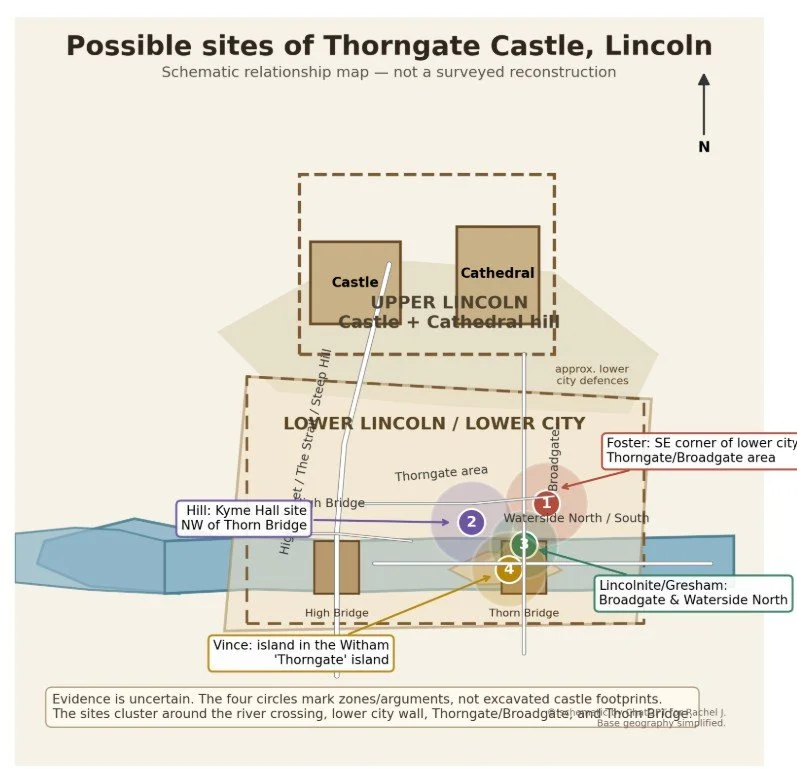
Possible sites of Thorngate Castle, Lincoln
Foster (1931): just outside the south-east corner of the lower Roman city, near the Witham — the standard view, echoed by most accounts, which describe the castle as forming the south-east corner of the city walls.
Hill (1948): the site was later occupied by Kyme Hall, the manor house of the Kyme family, north-west of Thorn Bridge.
Cameron (1985): places Kyme Hall in Hungate instead, thereby distinguishing it from Thorngate — a direct scholarly disagreement with Hill.
Vince (2003): the castle stood on the actual island of Thorngate in the River Witham.
A widely repeated local identification, popularised by The Lincolnite, places the site at the corner of Waterside North and Broadgate. And there is a fifth contender: in 2017, ahead of the building of the city's new transport hub, Allen Archaeology excavated beneath the former Lincoln bus station — turning up thousands of artefacts, the walls of an old brewery, and a medieval dumping ground — in the hope of finally pinning Thorngate down. As far as the record shows, they did not find it. The castle stayed hidden.
What is striking, looking at the map, is how close together all these candidates sit — a few hundred metres of riverside ground at the south-eastern edge of the lower city. The debate is not really whether the castle stood in this zone, but precisely where within it.
Notice, too, the vertical drama a flat map hides: Lincoln Castle sits high on the hill; every Thorngate candidate lies downhill, by the water, about two-thirds of a mile to the south-east. That low, riverside position is the point of Thorngate. It guarded the vulnerable south-eastern river approach to the lower city — the corner the great hilltop castle could never cover.
As the Gatehouse Gazetteer soberly concludes: without further excavation, it is hard to see how this question will be resolved. Thorngate is genuinely a lost castle — a research target, not a ruin.
And so, since no one can prove me wrong, let me offer a picture of my own. I like to imagine that all these candidate sites are fragments of a single answer — that the castle did not sit in one spot but stretched across this riverside ground. Picture the motte and its keep raised on the island of Thorngate itself, ringed by the Witham (as in the reconstruction at the head of this piece), with a bridge carrying out to a wider bailey and settlement spread along Broadgate and Waterside North. A castle with its feet in the river and its reach into the lower city. It is a fancy, I admit, and the documents will not bear its full weight — but until a spade turns up something definitive, the lost castle belongs a little to the imagination as well as to the historians.
The name that outlived the castle
Here is something quietly wonderful. Though the castle vanished, its name did not. There is still a street and area called Thorngate in Lincoln today, down in the lower city by the Witham. There is a Thorngate Bridge over the river (the old Thorn Bridge, around which Hill built his whole locational argument). There is even a modern Thorngate House on Broadgate — which, fittingly, was the subject of an archaeological evaluation in 2002.
But note the direction of the naming, because it is easy to get backwards. The castle was named after the place, not the other way round. "Thorngate" almost certainly predates the Condets and the Anarchy: the "-gate" is the Old Norse gata, meaning "street" or "way" — the same Danelaw legacy you see all across Lincoln in Clasketgate, Hungate, Pottergate and the rest. "Thorngate" is, in origin, something like "thorn street." The fortress simply borrowed the name of the locality it guarded. The name is older than the castle, and it has outlived it by more than eight hundred years — a small linguistic ghost of a fortress that has otherwise vanished entirely.
Picturing the lost castle
We have no image of Thorngate. We never will. But we can picture its kind.
If you want to imagine it, look to the surviving reconstructions of Anarchy-period timber castles — the motte-and-bailey and ringwork fortresses thrown up across England in these same years. Picture a raised earthwork bank, a timber palisade, a wooden tower or gatehouse, a huddle of buildings within, and beyond it the River Witham and the roofs of the lower city climbing toward the distant stone crown of the royal castle on the hill.
Standing at the corner today
Walk down to the corner of Broadgate and Waterside today and you will find no mound, no marker, no ruin — only traffic, shops, the ordinary business of a modern city, and the Witham sliding past as it has for two thousand years. Broadgate itself runs along the line of the old Roman east wall and ditch: the very defensive edge the castle once guarded.
There is nothing to see. And yet, if you know the story, everything is there. A widow choosing a side in a civil war. A young man married off at swordpoint. An earl who was his own only loyalty, trading his sister's castle for a few months' peace. A name in Old Norse that has outlasted the stones — or rather the timbers — by eight centuries.
Lincoln's second castle protected the south of the city for no more than seventy years (probably much less), and then it was gone. But it is not quite gone. It survives in two documents, in four scholars' arguments, in a street name, in a bridge — and now, perhaps, in the imagination of anyone who walks that unremarkable corner and pauses to wonder what once stood there.
Rachel Elwiss Joyce writes historical fiction recovering the overlooked women of medieval England. Her novels, published under the Idonea brand, centre on Lincoln and the remarkable women of its castle and county. Find more at rachelelwissjoyce.com.
Read more about Nicola de la Haye: https://www.rachelelwissjoyce.com/nicola-de-la-haye