What do a Roman soldier, a flock of noisy geese and a medieval blood pudding have in common? The answer is Martinmas, one of the great forgotten festivals of medieval England.
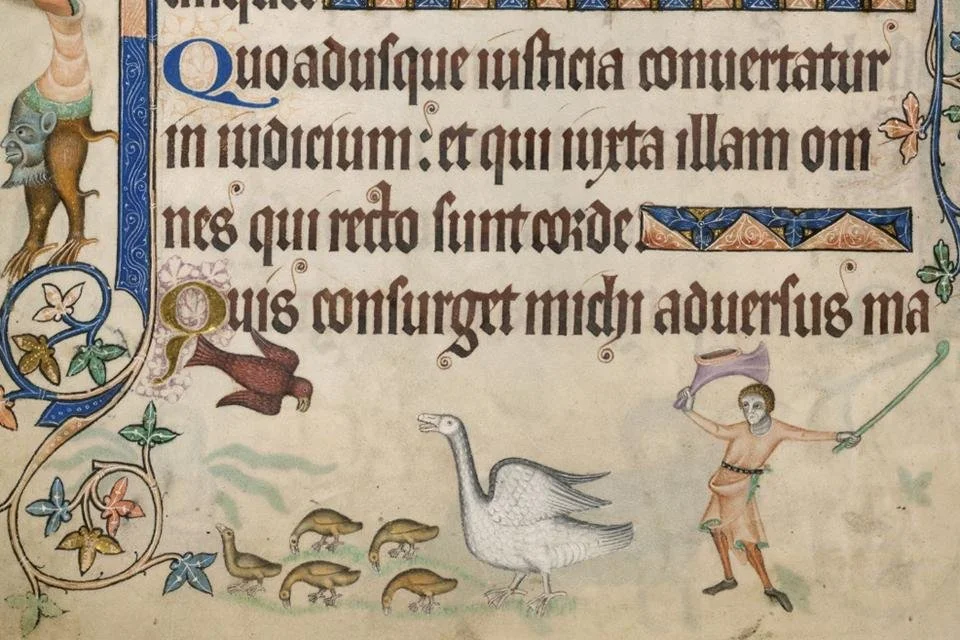
Geese illustrated in the Luttrell Psalter (c. 1325–1340), created in Lincolnshire. Fattened geese were traditionally slaughtered in autumn and became associated with Martinmas feasting on 11 November
Every year on 11 November, medieval communities celebrated the feast of St Martin of Tours. Today, Martinmas has largely disappeared from the English calendar, but in the twelfth century it marked an important turning point in the agricultural year. The harvest was over, the nights were drawing in, and households were preparing for the long winter ahead.
And what better way to prepare than with a feast?
The Saint Who Shared His Cloak
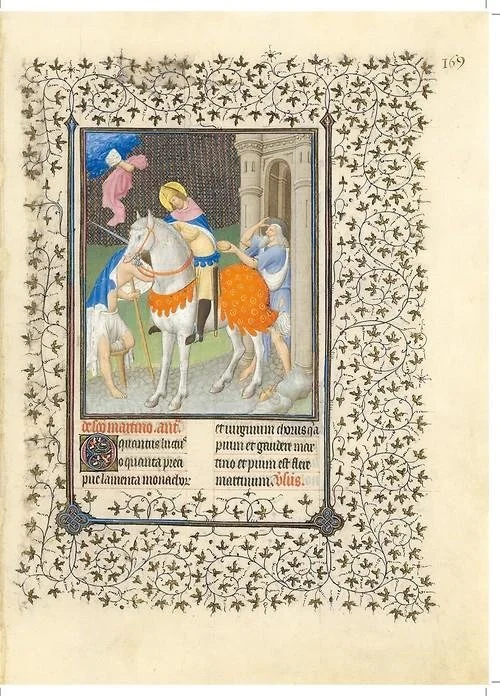
St Martin sharing his cloak with the beggar
Martin of Tours was born in the fourth century, in what is now Hungary, and served as a soldier in the Roman army.
According to legend, one bitterly cold day, while riding near the gates of Amiens in France, he encountered a beggar dressed in rags. Martin drew his sword, cut his military cloak in two and gave half to the freezing man.
That night, Martin dreamed of Christ wearing the half-cloak he had given away. He subsequently devoted himself to Christianity, eventually becoming Bishop of Tours.
Martin died in AD 397, and his burial on 11 November became his feast day. His reputation for charity made him one of medieval Europe's most popular saints.
But how did a festival honouring a charitable bishop become associated with eating enormous quantities of meat?
November: The Month of Slaughter
For medieval farmers, November brought some difficult decisions.
Cattle, pigs, sheep and poultry had been fattened on the remains of the harvest. Pigs had spent the autumn foraging for acorns and beechmast in the woods, while geese had grazed on the stubble left in the fields.
But winter fodder was expensive, and there was little point keeping more livestock alive than could be fed until spring.
Martinmas therefore coincided with the traditional slaughtering season. Animals not required for breeding were killed, their meat salted or otherwise preserved for winter.
The Anglo-Saxons even called November ‘Blood Month’.
Even monasteries took part. Records from Rochester Priory describe the slaughter of sheep and pigs on St Martin's Day as one of the duties of the monastery's cooks.
The result was an unusual abundance of fresh meat. For households accustomed to making every morsel last, this was an opportunity to eat well before the restrictions of winter.
Martinmas became a time of feasting, drinking and celebration. It was also a practical occasion for settling accounts, collecting dues and preparing households for the months ahead.
Why Geese? And What About the Black Pudding?
There is a wonderfully entertaining legend explaining why geese became associated with St Martin.
When the people of Tours wanted Martin to become their bishop, he supposedly tried to escape the honour by hiding among a flock of geese. Unfortunately, the birds began honking so loudly that they betrayed his hiding place.
According to the story, the geese were subsequently punished for their treachery by being eaten on his feast day!
It's a delightful explanation, although the real reason was probably rather more practical. Autumn was the ideal time to slaughter fattened geese before winter.
Roast goose became particularly associated with Martinmas in Germany and other parts of northern Europe. In England, beef was more commonly associated with the festival, although geese were also eaten.
Then there were the blood puddings.
Slaughtering an animal meant making use of as much of it as possible. Blood could be mixed with fat, grain and seasonings, stuffed into cleaned intestines and cooked. The result was an ancestor of the black pudding we still eat today.
For medieval households, blood pudding was an economical and nourishing food, but it was also a welcome addition to the Martinmas table.
And that brings us to Lincoln Castle in November 1168.
Martinmas at Lincoln Castle: A Feast in Trouble
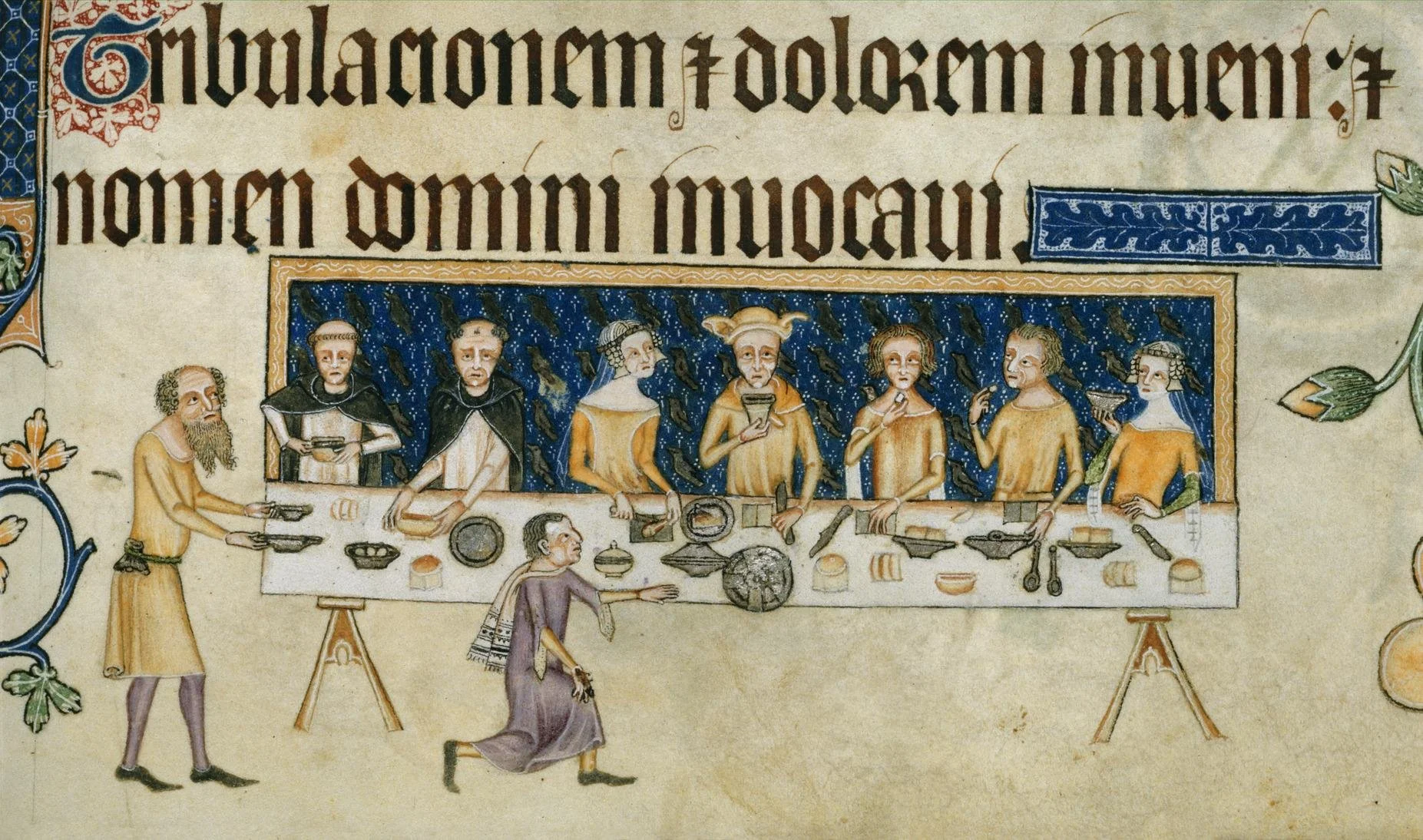
A medieval feast
In my historical novel Lady of Lincoln, fourteen-year-old Nicola de la Haye is responsible for organising the Martinmas feast at Lincoln Castle.
Her father, Richard de la Haye, the castle's constable, will be entertaining the city's leading nobles, and Nicola is determined to prove that she can manage the household in her mother's absence.
Unfortunately, almost everything that could go wrong does.
The steward, Rufus, has purchased dead geese rather than live birds, and when Nicola inspects them, she discovers that they are no longer fresh. Some have damp skin beneath their feathers. Others positively stink of decay.
Worse still, the blood puddings haven't arrived.
Nicola is furious. She confronts Rufus, who blames the shortage of poultry on Martinmas itself.
Her response is wonderfully practical:
"Martinmas isn't ever a surprise. You had weeks. If you'd ordered sooner, we wouldn't be in this mess."
But Rufus is an experienced steward who resents being ordered about by a girl, even one who will inherit the castle. Nicola must assert her authority without running to her father for help.
And the geese are only the beginning.
The tablecloths are filthy, the servants aren't doing as they're told, rain is threatening to soak the arriving guests, and Nicola's monthly bleeding has started, leaving her doubled over with cramps.
She is also coping with something far more troubling than a ruined feast. Her father is pressing her to accept a marriage she doesn't want, and she is beginning to understand how little control even a wealthy heiress may have over her own future.
It's hardly surprising that her temper is fraying.
The Martinmas preparations become a test of Nicola's ability to command. She must organise the servants, confront an obstructive steward and somehow produce a feast worthy of Lincoln Castle.
All while trying to persuade herself that she is equal to the responsibility thrust upon her.
More Than Just a Feast
One of the things I love about writing historical fiction is discovering how ordinary events can illuminate the lives of people who lived centuries ago.
We tend to remember medieval history through battles, sieges, kings and political intrigue. But people still had households to run, food to preserve, difficult servants to manage and family expectations to endure.
For women, particularly noblewomen responsible for large households, occasions such as Martinmas demanded considerable organisational skill. A successful feast demonstrated the household's wealth, hospitality and standing within the community.
And for Nicola, it was an early lesson in leadership.
The young woman struggling to procure fresh geese in November 1168 would one day become one of the most remarkable women in English history, defending Lincoln Castle against armies and refusing to surrender her inheritance.
But before she could stand up to kings, she had to learn to stand up to her own steward.
And make certain that the goose was fit to eat.
Discover the extraordinary true story of Nicola de la Haye in Lady of Lincoln, the multi-award-winning first novel in the Nicola de la Haye series by Rachel Elwiss Joyce.