Willikin of the Weald: Was He the Real Inspiration for Robin Hood?
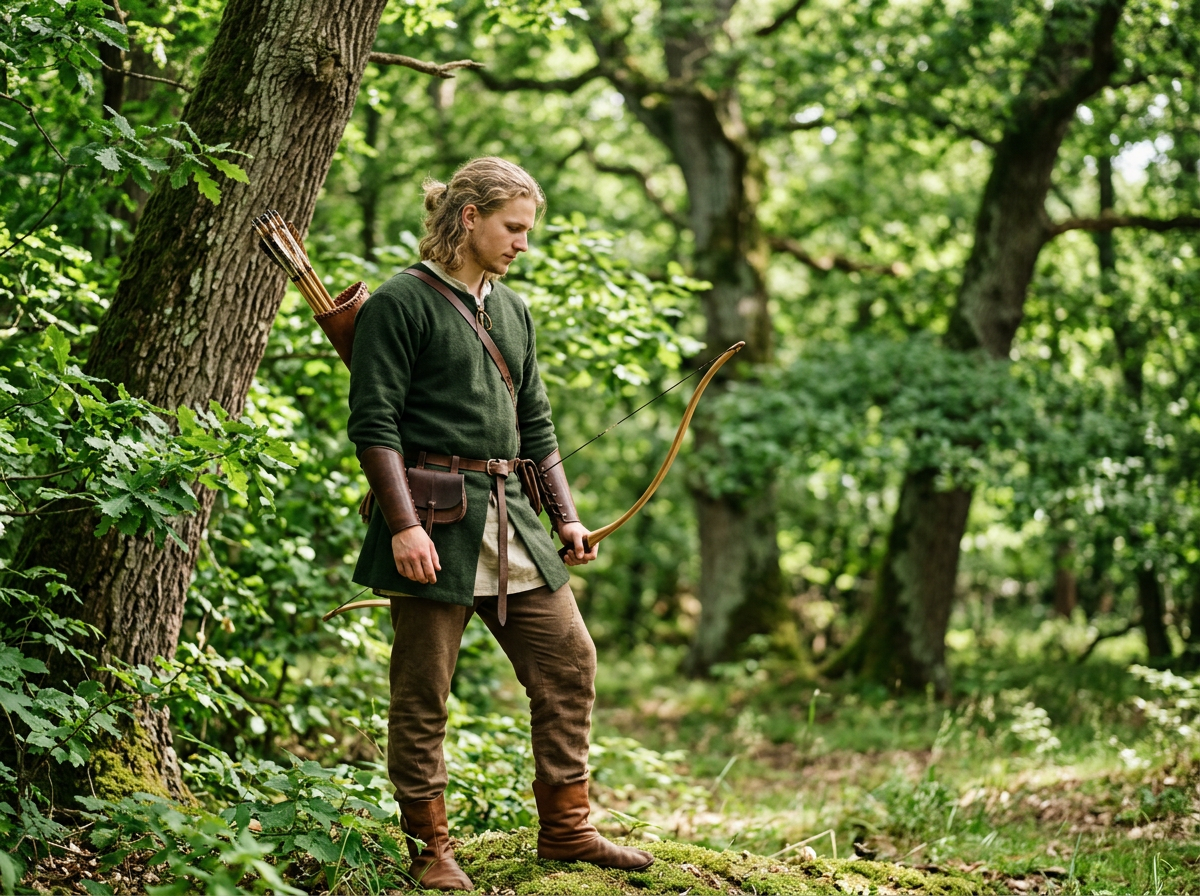
Was William of Cassingham (Kensham), also known as Willikin of the Weald, the inspiration for the start of the Robin Hood legend?
In my previous historical post, I looked at William de Wenneval, the Sheriff of Nottinghamshire and Derbyshire during the years when Richard the Lionheart was absent on crusade and then held captive in Germany.
Wenneval was one of the men who controlled Nottingham Castle while Prince John was plotting against his brother. That does not make him the Sheriff of Nottingham from the Robin Hood stories, but it places a real royal official in the right position, in the right place and at the right moment to have contributed something to the legend.
But what about Robin Hood himself?
There have been many attempts to identify a historical man behind the famous outlaw. One of the most intriguing candidates lived not in Sherwood Forest, but in the wooded country of Kent and Sussex. His name was William of Cassingham, although he became better known as Willikin of the Weald.
Unlike Robin Hood, Willikin was unquestionably real.
He was an archer and local fighting man who gathered a company in the forests, attacked occupying troops from ambush and became a hero to the communities around him. He fought during the reign of King John and was praised by medieval chroniclers for resisting England’s enemies when much of the south-east had submitted to them.
It sounds remarkably familiar.
So could Willikin of the Weald have helped inspire the legend of Robin Hood?
England Invaded
Willikin’s story belongs to the final and most disastrous years of King John’s reign, which I cover in my novel, Lady of England.
By 1215, John had alienated many of his barons through military failure, financial demands and arbitrary government. Magna Carta, sealed at Runnymede in June that year, failed to restore peace. Civil war followed, and the rebel barons invited Prince Louis of France, son of King Philip Augustus, to take the English throne.
Louis landed in Kent in May 1216. This was not merely a raid or a brief foreign intervention. Louis entered London and was accepted there as king, although he was never crowned. A substantial number of English barons supported him, and French forces gained control of much of eastern and southern England.
King John retreated rather than confronting Louis directly. Dover Castle, defended by Hubert de Burgh, remained one of the principal centres of royal resistance in the south-east. Elsewhere, the French appeared to be carrying everything before them.
It was in this atmosphere that William of Cassingham emerged.
A Fighter in the Forest
Very little is known about Willikin’s early life.
He appears to have come from Cassingham, generally identified with the modern hamlet of Kensham near Sandhurst in Kent. Roger of Wendover, one of the principal chroniclers of the period, describes him as a young man, a fighter and a loyalist.
According to Wendover, William refused to submit to Prince Louis. Instead, he gathered local archers in the forests and uncultivated places of the Weald and began attacking the invaders.
The Weald was ideally suited to this kind of warfare. Stretching across parts of Kent and Sussex, it was a difficult landscape of woodland, ridges, streams, narrow tracks and scattered settlements. An army moving through it depended upon guides, reliable roads and a steady supply of food. Local men who understood the terrain could strike suddenly and disappear before heavily equipped soldiers were able to respond.
Roger of Wendover credited Willikin’s force with repeatedly attacking and disrupting the French. His claim that many thousands were killed should be treated with the usual caution applied to medieval chroniclers’ numbers, but there is little reason to doubt that the attacks were persistent and serious. A Kent Archaeological Society account describes Willikin’s locally recruited archers as a core of resistance within territory otherwise dominated by Louis.
This was not warfare conducted according to the formal conventions of knights meeting in open battle. Willikin’s men attacked patrols, messengers, supply parties and isolated groups. They exploited the forest, avoided the enemy’s strength and made the roads unsafe.
In modern language, we would probably describe them as guerrillas.
From Lewes to Winchelsea
King John died at Newark in October 1216, leaving the crown to his nine-year-old son, Henry III.
John’s death transformed the political situation. Many of the English barons who had been willing to fight John had no desire to deprive a child of his inheritance. William Marshal, Earl of Pembroke, became guardian of the young king and the leading figure in the royalist government. Magna Carta was reissued in Henry’s name, giving former rebels a way to return to their allegiance.
Willikin continued fighting for the royalist cause.
The surviving accounts connect him with operations around Lewes, Rye and Winchelsea, where French forces needed access to the coast and supplies from across the Channel. Chroniclers describe French troops being attacked as they moved through the region and being driven towards Winchelsea. I have a scene in Lady of Englandwhere Willikin’s men and Falkes de Breauté almost capture Louis at Rye - as described by the Magna Carta project below:
Early in January 1217, Louis attempted to return to France via Winchelsea. As he approached Camber Castle, the burghers of the town smashed the mills in their town, and then went to join Philip d’Albini and his fleet off Rye. Louis was caught in a trap, blockaded by sea, by the garrison of the newly captured Rye across the channel and in the rear by ‘Willikin of the Weald’. His men broke down every bridge and blocked every route north. Eustace ‘the Monk’ managed to break the blockade and get into the port where he built a huge ‘castle’ on one of the ships. A stone-caster was next set up on another ship, to hurl stones at the English fleet. However, the English sailed into the harbour and destroyed Eustace’s ships. At the end of February, a French relief fleet with 3,000 men broke the blockade and Louis managed to escape to France.
Willikin’s activities also threatened the roads and supply lines linking the French-held towns with Louis’s wider army.
The History of William Marshal, a near-contemporary verse biography of the great regent, refers admiringly to the deeds of “Willikin of the Weald” against the French. That passing mention is significant. William was not simply remembered in a local tradition: his contribution was known to people close to the highest levels of royalist command.
In 1217, when Louis returned from France with reinforcements, Willikin and men associated with the defence of Dover were again active around the French siege camp. One account says that the camp was attacked and burned, helping to force Louis to alter his landing plans.
Willikin did not single-handedly defeat the invasion. That was accomplished through a combination of political reconciliation, the defence of Dover, William Marshal’s victory at the Battle of Lincoln in May 1217 and Hubert de Burgh’s naval victory off Sandwich in August.
Nevertheless, Willikin’s resistance mattered. His men denied the French secure possession of the Weald, endangered their communications and demonstrated that occupation did not necessarily mean submission.
What Happened to Willikin?
After Louis abandoned his claim to the English throne and agreed to leave the country, Willikin did not disappear into the greenwood as an outlaw.
He was rewarded by the Crown.
Royal records indicate that William received payments and employment connected with the Weald. He later performed duties for the royal household and appears to have remained in royal service for many years. He is generally believed to have died in 1257.
This is an important difference between Willikin and the Robin Hood of popular imagination. Willikin was not, as far as we know, a permanent opponent of royal government. He fought for the Crown during an invasion and was subsequently absorbed into royal administration.
Yet that difference may also make his story more interesting.
During the war, legitimate government had almost ceased to function across parts of the south-east. Willikin operated beyond the ordinary machinery of law because there was little effective law left to protect his community. Once order returned, he laid down that irregular role and entered the king’s service.
He was not necessarily an outlaw.
But for a time, he looked very much like one.
The Similarities to Robin Hood
The parallels are difficult to ignore.
Willikin was a skilled fighting man associated with the bow. He gathered a band of local archers. He lived and fought in heavily wooded country. His men used their knowledge of the forest to ambush a stronger enemy. They attacked armed parties moving along the roads and were celebrated for resisting oppression.
His story also belongs to the reign of King John, the period in which later storytellers eventually placed Robin Hood.
There is even something Robin Hood-like about his name. “Willikin” is a familiar or diminutive form of William, while “of the Weald” identifies him not by a great estate or noble title but by the wild landscape in which he operated.
A man of comparatively modest status becomes the protector of an entire region. He gathers bowmen around him, turns the forest into a weapon and acquires a reputation powerful enough to frighten professional soldiers.
If Willikin were fictional, we might assume that he had been created from Robin Hood.
But Willikin lived before the earliest surviving Robin Hood stories were written down.
How Old Is the Robin Hood Legend?
The difficulty is that we do not know exactly when the Robin Hood tradition began.
The earliest clear literary reference appears in William Langland’s Piers Plowman, composed during the later fourteenth century. One of Langland’s characters admits that he does not properly know his prayers but does know “rhymes of Robin Hood”. The remark shows that stories or songs about Robin were already familiar to a wide audience by around 1377.
The surviving medieval ballads are later still, although they almost certainly drew upon an older oral tradition.
Intriguingly, forms of the name “Robin Hood” or “Robehod” appear in thirteenth-century legal records as nicknames applied to criminals or fugitives. A William son of Robert le Smith, outlawed in 1261, was subsequently recorded as William Robehod. That suggests the name had already acquired an association with outlawry by the middle of the thirteenth century—only a few decades after Willikin’s campaigns.
But it does not tell us who the original Robin Hood was, or whether there ever was a single original.
Was Willikin the Inspiration?
There is no documentary evidence connecting William of Cassingham directly with the Robin Hood tradition.
No medieval chronicler calls him Robin Hood. No surviving ballad names Willikin. No known chain of stories carries his adventures from the Weald into Sherwood or Barnsdale. The earliest Robin Hood traditions are generally associated with the Midlands and northern England, rather than Kent and Sussex.
That means we cannot responsibly claim that Willikin was Robin Hood.
There are other historical candidates, including men actually named Robert Hood and later outlaws such as Roger Godberd, who operated in the Midlands following the Second Barons’ War. It is also possible that Robin Hood was never based upon one man at all. The legend may have grown from numerous tales about outlaws, dispossessed men, woodland resistance and defiance of corrupt authority.
Yet Willikin remains a compelling part of the puzzle.
Stories did not remain neatly within county boundaries. Soldiers, merchants, pilgrims, clerks and entertainers travelled. Men who had fought in the First Barons’ War carried their memories into later reigns. A celebrated tale about woodland archers humiliating a powerful enemy could have survived long after the circumstances of the French invasion were forgotten.
Over time, a royalist resistance fighter from the Weald might have contributed to a much broader legendary figure: the archer in the forest, the leader of loyal companions and the defender of ordinary people against men who misused power.
That is possible.
It is not proven.
The Historical Man Behind the Familiar Shape
William de Wenneval and Willikin of the Weald offer two different glimpses into the world from which the Robin Hood legend eventually emerged.
Wenneval gives us the historical Sheriff of Nottingham during Richard’s absence: a royal official associated with Prince John’s rebellion and the occupation of Nottingham Castle.
Willikin gives us something resembling the hero: a young fighter leading forest archers against a stronger force during one of the most chaotic periods of King John’s reign.
Neither can be securely identified as a character from the legend. The stories as we know them developed over centuries, changing each time they were retold. Richard the Lionheart, Prince John, Maid Marian, the dispossessed Earl of Huntingdon and the familiar “steal from the rich and give to the poor” mission did not all belong to the earliest versions.
But legends rarely emerge from nothing.
Somewhere behind Robin Hood lies the experience of medieval England: its forests and oppressive laws, its sheriffs and outlaws, its local grievances and its admiration for the man who could defeat powerful enemies with a bow.
Whether Willikin’s name was ever spoken in the same songs as Robin Hood’s, we may never know.
What we can say is that, in 1216 and 1217, England really did have a woodland leader who gathered archers, fought from the forests and protected his country against an occupying army.
His name was William of Cassingham.
And perhaps the most surprising thing about Willikin of the Weald is not that he resembles Robin Hood but that it is that his true story has been almost completely forgotten.
Sources and further reading
The principal medieval sources for Willikin include Roger of Wendover’s Flowers of History, the anonymous History of William Marshal and the French account commonly known as the Histoire des ducs de Normandie et des rois d’Angleterre.
Useful modern studies include G. R. Stephens, “A Note on William of Cassingham,” published in Speculum in 1941, and Sean McGlynn’s account of the French invasion, Blood Cries Afar.
As with many figures from the early thirteenth century, the broad outline of Willikin’s activities is better documented than his private life, motives or the precise composition of his band. Claims that he was the historical Robin Hood should therefore be treated as an intriguing theory rather than an established fact.
discover Lady of England
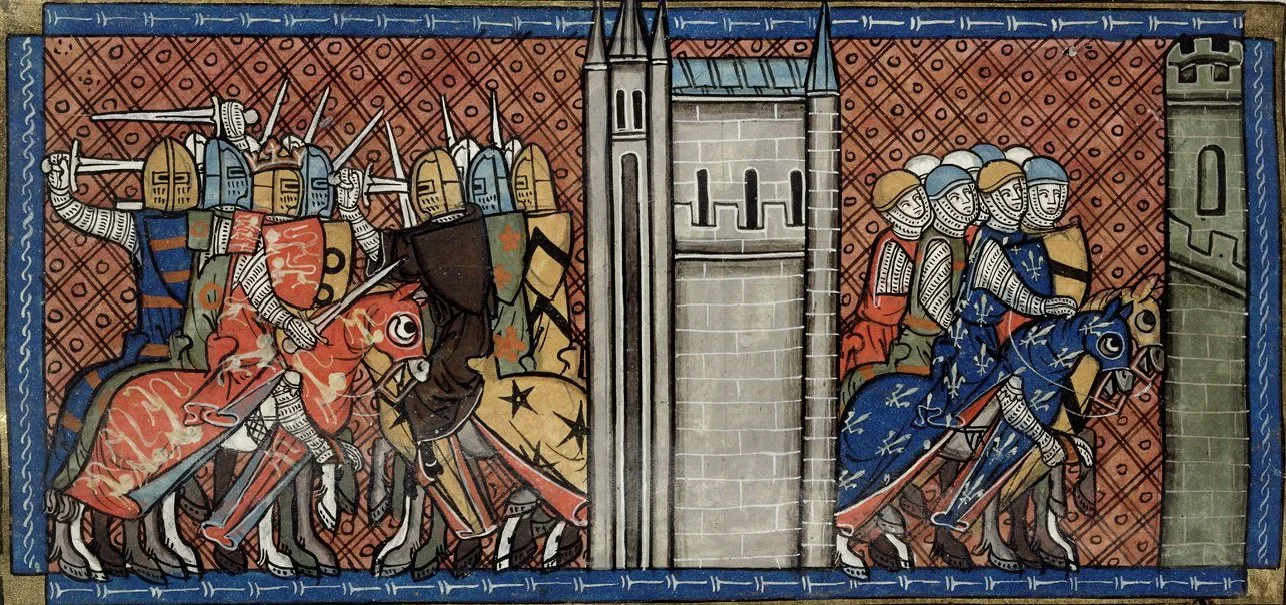
Lady of England, a Novel of Magna Carta and the Woman who Refused to Surrender, is out soon. Click the image for more information. (Image depicts fighting between King John’s forces and Prince Louis’s invading army.
discover lady of the castle
Click the image to find out more about Lady of the Castle that features the real Sheriff of Nottingham, William de Wenneval, who was caught up in the conflict that tore England apart as Prince John took power when King Richard the Lionheart had been captured on his return from crusade.