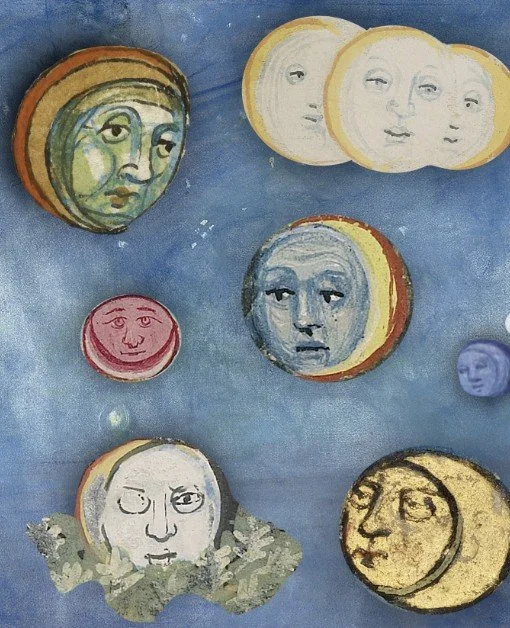
Medieval Manuscript Moons
Friday 13 November 2026. Unlucky for some?
If you think black cats, broken mirrors and walking under ladders are bad luck, spare a thought for anyone living in medieval England. In the 12th and 13th centuries, there were far more things to worry about, from a neighbour's envious glance to an unexpected sneeze.
For people living in Nicola de la Haye's time, the supernatural was part of everyday life. An eclipse might foretell war, a dream could carry a message from God, and even a woman's monthly period was thought capable of causing disaster.
And then there were the Knights Templar. But more about them in a moment.
Friday the 13th and the Knights Templar
One of the most popular explanations for Friday the 13th being unlucky involves the Knights Templar, the wealthy and powerful religious military order founded during the Crusades.
On Friday 13 October 1307, King Philip IV of France ordered the arrest of the Templars throughout his kingdom. Hundreds were imprisoned and subsequently subjected to accusations of heresy, torture and execution.
It certainly wasn't a lucky Friday for them.
However, there's no convincing evidence that these arrests gave rise to the superstition. The association seems to have developed many centuries later.
The Templars were very much part of Nicola's world, though. In Lady of the Castle, knights from the Lincolnshire preceptory of Temple Bruer help with the aftermath of the devastating Lincoln earthquake. They also appear in my forthcoming novel, Lady of England, including at Temple Ewell, where King John meets the Pope's legate during his struggle with the Church.
But what did people in Nicola's time actually consider unlucky?
The Evil Eye Could Ruin Your Life
Imagine believing that someone could make you ill simply by looking at you.
The evil eye was an ancient superstition that survived throughout the Middle Ages. An envious or malicious glance was thought capable of causing illness, misfortune, and even death.
Children were particularly vulnerable, as were successful people whose prosperity might attract jealousy. Livestock, crops and livelihoods could all suffer from someone's ill will.
People sought protection through prayers, charms and amulets. It wasn't necessarily enough to avoid your enemies. You also had to worry about your friends and neighbours envying what you possessed.
Interestingly, this belief was shared by Christians and Jews.
In Lady of the Castle, Nicola's Jewish childhood friend Bella frequently makes a protective gesture against the evil eye, known in Hebrew as ayin hara. It was a common concern in Jewish folk belief, particularly when protecting children and family members.
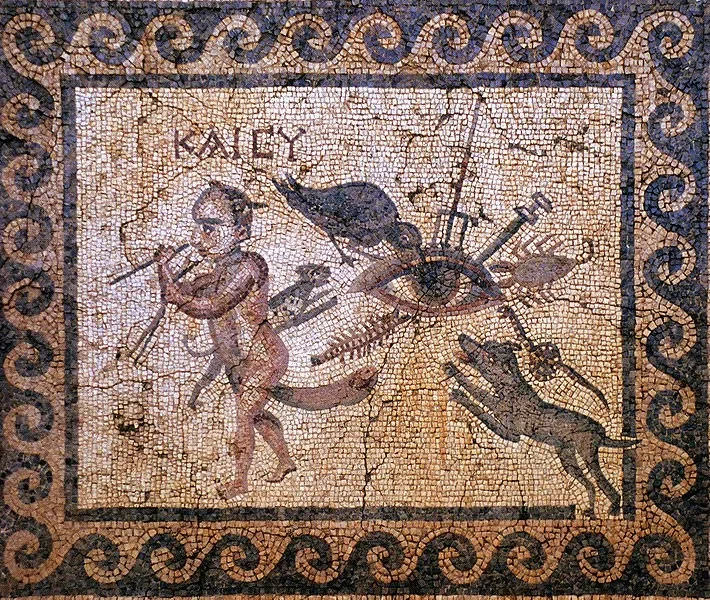
An ancient depiction of the evil eye
Jewish Superstitions and Protective Charms
Bella and the other Jewish characters in Lady of the Castle inhabit the same medieval world as their Christian neighbours, but their beliefs about omens, dreams and supernatural dangers draw upon a different religious tradition.
Jewish communities had their own protective prayers and customs. Some used amulets inscribed with Hebrew prayers, biblical verses or sacred names to ward off illness and misfortune. These practices were not universally approved by rabbis, but they were certainly part of medieval Jewish life.
Dreams could also have significance. The Talmud contains discussions of prophetic dreams and their interpretation, although it warns against placing too much trust in them.
Perhaps most interestingly, Jewish tradition also attached meaning to eclipses.
The Talmud describes a lunar eclipse as a troubling omen for the Jewish people, whose religious calendar follows the moon, while a solar eclipse could be interpreted as an omen for other nations.
Not all Jewish scholars agreed that celestial events should inspire fear. Nevertheless, Bella and Berechiah would have known these traditions.
And this brings us to one of the most extraordinary episodes in Nicola's life.
Earthquakes, Blood Moons and Eclipses: When God Sent Warnings
In April 1185, a powerful earthquake struck the East Midlands, causing extensive damage to Lincoln and its cathedral.
Today, we understand earthquakes as movements of the Earth's crust. But imagine living in a world where such an event was almost certainly interpreted as a warning of divine displeasure.
And Lincoln's misfortunes didn't end there.
A blood moon and a solar eclipse followed the earthquake. To people already frightened by the destruction around them, these strange events in the heavens would have seemed deeply ominous.
All three events feature in the opening chapters of Lady of the Castle.
As Nicola struggles with the terrible consequences of the earthquake, the moon turns blood-red above the ruined cathedral. People fall to their knees in prayer, convinced that God is punishing Lincoln for its sins.
Then, at a funeral, the sun itself begins to disappear. Darkness falls in the middle of the day. Terrified mourners believe the end of the world may be approaching.
For Nicola, already overwhelmed by grief, these portents are particularly frightening. Has God singled her out for punishment? And what more does He intend to take from her?
The earthquake and the celestial events were real. Their significance, of course, depended upon who was watching.
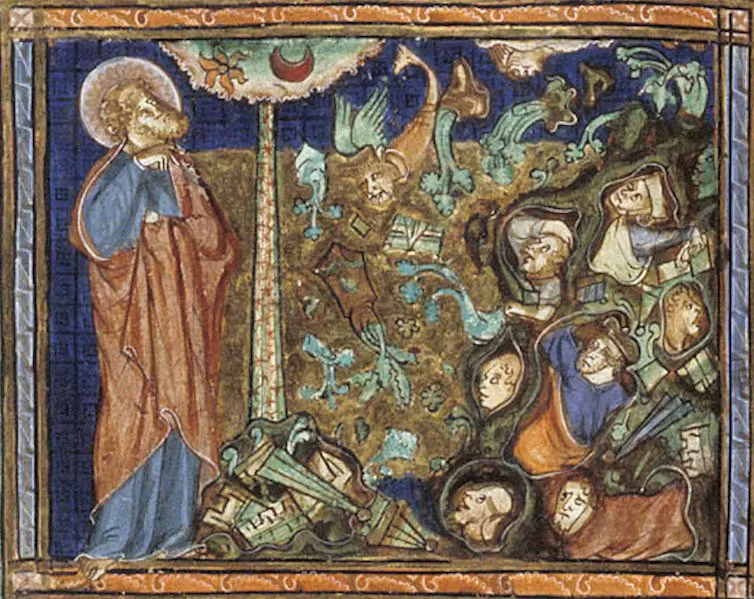
A medieval depiction of an earthquake
Iron Was Your Friend
Medieval people also believed certain objects offered protection against supernatural dangers.
Iron had a particular reputation for warding off harmful spirits and otherworldly beings. In European folk traditions, iron objects and nails could be used to protect homes and their occupants.
Horseshoes eventually became familiar good-luck charms, although we cannot be certain how widespread that particular custom was in Nicola's lifetime.
It is rather amusing to imagine a medieval knight, covered from head to foot in iron, as the best-protected person in the kingdom.
Unfortunately, it didn't stop him being killed by an enemy's sword.
Never Trust the Moon
Long before anyone understood the causes of mental illness, the moon was believed to influence human behaviour.
The word lunatic comes from the Latin luna, meaning moon, and medieval medical thinking frequently linked the moon's phases with disturbances of the mind, seizures and other illnesses.
The moon was known to influence the tides, and physicians believed that heavenly bodies could also affect the fluids within the human body.
Astrology was not simply the pastime of fortune-tellers. It formed part of learned medieval medicine, and the positions of the sun, moon and planets could influence decisions about treatment.
For someone suffering from an unexplained illness, the night sky might offer both an explanation and another reason to worry.
Spilling Salt Was Bad News
Salt wasn't simply something you sprinkled over your dinner. It was essential for preserving meat and fish, particularly through the winter, and had religious and symbolic importance.
Spilling it was considered a bad omen, associated with quarrels and misfortune.
The familiar practice of throwing a pinch of spilled salt over your left shoulder was intended to ward off evil. According to one explanation, the devil lurked behind your left shoulder, and throwing salt into his eyes would prevent him from taking advantage of your carelessness.
The exact origins of that custom are difficult to establish, although belief in the ill fortune associated with spilled salt has ancient roots.
So, next time you knock over the salt cellar, remember that a medieval householder might have regarded it as considerably more serious than having to clean the table.
Women's Bodies Were Dangerous
This is one of my favourites, although it's also rather depressing.
Medieval medical writers inherited some extraordinary ideas about menstruation from classical authorities.
According to beliefs recorded by the Roman writer Pliny the Elder, menstruating women could sour wine, destroy crops, kill bees, tarnish mirrors and even make metal rust.
These claims continued to influence medical and natural-history writing during the Middle Ages.
Apparently, a woman didn't need a sword or a siege engine to be dangerous. She merely needed to have her monthly period.
For a society that considered women physically weaker than men, it was remarkably willing to attribute terrifying powers to their bodies.
Dreams Could Predict the Future
Dreams were taken very seriously.
A particularly vivid or disturbing dream might be interpreted as a warning from God, a saint or even the devil. Dreams could foretell death, illness, betrayal or some other approaching disaster.
Medieval people inherited elaborate systems of dream interpretation from classical and biblical traditions. Religious authorities debated which dreams were divine messages and which were the products of ordinary bodily disturbances or malicious spirits.
And there were plenty of biblical precedents. Joseph interpreted Pharaoh's dreams, while the Magi were warned in a dream not to return to Herod.
The difficulty, of course, was knowing which dreams to believe.
An unfortunate nightmare about your husband might leave you rather suspicious of him the following morning.
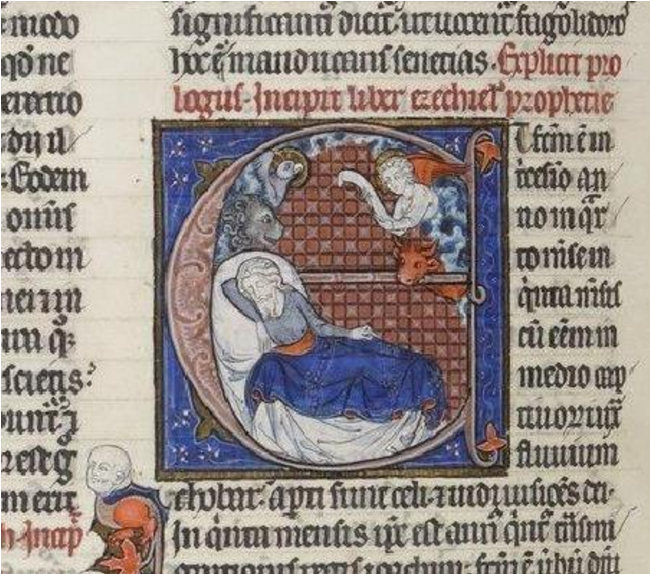
Dreams were believed to be a warning
Curses Could Destroy You
A curse was no laughing matter in medieval England.
The Church possessed a particularly formidable weapon: excommunication.
To be excluded from the sacraments and the community of the faithful was a terrifying prospect for anyone who believed that salvation depended upon remaining in God's favour.
Kings themselves weren't immune. Henry II suffered the consequences of his quarrel with Thomas Becket, while King John was excommunicated during his dispute with Pope Innocent III.
Ordinary people also feared malicious curses, particularly those uttered by someone believed to have suffered a serious injustice.
A wronged widow's denunciation might not have the legal authority of a bishop's excommunication, but it could still inspire considerable anxiety.
After all, if God heard the prayers of the innocent, who could be certain He wouldn't avenge their suffering?
Even Sneezing Was Suspicious
Nowadays, saying 'God bless you' when someone sneezes is little more than good manners.
In earlier centuries, however, sneezing could carry religious and supernatural significance.
One traditional explanation was that a sneeze might allow the soul to escape the body or leave a person vulnerable to evil spirits. The precise origins of these beliefs are uncertain, but the custom of blessing someone who sneezed is very old.
Disease was another concern. In a world where an apparently healthy person could fall ill and die within days, invoking God's protection was a natural response.
A sneeze might be nothing. Or it might be the beginning of something dreadful.
Better say a prayer, just in case.
The Greatest Superstition of All?
Of all the extraordinary beliefs I've encountered while researching medieval England, one has always struck me as particularly damaging.
The assumption that women were incapable of exercising authority over men.
This wasn't a supernatural superstition, of course, but it was a deeply entrenched prejudice.
A woman might inherit land, administer an estate or act on behalf of her husband. But commanding soldiers, defying powerful noblemen and holding a strategically important royal fortress were another matter.
And that's precisely what Nicola de la Haye did.
During the Great Rebellion of 1173–74, when Henry II's own sons rose against him, Nicola helped secure Lincoln Castle for the king.
She went on to defend her position against some of the most powerful men in England, including those who sought to strip her of her castle and authority.
In October 1216, she became England's first female sheriff appointed in her own right.
Then came her greatest challenge. In 1217, with England in the grip of civil war and a French prince threatening to seize the throne, Nicola refused to surrender Lincoln Castle to the rebel forces besieging it.
Her resistance gave William Marshal's army the opportunity to relieve the castle and defeat the rebels at the Battle of Lincoln. That victory helped turn the war in favour of the nine-year-old Henry III.
Nicola didn't merely prove that a woman could command a castle. She helped save England from conquest.
She didn't lead a charmed life. She suffered terrible losses, endured betrayal, and was repeatedly forced to fight for what was rightfully hers. But she never accepted that being a woman made her incapable of wielding power.
And perhaps that's what I admire most about her.
Discover the Woman Who Defied Medieval England
If Friday the 13th has put you in the mood for a little medieval superstition, why not step into Nicola's world?
My multi-award-winning historical novels bring her remarkable true story to life, with all the love, grief, betrayal, political intrigue and danger that accompanied it.
Begin with LADY OF LINCOLN, the story of a young heiress caught between love and duty as rebellion threatens everything she holds dear.
Then continue with LADY OF THE CASTLE, where an earthquake, a troubled marriage, religious persecution and the dangerous reign of Richard the Lionheart threaten Nicola and those she loves.
Both novels are inspired by real events and the extraordinary life of a woman history nearly forgot.