The Holy Innocents Leper Hospital, Lincoln: The Malandry's Forgotten History
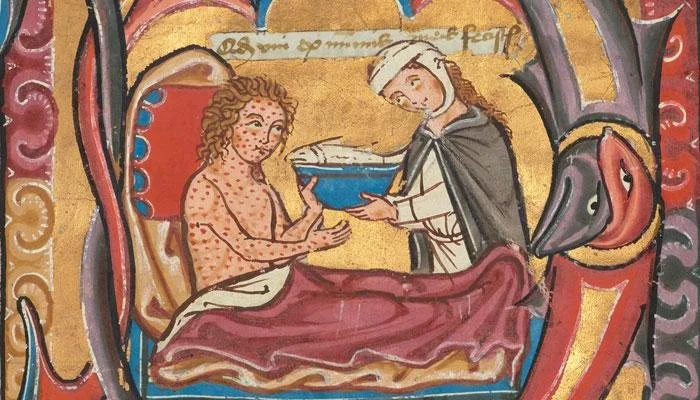
A medieval nun tending a leper
The Holy Innocents Leper Hospital in Lincoln, known as the Malandry, was founded in the early twelfth century to care for people with leprosy. Situated outside the medieval city, it survived for centuries before disappearing from view. Now archaeological discoveries are revealing its history, and challenging what we think we know about medieval lepers.
In the autumn of 1194, a man knelt before Bishop Hugh of Lincoln, waiting for his feet to be washed. His nose had collapsed, his eyes watered and the skin of his feet was cracked and raw. His disease had robbed him of his livelihood and separated him from the family and friends among whom he had once lived.
The bishop's young companion hesitated. Then he recognised the man. It was Waldin, a corn merchant from Lincoln, whose son had been his childhood friend.
This encounter takes place in my historical novel, Lady of the Castle. Waldin is fictional, as is the scene. But the hospital where it happens was real, and the bishop's extraordinary treatment of people suffering from leprosy is recorded by a man who knew him.
The hospital was called the Malandry, or more formally the Hospital of the Holy Innocents. It stood outside Lincoln's southern gates, where the medieval city gave way to fields and the road south.
For centuries, people came here because they were suffering from one of the most feared diseases of the Middle Ages. Some found refuge. Others were less fortunate. And the institution established to care for them would eventually become the subject of a remarkable royal investigation.
Now, more than 800 years after Bishop Hugh's lifetime, archaeologists are uncovering its remains beneath Lincoln's South Common.
What was the Holy Innocents Leper Hospital in Lincoln?
The Holy Innocents Leper Hospital, commonly called the Malandry, was a medieval religious hospital founded outside Lincoln in the late eleventh or early twelfth century. It provided accommodation and care for people suffering from leprosy, under the supervision of a warden and two chaplains.
It may have been the earliest leper hospital in Lincolnshire. Its precise foundation date remains uncertain. One tradition attributes it to Remigius, Lincoln's first Norman bishop, who died in 1092. Another names King Henry I, who ruled England from 1100 to 1135. The stronger documentary evidence favours Henry. During the reign of Edward III, an inquiry examined charters relating to the hospital and identified Henry I as its founder. Ranulf, Earl of Chester, was another benefactor, while Henry II subsequently confirmed the gifts made to the institution.
The royal connection was prestigious, but it came with strings attached. According to the foundation's terms, the hospital could accommodate ten people with leprosy, men or women. Potential residents might be recommended by the mayor and leading citizens of Lincoln, but admission required the consent of the king and his chancellor.
Even a charitable institution, it seems, could not entirely escape medieval bureaucracy.
The hospital's more familiar name, Malandry, derives from the French maladrerie, a place for the sick, particularly those suffering from leprosy. The name appears in medieval records as La Maladerie. The surviving evidence suggests that the hospital developed into a substantial complex. Later descriptions refer to accommodation for twenty patients, ten men and ten women, with individual dwellings, hearths and small enclosed plots.
It was a religious community, a place of care and an institution with its own property and income. And it stood in a carefully chosen position. (Heritage Explorer)
Where was Lincoln's Malandry, and why was it outside the city?
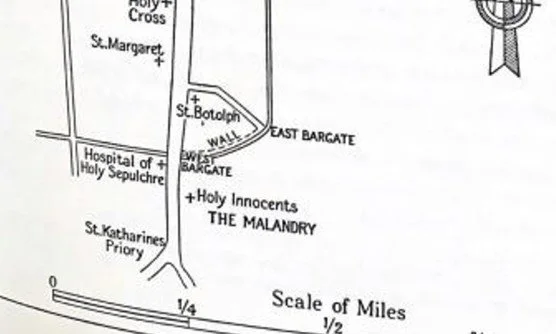
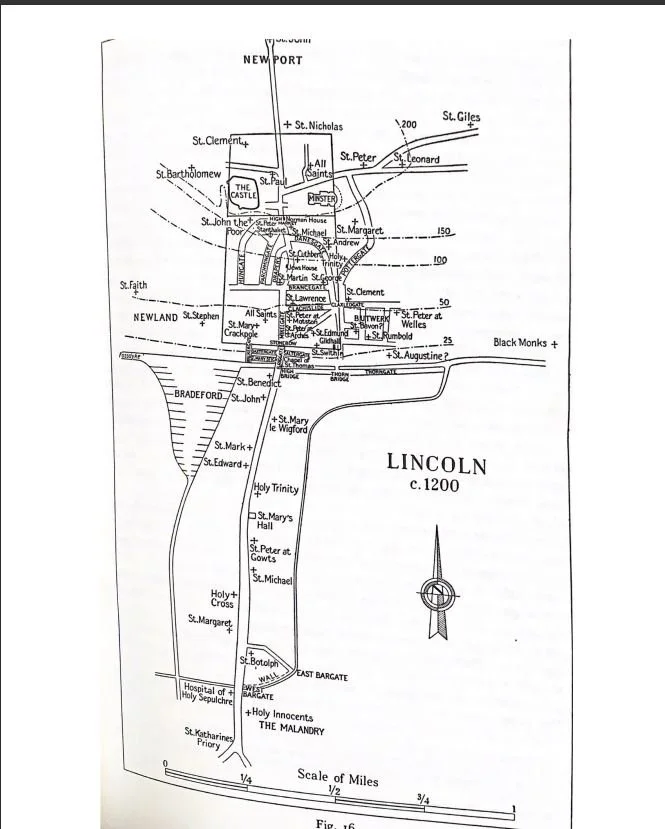
The location of the Holy Innocents Hospital, known as the Malandry, beyond Lincoln's southern gates. Taken from Hill’s ‘Medieval Lincoln’.
The Malandry stood south of Lincoln's Bargates, beyond the suburb of Wigford, on land associated with what is now South Common. Its precise boundaries remain uncertain, but archaeological and documentary evidence places it near the southern approach to the medieval city.
To understand its location, we need to imagine Lincoln before the railway, the modern roads and the buildings that now occupy parts of the site. The cathedral dominated the hill to the north, its towers rising above the crowded streets within the city walls. Below, Wigford stretched southwards along the Roman road, with houses, workshops, churches and merchants' premises lining the route. Beyond the southern gates lay the Malandry.
Its position was entirely practical. Leper hospitals were frequently established beside important roads, often outside town walls. This gave their inhabitants access to travellers who might offer alms, while the institution remained close enough to the town to maintain economic and social connections. A hospital hidden away in the countryside would have struggled to attract donations.
The patients were therefore separated geographically from much of the urban population, but they were hardly invisible. They could beg, receive visitors and, subject to the rules of their institution, travel beyond its grounds.
The Lincolnshire Historic Environment Record describes a church, several houses and accommodation that may have included individual gardens. It also records medieval pottery, a possible graveyard boundary and human remains discovered during railway construction. The institution had its own burial ground, although the precise layout is still being investigated (Historic England). These details are important because they allow us to picture something more substantial than a collection of miserable huts outside the walls.
People lived here. They prayed, ate, worked and died here. Some may have cultivated vegetables or medicinal herbs in their small plots. Others would have been too ill to do much at all.
In the late twelfth century, when the events of Lady of the Castle take place, the Malandry was an established part of Lincoln's landscape. Its existence raises a question that is central to understanding medieval attitudes towards illness.
How were people with leprosy treated in medieval England?
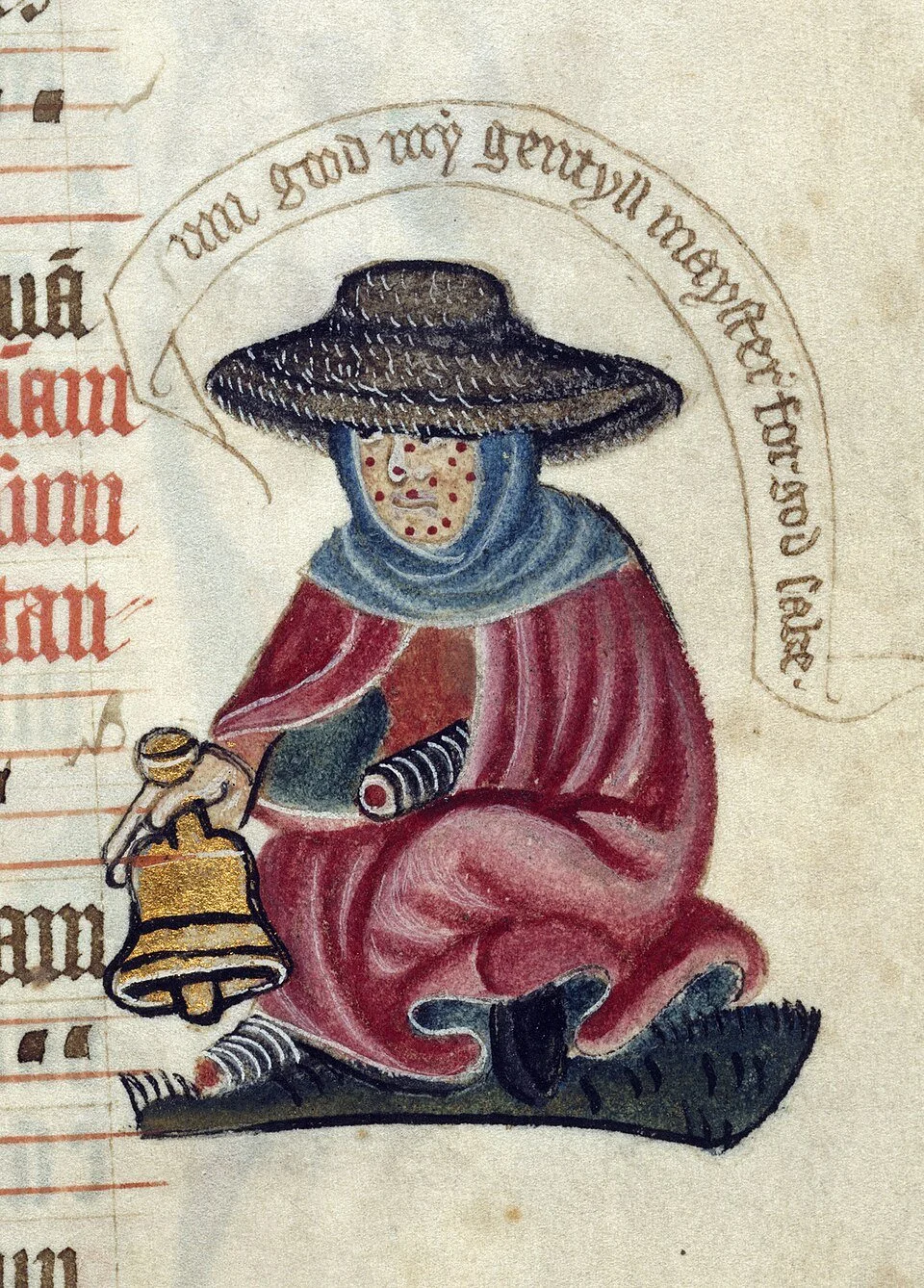
A person with leprosy holding a bell, depicted in an English manuscript dating from around 1400. British Library, Lansdowne MS 451, fol. 127
Leprosy was one of the most feared diseases of the Middle Ages, but the treatment of people suffering from it was considerably more complicated than popular accounts suggest. Some were shunned. Others received charity, medical treatment and religious care. Leper hospitals could provide a refuge that people actively sought.
What was leprosy?
Leprosy, now called Hansen's disease, is a chronic infection caused principally by the bacterium Mycobacterium leprae. It damages the skin and peripheral nerves, often developing slowly over many years. Because affected areas lose sensation, patients may suffer burns, cuts and other injuries without feeling them. Repeated injury and secondary infection can cause severe damage to hands and feet. In advanced cases, the disease can produce facial disfigurement, blindness and damage to the nose.
There was no effective cure in medieval England. Today, leprosy can be treated and cured with multidrug therapy. It is also much less easily transmitted than its historical reputation suggests. For a medieval patient, however, the disease could mean years of physical suffering, accompanied by the loss of work, income and personal independence.
Medieval medicine was not entirely helpless. Physicians recognised different manifestations of the disease and attempted treatment through diet, bathing, ointments and other measures. They could alleviate some symptoms, but they could not eliminate the infection.
Were lepers regarded as sinners?
Medieval Christianity offered conflicting interpretations of leprosy. The Old Testament associated certain skin diseases with ritual impurity. Leviticus instructed afflicted people to live apart and announce their condition to others. For some medieval Christians, visible disease could suggest divine punishment.
Yet the same religious culture encouraged a very different response. The suffering of lepers could be compared with Christ's suffering on the cross. Some theologians regarded their illness as a kind of earthly purgatory, through which their souls might be cleansed before death. Caring for them was therefore an act of Christian charity. It could also benefit the soul of the benefactor. This might sound rather self-interested to modern ears. Medieval Christians, however, were deeply concerned with salvation, and prayers offered by the sick could be considered particularly valuable.
The two attitudes existed alongside one another. A person might recoil from a leper's physical appearance while believing that helping him could bring spiritual reward.
Leprosy inspired fear, but it also inspired organised charity on a considerable scale.
By 1350, at least 320 religious houses and hospitals for people with leprosy had been established in England. Their residents could receive food, clothing, accommodation and spiritual care. Many maintained contact with friends and family, and some were able to travel outside their institutions (Historic England).
The Malandry was part of this wider development.
Were medieval lepers really declared dead?
One of the most familiar stories about medieval leprosy concerns a ceremony sometimes described as the leper's funeral. According to this tradition, a person diagnosed with leprosy underwent a religious ritual resembling a funeral. He might be covered with a black cloth, or stand in a grave while earth was scattered over him, before being declared dead to ordinary society.
It is a deeply disturbing image. It is also one we should treat with considerable caution. The historian Carole Rawcliffe, in her important study Leprosy in Medieval England, challenges the assumption that this ceremony was routinely practised in medieval Britain. Rituals of separation are known from continental European sources, particularly later medieval French liturgies. But Rawcliffe found no firm evidence that the supposed leper's funeral was performed in medieval England. She also demonstrated how nineteenth-century writers helped establish the popular image of medieval lepers as people forcibly expelled from their communities, stripped of their identities and condemned to live as social outcasts.
The historical record tells a more varied story. Some lepers continued to live among their families. Others entered hospitals voluntarily, sometimes paying substantial sums to secure accommodation and care. Admission to a hospital might involve accepting religious discipline and restrictions on movement, but that was not the same as being imprisoned. For a person facing poverty and illness, a place in a well-funded hospital could be highly desirable (IUScholarWorks).
The leper's funeral in Lady of the Castle
In Lady of the Castle, I explore the fear surrounding leprosy through Waldin, a widowed corn merchant whose son, Nick, is a friend of Nicola de la Haye's family.
In April 1186, Nicola's daughter Tilly watches a religious procession making its way through Lincoln. The man at its centre is Waldin, dressed in sackcloth and being led away to begin his life at the Malandry. The scene draws upon the medieval tradition of ritual separation, although, as Rawcliffe's research makes clear, we cannot establish that such a ceremony was practised in Lincoln.
I wanted to capture what a diagnosis of leprosy might mean to a family: the fear of losing someone who was still alive, the uncertainty surrounding his future, and the distress of being separated from him. For Nick, the immediate problem is practical. His father can no longer support himself, and the family must find a way to secure him a place at the hospital.
The hospital's original regulations required official approval for admission. Later records also reveal residents paying for places, sometimes contrary to its charitable foundation. We cannot prove that families were paying for admission in precisely the way I describe in 1186, but the underlying problem was real.
What happened to someone who was too sick to work, but too poor to secure care?
The answer depended heavily on the resources available to them. And even admission to a hospital offered no guarantee that they would receive the treatment its founders intended.
Why did St Hugh of Lincoln kiss people with leprosy?
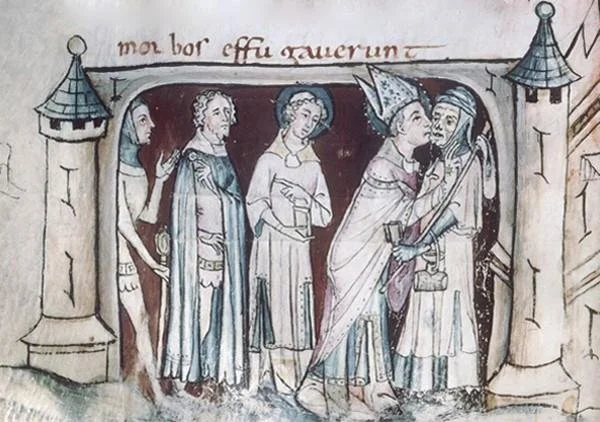
Saint Martin of Tours kissing a leper
Hugh of Avalon became Bishop of Lincoln in 1186. A Carthusian monk from Burgundy, he was already known for his religious discipline and determination to uphold what he believed was right. His treatment of people suffering from leprosy became one of the most distinctive features of his reputation.
Hugh's biographer, Adam of Eynsham, describes his willingness to approach people whom others avoided, washing their feet and kissing them despite their disfigurement. One particularly revealing anecdote concerns a comparison with St Martin of Tours. Martin, according to the story, had kissed a leper and miraculously cured him. When someone pointed out this precedent to Hugh, the bishop reportedly replied that Martin's kiss had cured the leper's body, whereas the leper's kiss had cured his own soul.
The exchange neatly expresses Hugh's understanding of Christian charity. He was not seeking to demonstrate that he possessed miraculous powers. He believed that contact with those who suffered could benefit him spiritually.
Adam was writing a saint's life, and we must remember his purpose. He wanted readers to recognise Hugh's holiness, and his account was necessarily selective. That does not make his descriptions worthless. Adam knew Hugh personally and provides important evidence of his behaviour. The bishop's care for lepers is consistent with the religious ideals he practised elsewhere. But we should be careful about one detail: although Hugh's ministry to lepers is documented, I have not found a contemporary record specifically describing him visiting Lincoln's Malandry.
In Lady of the Castle, I bring him there.
Bishop Hugh, Turstin, and Waldin
In March 1194, my fictional character Turstin accompanies Hugh to the Malandry. Turstin, Nicola de la Haye's foster son, is struggling with guilt and uncertainty about his vocation. He has been deeply affected by the massacre of York's Jewish community in 1190, and Hugh encourages him to discover what Christian service should demand of him.
At the Malandry, the bishop kneels beside a basin and instructs Turstin to wash the patients' feet. Turstin recoils from the sight and smell of the disease, before recognising Waldin, the father of his childhood friend. Waldin tries to spare him the task, but Turstin kneels and begins washing his damaged feet.
For me, the important moment is neither the bishop's instruction nor the severity of Waldin's symptoms. It is Turstin's recognition that the disfigured man before him is someone he knows, someone who was once part of his ordinary life. The man has changed, but his humanity has not.
Turstin's experience at the Malandry also changes his understanding of religious duty. Until then, he has associated service to God largely with scholarship, prayer and obedience. Here, he encounters something more demanding.
The scene draws upon Hugh's documented behaviour, although Turstin and Waldin are fictional, and the encounter itself is invented. It allows me to explore how the bishop's example might have affected those around him.
Hugh was canonised in 1220, twenty years after his death. His treatment of lepers was one reason his contemporaries considered him a holy man.
But the institution in which I have placed this fictional encounter had a less happy future.
What went wrong at Lincoln's Malandry?
By the late thirteenth century, the Malandry was experiencing serious administrative problems. The institution had been founded to care for people with leprosy, but its royal patronage created opportunities for appointments that had little to do with the welfare of its patients. The king could appoint a warden, often from among royal clerks. Some wardens did not reside at the hospital and entrusted its management to deputies.
The arrangement was convenient for those receiving the appointment. It proved less convenient for the people who depended upon the institution. In 1274, the warden, John of Colchester, was ordered to replace his deputy, Walter Otre, whose administration had allowed the hospital's resources to be wasted. The situation was sufficiently serious that the residents were reportedly in danger of having to beg elsewhere for their maintenance.
The Crown intervened again in 1284, placing the hospital under the sheriff's custody and ordering arrangements for the accommodation of its chaplains, brothers and sisters.
Yet the complaints continued.
Licences allowing the residents to beg for alms were issued in 1294 and 1297. In 1301, the hospital was still reported to be badly governed. Its financial problems were persistent, and the system of royal supervision did not appear particularly effective at solving them. Then, in 1335, an investigation exposed the extent to which the institution had departed from its original purpose.
There were nine brothers and sisters living at the Malandry. Only one had leprosy. He had paid 100 shillings for his admission, contrary to the foundation's terms. Seven female residents had also paid for their places rather than being admitted through charity.
The hospital intended to accommodate people suffering from leprosy had become a place where money could secure admission. A charity for the sick was providing accommodation to people who could afford to pay, while its original beneficiaries were increasingly absent.
The Victoria County History records repeated complaints about poor administration and the diversion of resources throughout the following century. The problem cannot necessarily be explained entirely by corruption. Leprosy was declining in England, and hospitals established specifically for sufferers increasingly adapted to changing circumstances.
Some became almshouses or other charitable institutions. But in Lincoln's case, the records repeatedly show those responsible for the Malandry failing to administer it according to its foundation. The institution remained in existence but its original purpose was being lost.
What happened to the Malandry, and what has Time Team discovered?
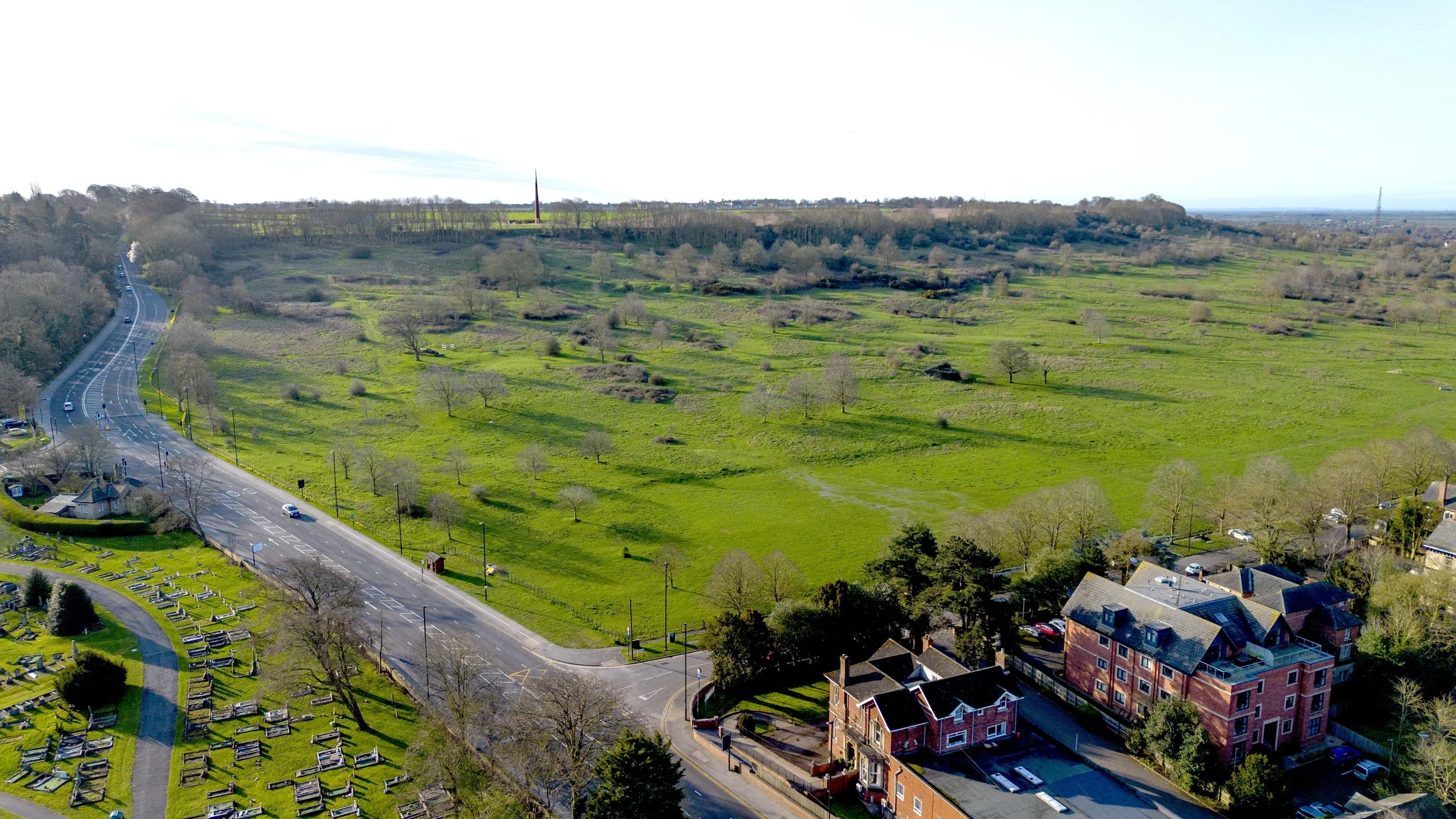
Archaeologists investigating the remains of Lincoln's medieval Holy Innocents Leper Hospital on South Common, October 2026
The Malandry survived into the later Middle Ages, although its history continued to be troubled by disputes over administration and money. In 1422, complaints were made about the loss of books, vestments and other property through the negligence of previous wardens. The hospital subsequently passed into the control of the Order of St Lazarus, which had long been associated with the care of people suffering from leprosy.
The records differ over the precise date of the transfer. The Lincolnshire Historic Environment Record gives 1456, while the Victoria County History records a royal grant in 1461. The relationship between those transactions needs further examination before we can explain the discrepancy with confidence. The 1461 grant required the hospital to maintain three of the king's servants or tenants should they develop leprosy. By 1534, its annual revenue was assessed at £30 13s 4d. Its existence as a religious institution ended following the dissolution of the Order of St Lazarus under Henry VIII. The buildings eventually disappeared, although their location remained visible on some later maps.
When the railway was constructed in the nineteenth century, workers encountered a stone coffin and human remains believed to have come from the hospital's burial ground. Then, in 1972, work near the former South Park School revealed an extraordinary find: a hoard of almost 750 silver coins dating from the reign of Henry I.
Whether the coins belonged to the hospital, or why they were concealed, remains unknown. The connection with the king who probably founded the institution is an intriguing coincidence, but no more can safely be claimed (Heritage Explorer).
Time Team returns to medieval Lincoln
In July 2025, a community archaeological investigation began exploring the remains of the Malandry beneath South Common. More than 100 volunteers took part, excavating 41 test pits and discovering evidence of medieval walls, building surfaces and artefacts.
The work attracted further funding. In September 2026, City of Lincoln Council announced a three-year project, Hidden Histories Unearthed, supported by £248,139 from the National Lottery Heritage Fund. The project brought Time Team to Lincoln for a three-day excavation between 2 and 4 October 2026. Working with local archaeologists and volunteers, the team investigated the site in greater detail.
Early reports describe the discovery of walls and square features which may represent parts of the hospital's accommodation. Professor Carenza Lewis suggested that some of these features could relate to the individual dwellings or yards associated with the residents. That possibility is particularly interesting because the documentary evidence refers to accommodation with individual hearths and enclosed plots.
Archaeology may therefore help establish how the people living at the Malandry organised their daily lives (City of Lincoln Council). The findings are preliminary, however. Further analysis will be needed before the excavated structures can be identified with certainty. What makes this excavation exciting is the prospect of recovering evidence about people who seldom appear as individuals in medieval records.
The surviving documents tell us about kings, bishops, wardens, donations and financial disputes. They tell us far less about the men and women who actually lived at the hospital. Archaeology may yet provide some of those missing details.
Timeline: Lincoln's Malandry
Before 1135: Hospital founded, probably during the reign of Henry I.
1186: Hugh of Avalon becomes Bishop of Lincoln.
1274: Serious mismanagement reported under Walter Otre.
1284: Hospital placed under the sheriff's supervision.
1335: Investigation reveals that only one of nine residents has leprosy.
1456–1461: Hospital passes into the control of the Order of St Lazarus.
Sixteenth century: Institution comes to an end following the dissolution of its religious order.
2025: Community excavation investigates South Common.
October 2026: Time Team joins renewed investigations of the hospital site.
Frequently asked questions
Where was the Holy Innocents Leper Hospital in Lincoln?
The hospital stood south of Lincoln's medieval city, beyond Bargates and the suburb of Wigford. Its site is associated with the north-western part of today's South Common, although the precise boundaries remain uncertain.
Who founded Lincoln's Malandry?
King Henry I is the most likely founder, based on charters examined during a fourteenth-century inquiry. An alternative tradition attributes the foundation to Bishop Remigius, who died in 1092.
What does Malandry mean?
Malandry derives from the French maladrerie, a term used for a hospital caring for people with leprosy. The medieval hospital appears in records as La Maladerie.
Were lepers forced to live in medieval hospitals?
Not necessarily. Medieval leper hospitals often provided sought-after accommodation and care, and some residents entered voluntarily. Historians have challenged the popular assumption that all medieval lepers were forcibly expelled from society.
Did St Hugh of Lincoln visit the Malandry?
Hugh's biographer records his care for people suffering from leprosy, including washing and kissing them. However, no contemporary account has yet been identified that specifically places him at Lincoln's Malandry.
What did Time Team discover at Lincoln's leper hospital?
In October 2026, archaeologists excavated parts of the site and identified walls and square features that may relate to the hospital's accommodation. The work forms part of a larger project investigating the medieval institution and the people who lived there.
The people behind the records
One of the difficulties in researching medieval history is that the records tell us most about the people who controlled institutions, rather than those who depended upon them. We know the names of many of the Malandry's wardens. We know how royal officials intervened when its finances were mismanaged. We know that one resident paid 100 shillings for admission in the fourteenth century. We know almost nothing about the lives of the hospital's patients.
When I wrote Waldin's story in Lady of the Castle, I wanted to explore what might happen to an ordinary man who developed leprosy, and what his illness would mean for the son who loved him. The disease threatened Waldin's livelihood, his independence and his place in the family. But it did not end his relationship with Nick, or erase the man he had been. That is also what interests me about Hugh of Lincoln's care for lepers. His biographer presents the bishop's actions as evidence of holiness, but they also remind us that behind the symptoms was a person who needed kindness and physical care.
The archaeological investigations now under way may tell us more about the people who lived at Lincoln's Malandry. For the moment, much of their history remains buried beneath South Common. Somewhere beneath the grass are the remains of a hospital chapel, buildings and burial ground, where generations of Lincoln's sick once lived, prayed and died. And perhaps, among the foundations being uncovered, archaeologists will find the small domestic spaces where those patients passed their days.
Discover the medieval Lincoln of Lady of the Castle
The Malandry is one of several real medieval locations featured in my historical novel Lady of the Castle, the second book in the Nicola de la Haye series. Set during the turbulent final years of Henry II's reign and the struggle for power between Richard the Lionheart, Prince John and their supporters, the novel follows Nicola as she fights to protect her family, her marriage and Lincoln Castle.
Through characters such as Waldin, Nick and Turstin, it also explores the lives of people whose experiences rarely find their way into the chronicles.

Discover the series and step into the streets, churches and households of twelfth-century Lincoln.
Rachel Elwiss Joyce writes award-winning historical fiction inspired by Nicola de la Haye, the medieval noblewoman who defended Lincoln Castle. Her novels draw upon extensive research into the politics, beliefs and everyday lives of twelfth- and thirteenth-century England.
Sources and further reading
Primary and historical sources
1. Victoria County History, A History of the County of Lincoln, Volume 2 (1906), pp. 230–232.
The principal historical summary of the Malandry's foundation, administration and subsequent decline. It draws on royal records, charters and ecclesiastical material.
Read the Victoria County History account
2. Adam of Eynsham, Magna Vita Sancti Hugonis (Life of St Hugh of Lincoln).
A near-contemporary account of Hugh's life, including his treatment of lepers. A hagiographical source, requiring appropriate caution.
3. Medieval royal records cited by the Victoria County History.
Including Close Rolls and Patent Rolls concerning the hospital's administration during the thirteenth and fourteenth centuries.
Modern research
4. Carole Rawcliffe, Leprosy in Medieval England (Boydell Press, 2006).
Essential reading on medieval attitudes towards leprosy, the operation of leper hospitals and misconceptions about compulsory exclusion.
5. Historic England, The Time of Leprosy: 11th Century to 14th Century.
Read Historic England's overview
6. Lincolnshire Historic Environment Record, MLI70159, Site of the Holy Innocents Leper Hospital.
View the archaeological record
7. City of Lincoln Council, Time Team Comes to Lincoln to Uncover More of South Common's History, 30 September 2026.
Read the council's announcement
8. Time Team excavation reporting, October 2026.