The Battle of Fornham 17 October 1217
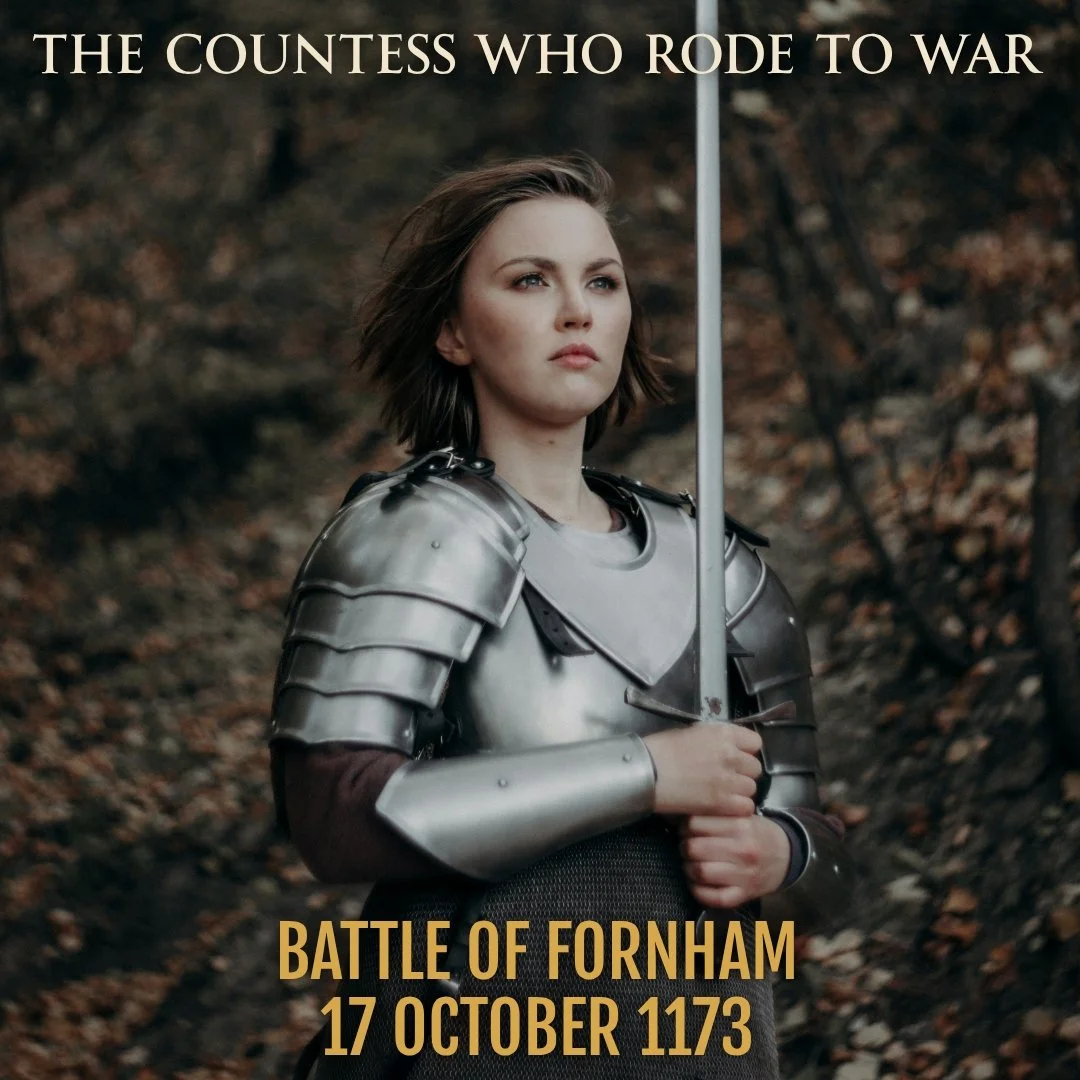
Countess Petronilla de Grandmesnil was at the Battle of Fornham, Suffolk in October 1173 (she would have been in chain mail hauberk not plate armour).
When a Countess Rode to War
On 17 October 1173, an army marched north out of Bury St Edmunds into the valley of the River Lark.
Its commander was Robert de Beaumont, Earl of Leicester, one of the most powerful noblemen in England. Much of his army consisted of Flemish mercenaries. Leicester was fighting not for Henry II, but against him, in the great rebellion that had set the king's own sons against their father.
And riding with Leicester was his wife.
Petronilla de Grandmesnil was no spectator. The contemporary chronicler Jordan Fantosme describes her wearing a hauberk and carrying a shield and lance. When battle came, she was among the rebel force.
By the end of the day, Leicester's army had been destroyed, thousands of men were dead or captured, and Petronilla herself had been pulled from a ditch.
The Battle of Fornham is one of the less well-known battles of Henry II's reign, yet it was a decisive moment in the rebellion of 1173–74. It also gave medieval chroniclers something they could scarcely resist recording: a great countess who had ridden to war.
It is a battle that appears in Lady of Lincoln, where I place Fitz — Sir William FitzErneis — among the supporters of the Young King, while Gerard de Camville fights for Henry II. The men Nicola loves find themselves on opposite sides of a civil war.
But the real story of Fornham is dramatic enough without fiction.
A King at War With His Own Family
The rebellion of 1173–74 tore Henry II's vast dominions apart.
Henry ruled England and extensive territories in France, but his eldest surviving son, Henry the Young King, had a title without much independent power. He had been crowned during his father's lifetime in 1170, yet Henry II retained effective control of the lands and revenues his son expected to rule.
In 1173, the Young King rebelled.
His brothers Richard and Geoffrey joined him. Their mother, Eleanor of Aquitaine, supported her sons and was later captured while attempting to reach them. Powerful barons in England and Normandy took sides, while King Louis VII of France and other enemies of Henry II saw an opportunity to weaken the Angevin ruler.
England itself became one front in a much wider conflict.
Among the rebels was Robert de Beaumont, Earl of Leicester. In September 1173, while Henry II was occupied across the Channel, Leicester sailed from Flanders with a large force, much of it made up of Flemish mercenaries.
His aim was to strengthen the rebellion in England by joining Hugh Bigod, Earl of Norfolk, another great magnate who had turned against the king. Leicester reached Bigod's stronghold at Framlingham before deciding to march westwards towards his own lands.
It was a dangerous moment for Henry.
The king himself was in France.
But England was not undefended.
Henry II's Government Fights Back
The royal response was led by Richard de Lucy, Henry II's justiciar, and Humphrey de Bohun, the king's constable.
They had been dealing with another threat in the north, where William the Lion of Scotland had joined the rebellion. After arranging a truce, they hurried south.
Other magnates joined them, including Reginald, Earl of Cornwall, William FitzRobert, Earl of Gloucester, and William d'Aubigny, Earl of Arundel. The Abbey of St Edmund also supplied knights, and the royal army carried the banner of St Edmund into battle.
That connection with the abbey is particularly striking when you visit Fornham today.
I visited the battlefield while researching this period. It lies only a few miles north of the remains of the great abbey at Bury St Edmunds. It is easy to visit the abbey ruins and then travel out towards Fornham and the valley of the Lark, following almost the same small patch of Suffolk landscape through which the events of October 1173 unfolded.
There is very little about the modern countryside to suggest that thousands of men once fought and died there.
But the landscape mattered enormously.
The Battlefield at Fornham
The battle was fought near Fornham St Genevieve, approximately three kilometres north of Bury St Edmunds, on the eastern side of the River Lark.
The medieval landscape was not identical to today's. The river has since been altered and canalised, and eighteenth-century landscaping destroyed much of the medieval village and field system. But we know that the eastern bank of the Lark was marshy and crossed by drainage ditches.
Leicester's army appears to have been trying to find a way across the river, probably towards a ford or causeway.
Instead, the royalists intercepted him.
Our sources do not allow us to reconstruct every movement with certainty. The Battlefields Trust cautions that the chronicles tell us surprisingly little about the precise deployment of the armies. What does seem clear is that Leicester's men were caught with marshy ground and the river restricting their movements.
That was disastrous for an army attempting to manoeuvre or retreat.
And Leicester's force was badly vulnerable in another respect.
He had only a relatively small body of mounted men protecting several thousand infantry, many of them Flemings.
The royalists had hundreds of knights.
Petronilla de Grandmesnil Rides to Battle
Among Leicester's forces was Petronilla de Grandmesnil.
Her presence is what makes Fornham particularly remarkable.
Petronilla was the daughter of William de Grandmesnil and heiress to estates of her own. Her marriage to Robert de Beaumont linked two important aristocratic families.
But on 17 October 1173 she was doing something unusual enough for contemporary chroniclers to comment upon it.
She was armed.
Jordan Fantosme, writing about the rebellion shortly afterwards, describes her in mail and equipped with shield and lance.
We need to be careful about turning that into a modern story of a woman deliberately setting out to defy medieval gender expectations. We do not know what Petronilla thought about her actions. We do not know whether she had received military training, whether she intended to fight in a cavalry charge, or precisely what role she expected to play.
But we do know that she accompanied her husband's army equipped for battle.
That alone is extraordinary.
Medieval noblewomen could wield enormous political and economic power. They defended castles, managed estates, negotiated with kings and raised money and men. But appearing in the field armed like this was unusual enough to attract attention.
And soon the chroniclers would have an even better story to tell.
The Battle of Fornham

The Battle of Fornham St Genevieve, 1173.
The battle itself appears to have been short and extremely violent.
The exact sequence is uncertain, but the royalist knights quickly overcame Leicester's much smaller mounted force. Once the rebel infantry began to break, the geography of Fornham turned defeat into catastrophe.
There was nowhere easy to run. The fleeing troops encountered wet ground, watercourses and ditches. Some were killed in the fighting; others drowned or were cut down during the pursuit.
Contemporary and near-contemporary chroniclers give terrible accounts of the slaughter. The Battlefields Trust estimates Leicester's army at perhaps 4,000–5,000 infantry and around eighty horsemen and notes traditions that more than 3,000 rebels died during the battle and rout. Exact medieval casualty numbers should always be treated cautiously, but there is little doubt that Leicester's army was effectively destroyed.
Local men apparently joined the pursuit.
Gervase of Canterbury's account gives a particularly vivid sense of the hostility felt towards Leicester's foreign mercenaries, describing the destruction of the Flemings with undisguised satisfaction. This was not a chivalric contest in which defeated soldiers simply laid down their arms and waited to be ransomed. For many of Leicester's infantry, there would be no ransom.
In Lady of Lincoln, I place Nicola de la Haye’s love rivals, William FitzErneis and Gerard de Camville, on opposite sides of the battlefield. There is a strong possiblity that that is exactly where they were. FitzErneis was on the rebel side, and may well be one of the hundreds of knights said to have travelled to England and fought in the battle, and Camville and his family were known royalists. A young Nicola, with friends, family, and possibly love interests divided in war, would have had a stressful time, to say the least.
Petronilla and the Ditch
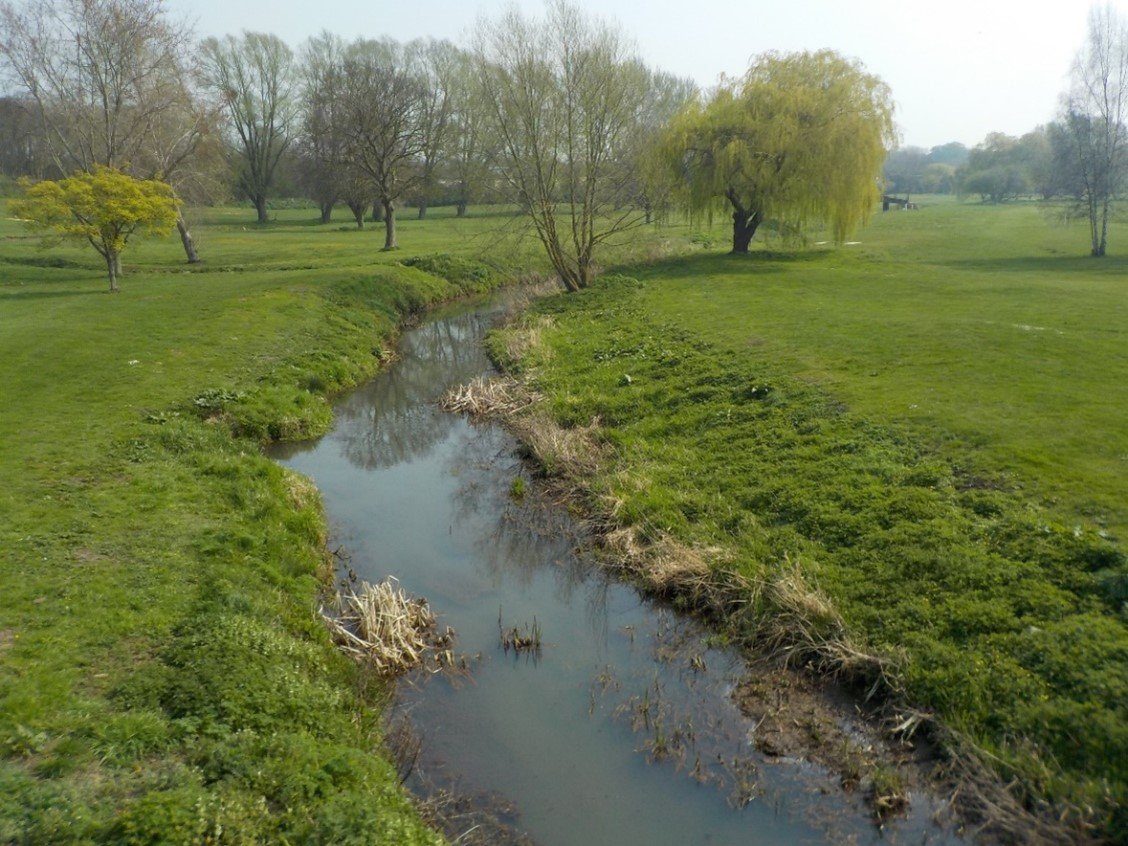
Ditch at Fornham
Then comes the incident for which Petronilla is remembered. During the rout, she fell into a ditch. Mail that offered protection in battle could become a serious disadvantage in mud and water. Petronilla lost her rings and was unable to escape unaided.
A man named Simon of Odell pulled her out. Jordan Fantosme has him tell her, in effect, to abandon the enterprise: war brings both winning and losing.
It is an extraordinary image. A countess who had ridden into battle armed with shield and lance was now trapped in the wet Suffolk earth while the rebellion collapsed around her.
It would be easy to treat the scene as comic — and medieval writers were not above enjoying the humiliation of defeated enemies. But Fantosme's account preserves something more interesting. Petronilla was there. Whatever later generations might think women were supposed to have done in medieval warfare, a contemporary writer recorded a noblewoman in mail, carrying the equipment of war, alongside her husband's army.
That makes her difficult to dismiss.
Robert of Leicester Surrenders
Robert de Beaumont was captured too. The rebel force that had crossed from Flanders hoping to transform the war in England had effectively ceased to exist. Leicester and Petronilla were sent into captivity and eventually held at Falaise in Normandy.
The battle was a major victory for Henry II, but it did not end the rebellion immediately. War continued into 1174. William the Lion of Scotland invaded again and was spectacularly captured at Alnwick in July. Hugh Bigod submitted. Other rebels followed, while Henry's sons were eventually forced to make peace with their father.
The Battlefields Trust describes Fornham as the only significant open-field battle fought in England during the war between Henry II and his sons. More importantly, it removed one of the gravest threats to royal authority in England at a moment when the king himself was abroad.
Fornham demonstrated just how resilient Henry II's government had become. The king did not need to be standing on an English battlefield for his kingdom to defend itself. His justiciar, constable, loyal earls and local forces could do it for him.
What Fornham Tells Us About the Great Rebellion 1173-4
The Revolt of 1173–74 is sometimes reduced to a spectacular piece of Plantagenet family dysfunction: Henry II fighting Eleanor and their rebellious sons.
It was much more dangerous than that. Scotland attacked from the north. Great English magnates rebelled. Foreign rulers supported the Young King. Mercenary armies crossed the Channel. Fighting stretched across Henry's territories in England and France.
At Fornham, all of those tensions came together. Robert of Leicester represented the aristocrats willing to risk everything against Henry. The Flemings represented the international nature of twelfth-century warfare. Richard de Lucy represented the increasingly sophisticated machinery of Angevin government. The knights carrying St Edmund's banner remind us how closely local religious institutions could become involved in political and military events.
And Petronilla reminds us that women could sometimes appear in places where neat descriptions of medieval gender roles tell us they should not have been.
Visiting Fornham Today
Standing at Fornham today, what struck me most was how little the landscape advertises what happened there. There is no great ruined fortress towering over the battlefield. No vast monument dominates the horizon. There are fields, the River Lark and the remains of the church tower at Fornham St Genevieve.
Yet this was the scene of one of the bloodiest engagements of the 1173–74 rebellion. The Battlefields Trust places the action around the river valley close to the ruined church, and new interpretation boards were unveiled on the battlefield in 2025.
The proximity to Bury St Edmunds makes it particularly rewarding to visit the two together. At the abbey ruins, you can imagine the extraordinary wealth and influence of the medieval Abbey of St Edmund. Then, only a short distance away, you can stand near the ground where the abbey's knights marched beneath St Edmund's banner and where Leicester's rebellion met disaster.
The two places belong to the same story.
Remembering Petronilla
Petronilla did not single-handedly change the course of English history at Fornham. Richard de Lucy, Humphrey de Bohun and the royalist army did far more to determine the political outcome of the day.
But that is not why we remember her. We remember her because medieval history is so often tidied into categories that the people themselves refuse to fit.
Kings fought. Knights fought. Women waited at home. Except sometimes they didn't.
On 17 October 1173, Petronilla de Grandmesnil rode with a rebel army wearing mail and carrying a shield and lance. She shared its defeat. She fell into the same treacherous ground that helped destroy Leicester's soldiers. And because contemporary writers thought the sight remarkable enough to record, we can still see her there more than eight centuries later.
That is what makes Fornham so fascinating to me. It was not simply a battle between two armies. It was part of a civil war that divided husbands from wives, fathers from sons and friends from friends.
That division lies behind the fictional story in Lady of Lincoln too. Fitz commits himself to the Young King's cause; Gerard fights for Henry II. At Fornham, I bring those two loyalties face to face, against the background of a battle whose real history was already filled with enough mud, divided allegiance and human drama to need very little embellishment.
On 17 October, I always think of that quiet Suffolk landscape — and of the men and women who found themselves on opposite sides there in 1173.