How Nicola de la Haye and Gerard de Camville Conquered the Sea, and Made a Deadly Enemy
dyke building in the medieval fens led to an accusation of treason
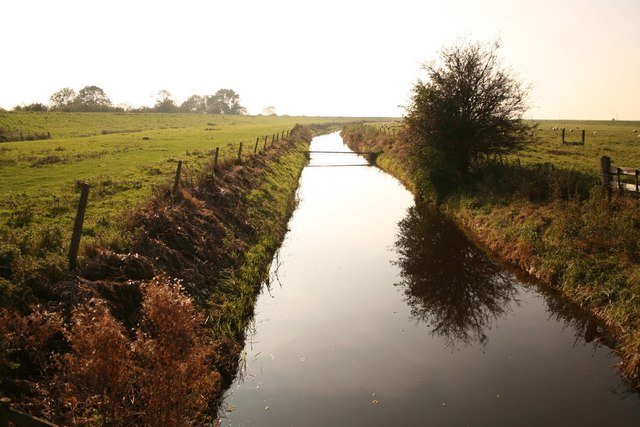
Modern fenland landscape with drainage near Crowland and Cowbit, Lincolnshire
Nicola de la Haye is remembered, rightly, as the woman who held Lincoln Castle through a number of sieges. But while researching her life for Lady of the Castle, I became fascinated by another battle being fought on her lands.
It was a battle against the sea.
And, rather unexpectedly, I discovered that Nicola and Gerard’s attempts to win that battle may also have helped create an enemy who would eventually bring an army to the gates of Lincoln Castle—and come close to having Gerard hanged for treason.
A county being built out of water
Much of Nicola’s land lay in southern Lincolnshire, including estates at Sutton and Lutton in what was then a very different landscape from the one we know today.
Large parts of the Lincolnshire fens were still marsh, saltmarsh and seasonally flooded ground. If you wanted more farmland, you could not simply clear a few trees and start ploughing.
First, you had to make the land.
One of the most fascinating books I found while researching Lady of the Castle was H. E. Hallam’s Settlement and Society: A Study of the Early Agrarian History of South Lincolnshire, published in 1965 and now, unfortunately, out of print. (Thank you, eBay!)
Hallam describes the enormous programme of reclamation taking place during precisely the period covered by my novels: the reigns of Henry II, Richard I and John.
People built great earth banks and dykes, redirected water and drained marsh. Slowly, field by field, they pushed the water back.
In other words, they were quite literally creating large parts of Lincolnshire.
The chronology is extraordinary. Hurdletree Fen Bank at Holbeach is traditionally dated to around 1160, Saturday Dyke to around 1170, the New Fendyke to around 1189, Asgardyke was being constructed by 1205, Goldyke was half-built by 1206, and the Hassock or Lords Dyke was completed around 1230.
I was ridiculously delighted when my copy of Hallam arrived and I discovered that the huge fold-out map at the back was still there. I spent far too long unfolding it across the table, finding Nicola’s lands and trying to work out which banks already existed during her lifetime and which were being constructed around her.
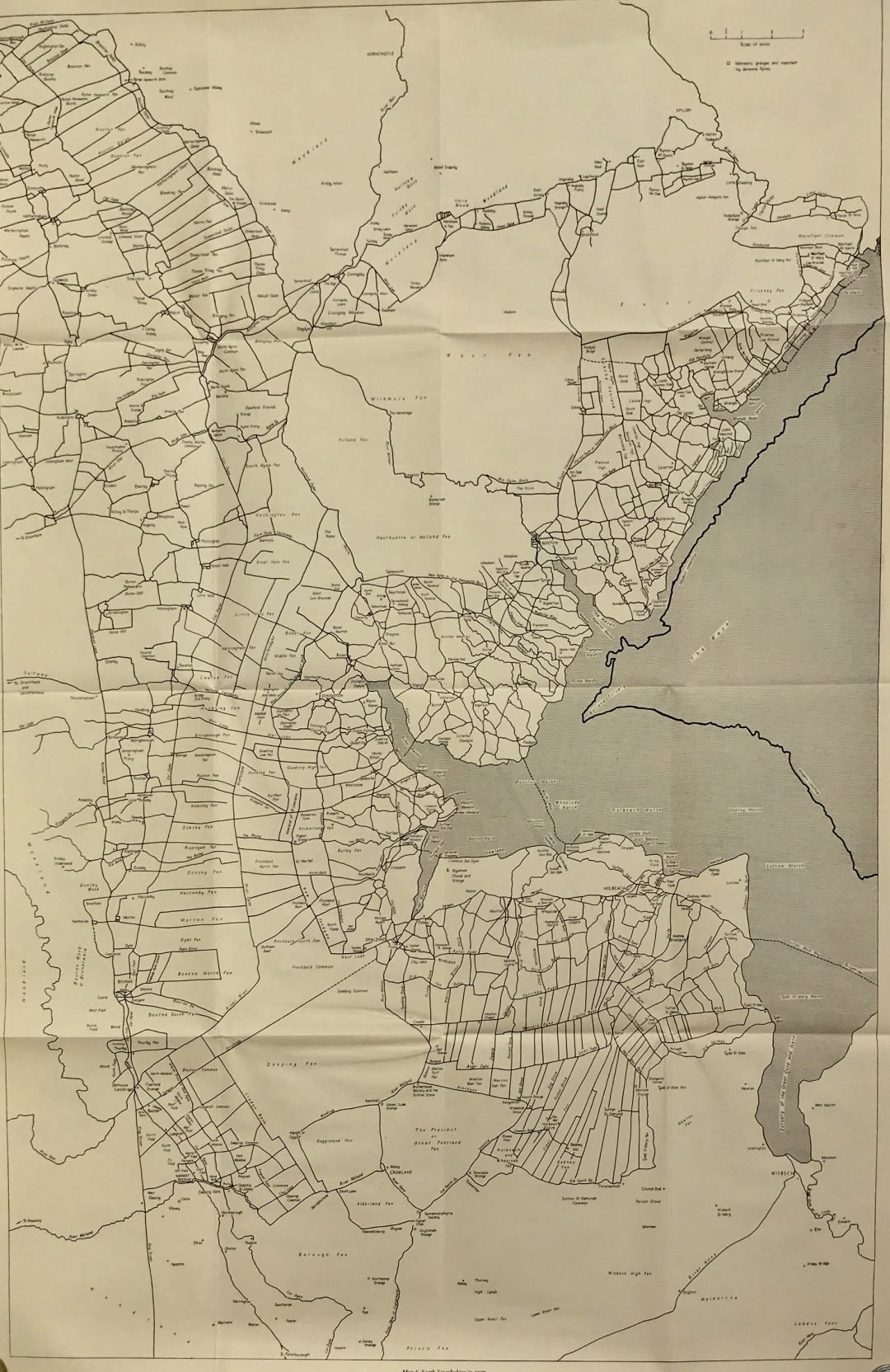
A pullout map of the medieval Lincolnshire fens from ‘Settlement and Society’
It was one of those lovely moments in historical research when a landscape you have been writing about suddenly becomes real. And this wasn't merely an interesting feat of medieval engineering.
It transformed people's lives. Behind a dyke, saltmarsh and reedbed could become meadow, grazing and eventually arable land. That meant more food. More livestock. More tenants. More rent. More wealth. It could mean the difference between a community surviving a bad harvest and starving.
There was also a personal connection that I couldn't resist. While researching my mother's family tree, I discovered that several of my ancestors came from Cowbit—pronounced Cubbit—which was largely underwater until the New Fendyke was constructed around 1189. Lincolnshire Heritage Explorer records that Cowbit village subsequently developed along the new bank.
So somewhere along the line, my own ancestors benefited from this extraordinary medieval assault on the water!
Nicola takes on the sea in Lady of the Castle
This became one of the threads running through Lady of the Castle.
Early in the novel, Nicola learns that the sea is encroaching on the grazing lands around Gedney, Sutton and Lutton. Her neighbour and ally Fulk d'Oyri is already planning major drainage works at Gedney, and Nicola begins considering what must be done on her own estates.
Later, she commits men and money to the enormous task of dyke-building. I cannot prove that Nicola personally commissioned a particular surviving medieval bank: the records simply aren't detailed enough for that. But what I could establish was that extensive reclamation was happening in and around her lands, in her lifetime, and that landowners in precisely her position were deeply involved in it.
And Nicola was no absentee heiress. She was a woman who managed estates, defended her inheritance and understood that her authority came with responsibility for the people living on her lands. So in the novel, I put her where I think she belongs: out in the fens, worrying about flooded crops and starving tenants, arguing about labour and money, and trying to stop the North Sea taking back what generations of Lincolnshire people had wrested from it.
For a time, it works. Nicola and Gerard, their tenants and neighbours do something rather magnificent. They conquer the sea. Or at least, a little piece of it.
Unfortunately, there was a problem: land newly won from the water had to belong to somebody. And everybody didn't necessarily agree about who that somebody was.
Enter Crowland Abbey
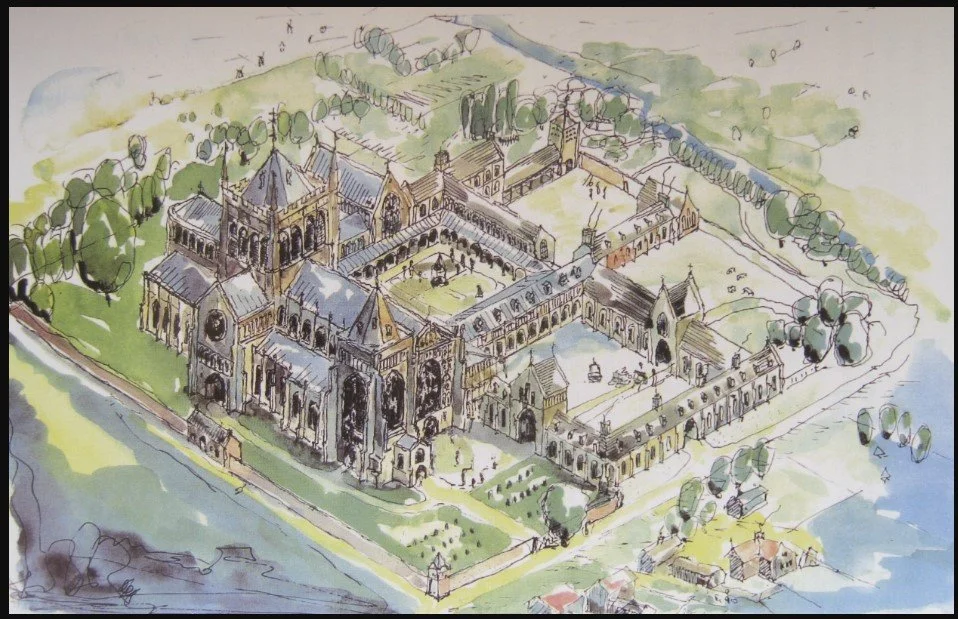
A Reconstruction of Crowland Abbey
This is where my nice story about medieval drainage became considerably less nice.
Crowland Abbey was one of the great religious houses of the Lincolnshire fens. It possessed extensive rights over marshland, grazing, fishing, turf-cutting and common pasture. But its neighbours had rights too, or said they did.
The result was the medieval equivalent of an extremely bitter boundary dispute—except that instead of arguing about six inches of garden fence, the parties were arguing about miles of marshland, valuable grazing and the direction in which water itself was allowed to flow.
And sometimes thousands of men got involved.
In May 1189, after a false report circulated that Henry II had died, a long-running quarrel between Crowland and its neighbours exploded into violence.
According to Crowland's own chronicle tradition, the trouble began after the abbey's men impounded cattle grazing on its hay meadows. Its opponents responded by gathering an armed force, invading the disputed marsh, dividing it between neighbouring communities, cutting woodland and asserting their own rights over the land.
Among the men named on the opposing side was Gerard de Camville, Nicola's husband.
The dispute was not a one-off squabble. Crowland's disagreements with neighbouring Spalding and the men of Holland continued for generations and involved grazing, common rights, causeways, turf—and dykes.
Crowland's monks were even accused of breaking down banks erected by their neighbours. And that matters because a dyke did not simply keep water out, it could also send water somewhere else. Protect your own fields and you might flood somebody else's. Drain marsh that you considered yours and you might destroy another community's traditional fishing or grazing rights.
Suddenly the lovely fold-out map at the back of Hallam's book looked rather more threatening. Every line represented land saved from water. But some of those lines also represented a vicious argument.
Then a Longchamp arrived at Crowland
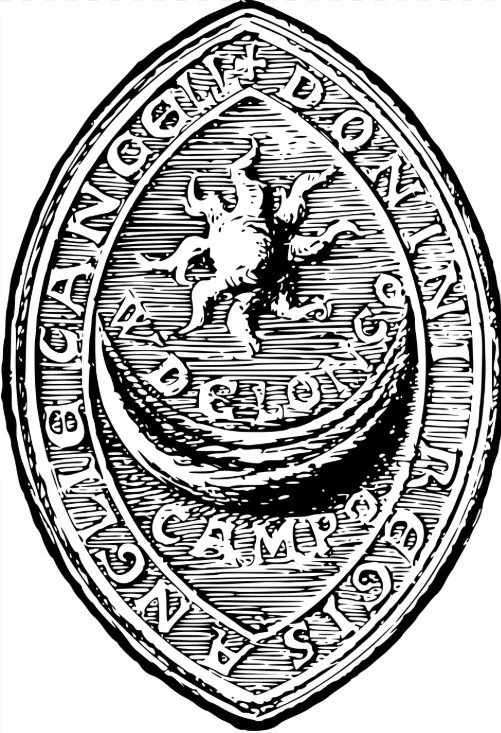
The Seal of William (Guillaume) Longchamp
And this is where the story becomes almost too convenient for a novelist.
When Richard the Lionheart left England on crusade, he entrusted enormous power to his chancellor and chief justiciar, William—or Guillaume—Longchamp. Longchamp rapidly became one of the most hated men in England.
And he also had a habit of finding useful jobs for his relatives. His brother Osbert became Sheriff of Yorkshire. His brother Henry, previously a monk at Evesham, became Abbot of Crowland!
Oops.
The abbey already locked in a bitter fenland dispute in which Gerard de Camville was one of its named adversaries. So now Gerard's opponent in the marshes was the brother of the most powerful man governing England in Richard's absence.
This is one of those moments in research when I stared at the page and thought: Oh. Because what happened next is at the heart of Lady of the Castle.
From an argument about marshland to an army outside Lincoln
In 1190, after the horrific massacre of the Jews at York, Longchamp travelled north on the king's business. On his return journey, he visited his brother at Crowland, then travelled to Lincoln.
There he accused Gerard of harbouring or supporting robbers who had attacked merchants at Stamford Fair and demanded that Gerard surrender his offices and Lincoln Castle.
Gerard refused.
The surviving evidence doesn't allow us to say, "Henry Longchamp invented the accusation because of the Crowland land dispute." History is very rarely that obliging, but having researched what happened at Stamford, I suspect he may have done.
There were political reasons enough for Guillaume Longchamp and Gerard to dislike one another. Gerard was increasingly associated with Prince John, while Longchamp was trying to ensure that England's strategically important castles were held by men he could trust.
I found the sequence extraordinarily suggestive: Longchamp visits Crowland, his brother is abbot, and the Crowland Chronicle itself describes Gerard as an ‘enemy of the chancellor’.
Longchamp then arrives at Gerard's castle with accusations serious enough to threaten his position. It is impossible to know how much the Crowland quarrel influenced what followed, but I found it impossible to ignore.
The dispute in Lady of the Castle
In Lady of the Castle, Nicola tries to deal directly with Henry Longchamp, only to find the gates of Crowland Abbey barred against her. Not long afterwards, Guillaume Longchamp arrives unexpectedly at Lincoln Castle.
Nicola and Gerard know immediately that this is unlikely to be a friendly visit, and they are right. Longchamp tells them that he has been at Crowland and has spoken to his brother. He produces allegations against Gerard concerning events at Stamford and demands the surrender of the castle.
Nicola refuses to give him her inheritance, and Gerard refuses to submit.
And eventually Longchamp returns with an army. What began in marshes and ditches has reached the walls of Lincoln Castle.
Even more dangerously, the accusation does not disappear when the siege ends. It follows Gerard for years, until Richard returns to England and Gerard finally has to answer a charge that has been inflated into treason!
In the novel's trial, the connection is laid bare: the accusation against Gerard came through an abbot with whom he had been engaged in a long-running land dispute—and that abbot happened to be the chancellor's brother.
Gerard's life hangs on the outcome. The enemy created among the reedbeds and drainage ditches of the Lincolnshire fens has followed him all the way to the king's court.
Conquering the sea had a price
That, for me, is what makes the history of Nicola's fenlands so fascinating. At first glance, medieval drainage sounds like background research: the sort of useful detail that helps make a historical novel feel authentic. But it wasn't.
These dykes were about survival, wealth and power. Nicola's tenants needed dry land on which to grow food and graze animals. Nicola needed productive estates if she was to maintain her household, her soldiers and Lincoln Castle. Every acre rescued from the marsh strengthened her inheritance.
But every acre newly enclosed could also diminish somebody else's rights.
The people reclaiming the Lincolnshire fens were not simply battling nature. They were competing with neighbours, monasteries and other landowners for control of a landscape whose boundaries were quite literally changing beneath their feet.
Nicola and Gerard could hold back the North Sea. What they couldn't control was what happened when powerful men decided the land behind those banks belonged to them.
And in the end, the most dangerous thing to emerge from their struggle with the water wasn't a flood, but an enemy: An enemy called Longchamp, the king’s chancellor, a very dangerous man indeed.
Sources and further reading
Nicola de la Haye: Castellan, Sheriff, and Defender of Lincoln.
H. E. Hallam, Settlement and Society: A Study of the Early Agrarian History of South Lincolnshire (Cambridge University Press, 1965).
A History of the County of Lincoln: Volume 2, “Houses of Benedictine monks: The Abbey of Crowland”, Victoria County History — particularly useful for the 1189 marsh dispute and the long-running disputes between Crowland, Spalding and neighbouring communities.
A History of the County of Lincoln: Volume 2, “Houses of Benedictine monks: The Priory of Spalding”, Victoria County History.
Heritage South Holland, Fen Drainage Timeline, 852 to Present Day— for the chronology of the medieval fen banks.
Historic England, Medieval dylings and flood defence bank at Gold Fen Dike Bank, Wrangle.
David Roffe, On Middan Gyrwan Fenne: Intercommoning around the Island of Crowland.
As always when writing the historical sections of my novels, I've separated what we know from what I've imagined. Gerard de Camville's involvement in the dispute with Crowland, Henry Longchamp's appointment as abbot, the extensive fen reclamation of this period and Guillaume Longchamp's subsequent conflict with Gerard are historical. We cannot prove that the Crowland dispute caused Longchamp's attack on Gerard. In Lady of the Castle, I use the very suggestive connections between those events to construct one possible explanation for how they became such bitter enemies.
Read more about Nicola de la Haye: https://www.rachelelwissjoyce.com/nicola-de-la-haye
discover lady of the castle
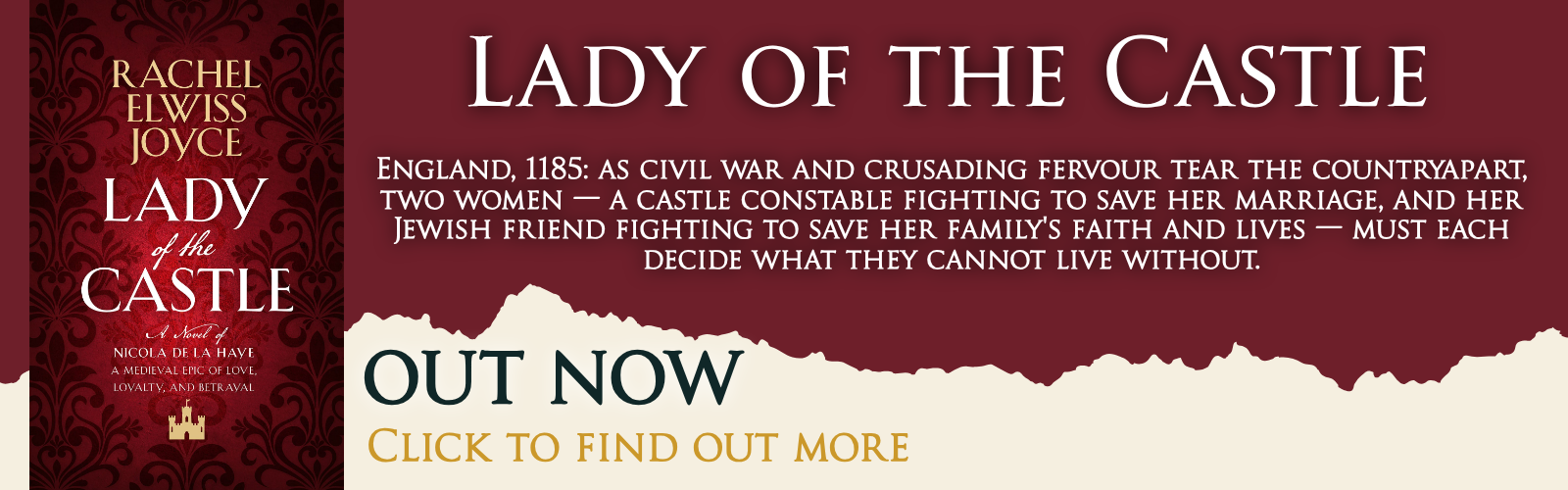
Click the image to find out more about Lady of the Castle that features dyke-building, the Crowland dispute, what happened at Stamford, and Nicola and Gerard’s dangerous conflict with William (Guillaume) Longchamp, Richard the Lionheart’s chancellor.