Black Shuck: The Devil’s Dog That Haunted Medieval England
A Medieval Folk Legend for National Black Dog Day
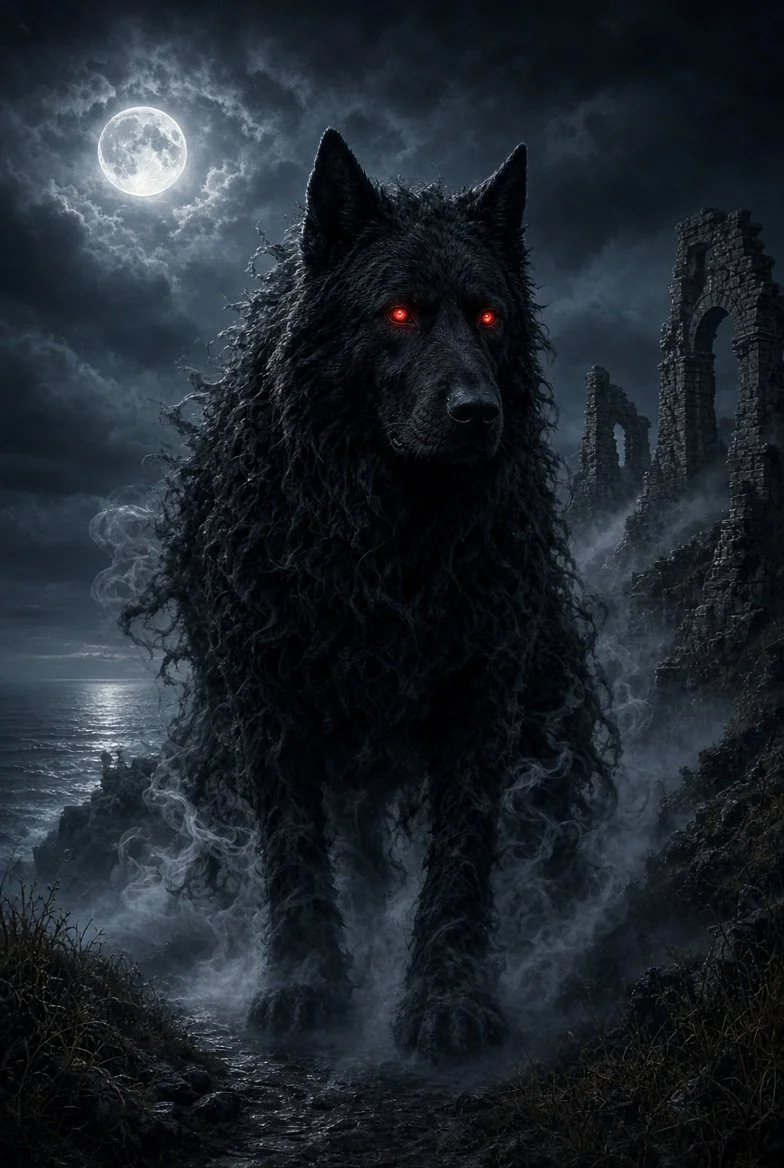
The Black Shuck is the name given to a ghostly black dog said to roam the coastline and countryside of East Anglia, England
On 1 October, National Black Dog Day celebrates the real black dogs who have sometimes been overlooked in favour of their lighter-coated companions.
But in English folklore, a black dog wasn’t always something you wanted to meet. For centuries, stories have been told of enormous black hounds appearing on lonely roads, beside churchyards or across the marshes. Sometimes they guarded travellers. More often, they brought something far less welcome.
They brought death.
And nowhere is that tradition stronger than in East Anglia, home of the creature now known as Black Shuck.
The Devil’s dog
Descriptions vary. Black Shuck may be enormous or merely unnaturally large. He may have one eye or two. Those eyes may burn red like coals. Sometimes he appears silently; sometimes his howl warns that something terrible is about to happen. And the name itself may reach back a very long way. It has commonly been linked to the Old English scucca, meaning an evil spirit, demon or devil.
But the most famous surviving account of the East Anglian black dog comes not from the Middle Ages, but from 1577. On Sunday 4 August that year, an extraordinary storm struck the Suffolk town of Bungay.
The congregation was gathered inside St Mary’s Church when thunder, lightning and violent rain engulfed the town. According to an account published that same year by Abraham Fleming, the church became so dark that people could scarcely see one another.
Then something entered the church. Fleming described it simply as a creature in the shape of a dog, black in colour. It ran through the congregation and passed between two people kneeling in prayer. Both reportedly died. Another man was horribly injured but survived.
Later that same day, a similar creature was reported at the church at nearby Blythburgh, where more deaths and injuries were attributed to it. Fleming interpreted the apparition as the Devil himself taking the form of a dog.
Today the Black Shuck is rather less frightening to the people of Bungay. The dog has become one of the town's most recognisable symbols, appearing on its coat of arms and even on the weather vane above the town.
Black Shuck enters Lady of Lincoln
I first brought the legend into the Nicola de la Haye series in Lady of Lincoln. The scene takes place, appropriately, at Bungay Castle during the revolt against Henry II in 1174.
Fitz—Nicola's first husband—is inside the besieged rebel castle. The rebellion is collapsing. King Henry has made his extraordinary act of penance at Canterbury for the death of Thomas Becket, the Scots king has been captured at Alnwick, and the men around Fitz are beginning to wonder whether God himself has taken Henry's side.
Into that atmosphere comes a piece of local terror when one of the soldiers announces that the Black Shuck has been seen. He describes the creature as the Devil's dog: black as soot, with fiery eyes, haunting the marshes and carrying off children.
Fitz, rather more practically, suggests that somebody has probably seen a wolf., but the soldier will have none of it. For him, the appearance of the dog is another sign that the rebels are cursed.
That was exactly why I wanted Black Shuck in the scene. The important thing is not whether the dog exists, but that the men might believe it might. Their world is already giving them signs. Storms have delayed armies. A murdered archbishop has become a saint. Henry has publicly submitted himself to scourging at Becket's tomb—and almost immediately his enemies begin to suffer reverses.
For frightened soldiers inside a doomed castle, a demonic black dog prowling the marshes is entirely believable, and belief can alter what men do just as powerfully as fact.
A child's monster in Lady of the Castle
Black Shuck appears again in Lady of the Castle, but in a very different way.
The novel opens in 1185 with Nicola noticing a collection of what she interprets as ominous signs—the castle's hunting hounds howling through the night, a dead cat in the well and ravens gathering on the gaol tower—shortly before the earthquake that strikes Lincoln.
Later, the supernatural black dog has found its way into the nightmares of Nicola's young son Dickon. Still grieving after the death of his little brother Tommy, Dickon creeps into Nicola's bed after wetting his own. He tells her that he has dreamed of the black dog with red eyes. In the nightmare he has to fight it because it wants to eat Tommy and drag him into Hell. Nicola tells him that Black Shuck doesn’t exist and that Tommy is safely in Heaven.
Here the legend is doing something quite different. In Lady of Lincoln, Black Shuck embodies the fear of an army that thinks God may have abandoned it. In Lady of the Castle, he embodies the fear of a child who cannot properly understand death. Dickon has heard the stories adults tell. His imagination has supplied the monster. And because medieval Christianity gave Hell a terrifying reality, his childhood grief turns that monster into something even worse: a creature that might come for the brother he has already lost.
Did medieval people really believe in creatures like Black Shuck?
Folklore was overwhelmingly oral. Stories might circulate for generations before anybody thought them worth writing down, and many never reached parchment at all. Much of British folklore survives precisely because stories were passed orally for centuries before antiquarians and folklorists eventually recorded them. Black dogs are part of a much broader family of supernatural creatures found in British tradition.
And the possible Old English ancestry of the word Shuck is particularly intriguing. The old word scucca meant a devil or evil spirit. That does not prove that an Anglo-Saxon—or a twelfth-century inhabitant of Bungay—would have recognised the creature we now draw as a huge black dog with blazing red eyes, but it does give the legend very old linguistic roots.
Portents and medieval beliefs form part of the fabric of my novels, along with the sights, sounds and smells of medieval England. Why not start the journey today and pick up a copy (ebook, paperback, or audio) of Lady of Lincoln, or continue the journey with Lady of the Castle today.