The Prayer That Outlived Him: Rabbi Yom Tov of Joigny (and York)
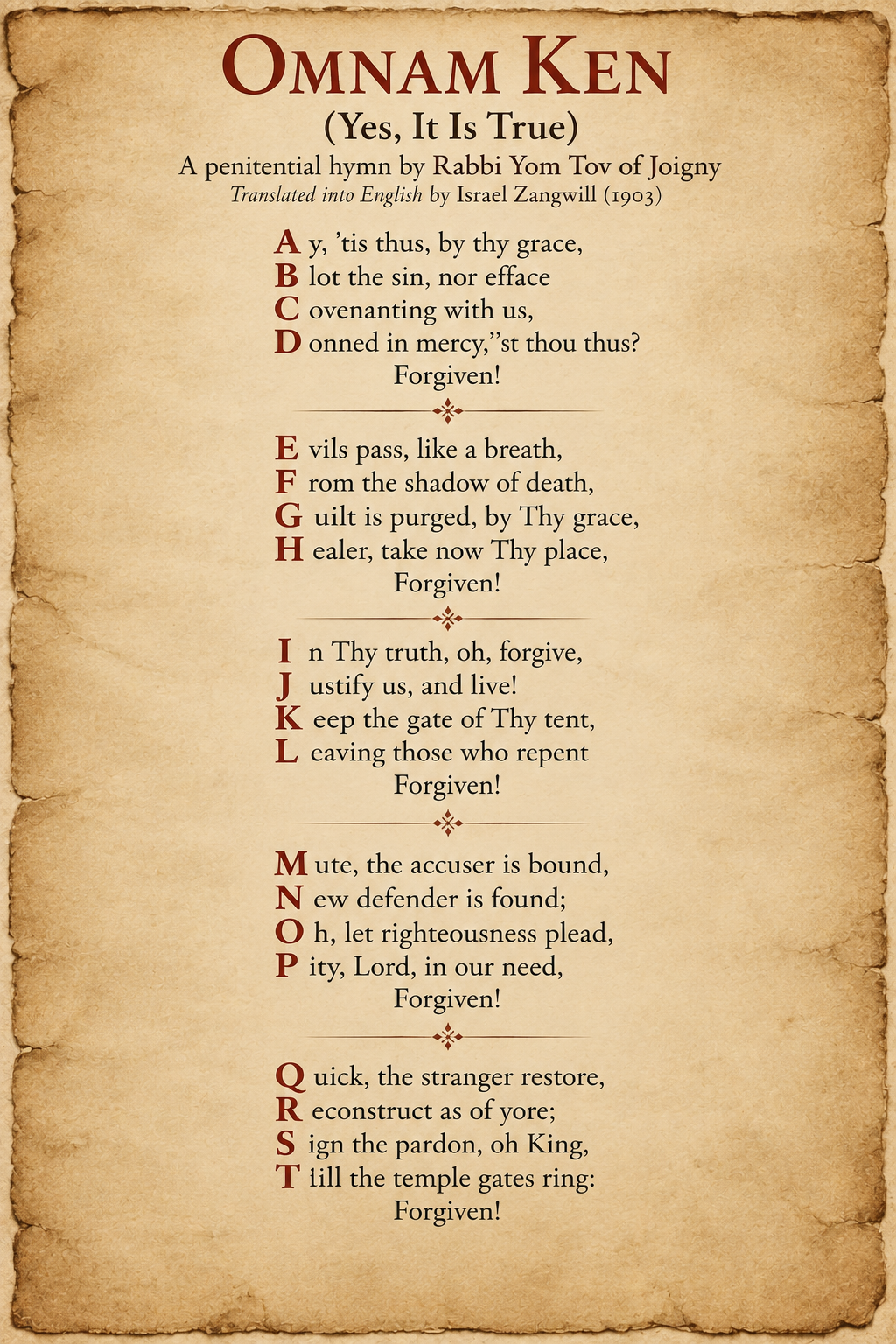
English translation of Omnam Ken by Israel Zangwill
We are now in the Jewish High Holy Days, the ten days between Rosh Hashanah and Yom Kippur when Jewish communities around the world turn towards reflection, repentance and forgiveness.
There is one prayer from Yom Kippur that I discovered that fills me with emotion. Not because of the words (although they are poignant and haunting), but because of the man who wrote them: Rabbi Yom Tov of Joigny. And because, more than eight hundred years after his death, those words have been sung again at the very place where he died: York Castle.
The prayer is called Omnam Ken, which translates as ‘Indeed, it is true’. It is a penitential hymn recited during the Kol Nidre service on the eve of Yom Kippur.
Written as an alphabetical acrostic, it acknowledges something uncomfortable but very human: that we fail. That we do things we regret. That the inclination towards wrongdoing exists within us. And over and over again, the prayer asks for mercy. And each section returns to one word:
Salachti, or ‘I have forgiven’.
It comes from the Book of Numbers, from God's response after Moses pleads for the people of Israel. And once you know who wrote them, and what happened to him and the people he led, they become hard to hear.
The image above is a poetic English translation of Omnam Ken by Israel Zangwill (originally published in 1903), which captures both the alphabetical flow and the rhyming structure of the original Hebrew text.
Rabbi Yom Tov of Joigny
Rabbi Yom Tov of Joigny was one of the most important Jewish scholars to live in medieval England. Born in France, he studied under Rabbeinu Tam, grandson of the great Jewish commentator Rashi, during an extraordinary period of Jewish scholarship. He later came to England and became a leading rabbi. Some say he became a permanent rabbi within York's Jewish community. I am personally not sure if that is the case, as there was another rabbi at York. My own theory is that he was peripatetic, spreading wisdom and knowledge all across England, but whatever the truth of that, he was a scholar, a teacher and a poet, and in March 1190, he died at York Castle.
The events that led to his death had been gathering for months. Anti-Jewish violence had broken out around Richard I's coronation in 1189 and spread to other English towns. Crusading fervour played its part, but in York religious hatred became entangled with a much more worldly motive: debt.
Some of those involved owed large sums to Jewish lenders. Dead creditors and destroyed records offered an obvious solution.
When violence erupted in York, members of the Jewish community fled with their families to the royal castle for protection. Around 150 men, women and children eventually found themselves trapped inside the wooden keep that stood on the mound where Clifford's Tower stands today.
Outside was a mob.
The accounts that survive were written by Christian chroniclers, not Jewish eyewitnesses, and are coloured by the prejudices of their time. We cannot know every word spoken inside that tower. But we know how the night ended.
Faced with the prospect of murder or forced baptism, many of those trapped inside chose death instead. According to the chronicler William of Newburgh, Rabbi Yom Tov urged them not to abandon their faith. Families died together. The wooden buildings (possibly a wooden tower, but I’ve already blogged about that here) burned.
Those who survived and emerged after being promised safety (if they were baptised) were murdered by the waiting crowd.
Afterwards, the records of debts owed to Jewish lenders were destroyed.
It remains one of the most terrible episodes in the history of medieval England. But I don't want the burning tower to be the only thing we remember about Yom Tov, because before that night, he had already written something that would outlive it.
Salachti - I have forgiven
Omnam Ken is not a prayer about martyrdom, nor a prayer demanding punishment upon enemies. It is about something far less dramatic and perhaps much harder: looking at ourselves.
Acknowledging our own faults, repenting of them, and asking to be forgiven.
That matters when we think about York, because there is an important distinction to make. Yom Kippur is not a demand that victims simply forgive whatever has been done to them. In Jewish teaching, wrongs committed against another human being cannot simply be settled between the wrongdoer and God. The person who caused the harm must seek forgiveness from the person harmed.
So I don't read Omnam Ken as a message that Yom Tov or the people who died with him were somehow obliged to forgive the men outside that tower. Quite the opposite.
What haunts me is the contrast. Outside were men who seem to have persuaded themselves that violence could be justified — by religion, by crusade, by resentment, by debt, perhaps simply because enough other people were doing it. Inside was a rabbi whose prayer recognises human failings and the need for penitence and forgiveness.
Hatred so often begins with certainty about somebody else's wickedness. But repentance begins by examining our own.
And still the prayer returns to the same answer: Salachti: I have forgiven.
Eight hundred years later
Which brings me to the reason I particularly wanted to write about Yom Tov now. A few years ago, the Jewish vocal ensemble Mosaic Voices recorded a new setting of Omnam Kein, composed by Benjamin Till. They did not record it in a synagogue. They went to York: to Clifford's Tower.
The surviving stone tower is not the building in which Yom Tov died — that was a shell keep with wooden buildings, or possibly a wooden keep, and today's tower was built decades later — but the mound is the site of the medieval castle and of the events of 1190.
And there, more than eight centuries later, Jewish voices sang Yom Tov's prayer again. Jewish Renaissance described the recording as a commemoration of Yom Tov and noted Mosaic Voices' description of Omnam Kein as the only piece in Orthodox liturgy written by an English rabbi.
You can watch it here:
Mosaic Voices performing Rabbi Yom Tov of Joigny's Omnam Kein at Clifford's Tower York. From Jewish Renaissance.
I find the film extraordinarily moving. I urge you to watch it, and listen. There is something about hearing those voices within the tower that no description can reproduce. This was a place from which Jewish voices were once violently silenced, but here they fill it. Not with a cry of vengeance, but with prayer. Salachti: I have forgiven.
Writing Yom Tov into Lady of the Castle
When I began writing Lady of the Castle, I knew that the massacre at York would form part of the novel. Nicola de la Haye's closest friend, Bella, is Jewish, and through Bella, Berechiah and their family I wanted to cover the months of antisemitic persecution that occurred in the wake of the Third Crusade. Lincoln’s Jews were also threatened (and this is covered in the novel), but the greatest tragedy happened at York.
I wanted to explore a part of medieval English history that is too often relegated to a paragraph about moneylenders, persecution and expulsion. Instead, I wanted to show that these were real people with real lives before they became victims of history. There were families, friendships, arguments, faith and scholarship. These people worried about their children. And they loved.
Rabbi Yom Tov entered the novel as part of that world. I hadn't expected to find he’d left a legacy other than martyrdom: a prayer about human imperfection, and forgiveness.
Perhaps that is because history has a habit of reducing people to the manner of their deaths. Yom Tov becomes the rabbi at Clifford's Tower. The Jewish men, women and children with him become the victims of the York massacre. But none of them began that night as victims. They were people. And Yom Tov was a teacher, scholar and poet long before anyone trapped him inside a burning tower.
That is why Omnam Ken matters so much to me.
The keep disappeared, and the people inside it died. A century later, in 1290, England expelled its remaining Jewish population altogether.
But Yom Tov's words survived. They travelled far beyond York. They passed from one generation to another for more than eight hundred years until people who had never heard his name were still speaking his words during the holiest days of the Jewish year. And then, eventually, the prayer came back to York. Back to the mound where he died, sung by Jewish voices.
History remembers the fire, but the fire did not have the final word: Salachti. I have forgiven.