Why Fish was so Important in Medieval England
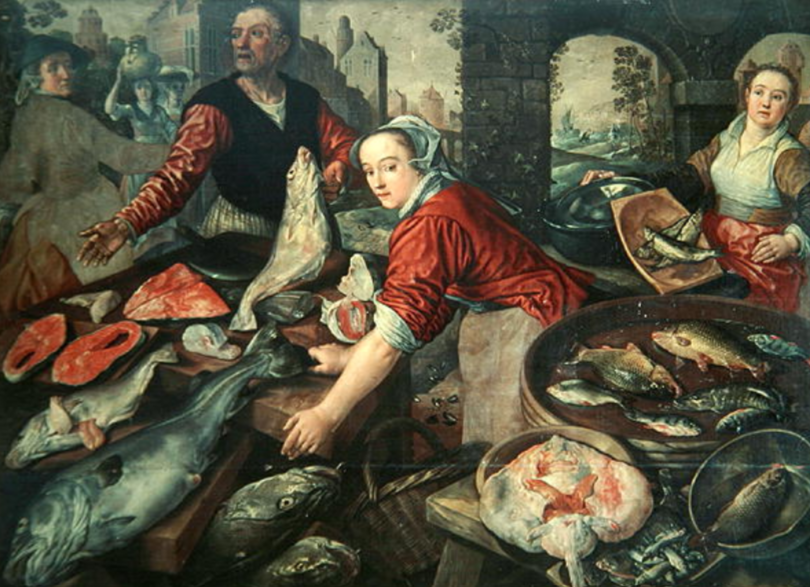
The Fish Market
If you lived in medieval England, you’d probably have eaten an awful lot more fish than you do today, and not necessarily because you liked it, or even because you lived near the sea, but because the Church often told you what you were supposed to eat.
And no one ate more fish than churchmen, which is probably why the fish market at Lincoln was close to both the castle and cathedral (and features quite a lot in my Nicola de la Haye novels).
So, with Advent beginning soon, I've been looking into the medieval custom of abstaining from meat, and often dairy. I realised that fish played such an important part in the medieval diet that it deserved an article of its own, which is what this blog is about.
Remember the Crucifixion
The Church didn’t allow you to eat meat on Fridays, apparently so we could remember Christ's crucifixion, which obviously would also explain the Lent prohibition. Depending on the period and local custom, other days of abstinence included Wednesdays, Saturdays and parts of Advent.
These medieval priests loved to control our lives (and not just what we ate). Add all these non-meat days together and it was clear that meat wasn’t allowed for a significant proportion of your year.
And this created an enormous demand for fish.
What could you eat instead of meat?
The Church's rules distinguished between the flesh of land animals and that of creatures living in water, which meant fish could be eaten on these meat-free fast days.
Unfortunately, medieval people didn’t understand that sea mammals weren’t fish. So porpoises and whales could be eaten then, too. These mammals sometimes appeared at aristocratic feasts, although their flesh would probably seem rather more like meat to us. A porpoise was a particularly prestigious dish, beyond the means of most households.
That makes me very sad. I love dolphins, who are highly intelligent and empathic.
Then there was the barnacle goose. One medieval belief held that these geese developed from barnacles attached to driftwood rather than hatching from eggs. Gerald of Wales, writing in the late twelfth century, described the extraordinary story and criticised those who used it to justify eating the birds during a fast. If the geese came from the sea rather than being born in the usual way, the argument went, perhaps they could be eaten as fish.
This might be one of the reasons why medieval English Jews sent a delegation to the Paris Beit Din to ask if they could eat barnacle geese. In my novel, Lady of the Castle, Bella’s husband Berechiah is part of that delegation.
And not everyone accepted this ridiculous idea that geese could be fish. But the fact that Gerald objected to it tells us that the supposed loophole was already controversial.
Herring for the poor, pike for the wealthy
As with most aspects of medieval life, what you ate depended heavily on how much money you had.
For ordinary people, herring was particularly important. It was abundant, relatively inexpensive and, crucially, could be preserved. A fresh fish was of little use to somebody living miles from the coast unless it could survive the journey inland.
Herring could be salted or smoked, while cod and other fish were dried, sometimes until they were hard as boards. Stockfish, usually dried cod, became a major article of trade. Before cooking, it had to be soaked to soften it, a process that could take several days.
It sounds disgusting. But these preserved fish were essential to inland communities. Somehow, I doubt anyone welcomed the prospect of yet another meal of salt herring after weeks of abstinence (again something I have reflected in my novels, when many people grow heartily sick of meals made of preserved fish).
The wealthy had a better time of it. A noble household might serve salmon, trout, pike, perch, eels or more expensive sea fish, according to what was available. Sturgeon was especially prized. Fish might be roasted, boiled or baked in pastry, and cooks had a remarkable range of sauces at their disposal.
Medieval cookery books include recipes using wine, vinegar, spices, herbs and almond milk. Nicola de la Haye’s (fictional) chief cook, Leofric, liked to make Dauce egre, and a fish dish seasoned with ginger, saffron or cinnamon could be tasty enough to technically fulfil the fasting rules without really meeting the spirit of the fasting.
And the absence of meat didn’t prevent an elaborate banquet. Wealthy households could serve several courses of fish prepared in different ways, together with vegetables, bread, fruit and other permitted foods. The contrast with the diet of a poorer household, living on bread, pottage and whatever salted fish it could afford, must have been considerable.
Why did castles and monasteries have fishponds?
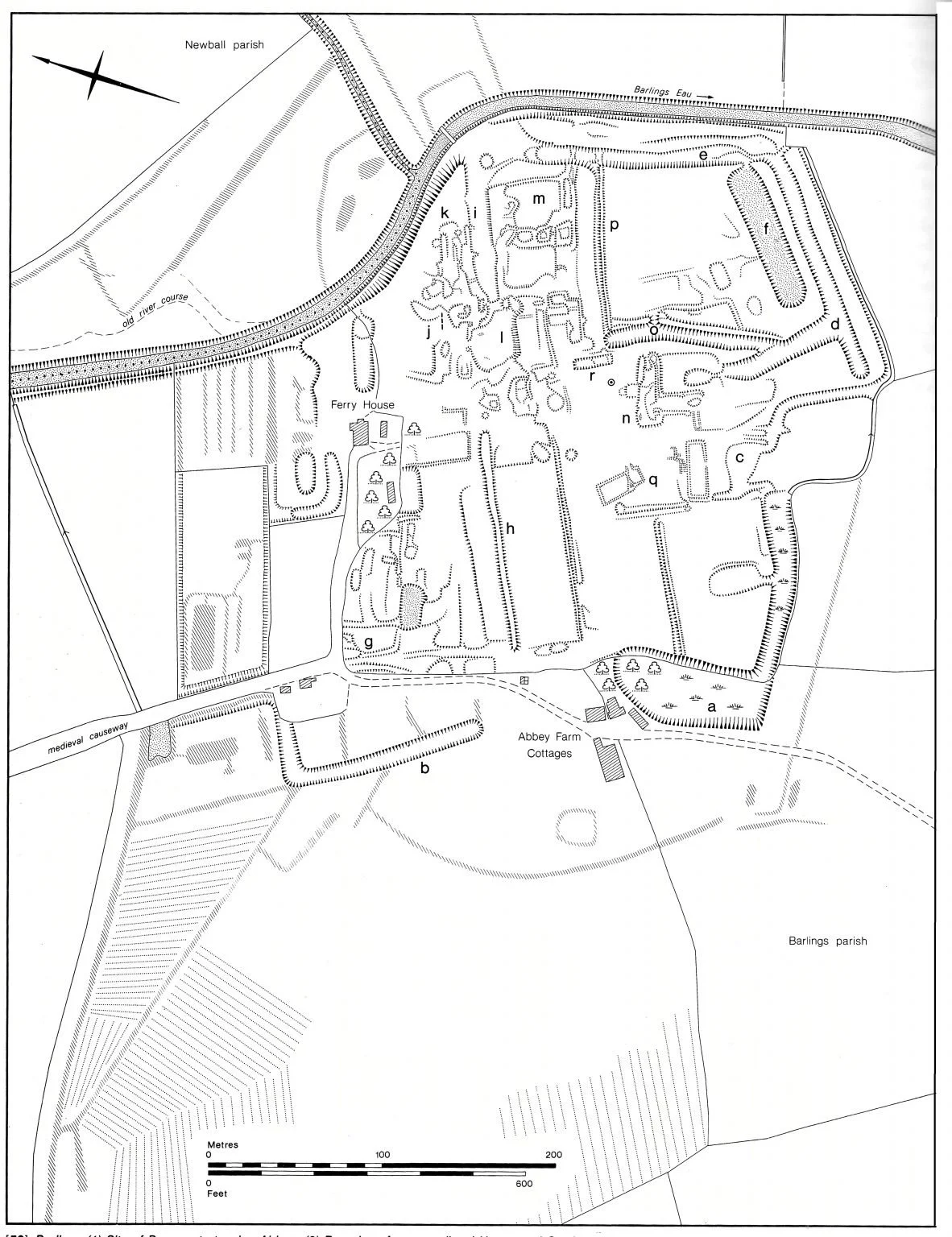
Barlings Abbey precinct survey: a – f: fish ponds, reservoirs and water channels; g: gatehouse to precinct; h: long, low stone wall; i: post-med track to ferry; j: surviving masonry fragment; k: chancel of abbey church; l: site of cloister; m: Infirmary?; n: post-med, L-shaped building (Wray’s mansion); o: garden water-feature; p: ditch and bank; q: barn?; r: well.
If you visit the remains of a medieval monastery or castle, you may find a series of ponds nearby. Above is a survey of Barlings Abbey (founded by Nicola de la Haye’s uncle Ralph and supported by her later on in life. Barlings is also a setting in Lady of the Castle where her foster son, Turstin, is a novice). You can see how many fishponds there were (marked a-f above)!
Fishponds provided a convenient supply of fresh fish, particularly important for monasteries where fasting rules were observed regularly. They also saved the trouble of bringing fresh fish from distant rivers or the coast (although Barlings was by a river, but fishponds allowed them to trap the fish easily).
Ponds could be stocked with species such as carp, tench, bream and pike, although which fish were kept depended on the place and period. A well-managed system might include several ponds, allowing fish to be bred, raised and caught as needed.
For a large religious community, this was a valuable resource. Monks needed feeding throughout the year, and relying entirely on local fishermen or merchants would have been expensive and unreliable.
As I said, in my novel Lady of the Castle, Nicola de la Haye’s foster son Turstin is sent to Barlings Abbey in Lincolnshire in 1186. On his arrival, he’s shown the abbey’s three enormous fishponds, supplied by a system of traps that catch fish and eels from the river. But Turstin soon discovers that not everyone in the abbey eats equally well. At supper, while the abbot and senior canons enjoy roast duck, the novices and junior canons are served lumpy, tasteless stewed clubfish on stale bread trenchers. It's hardly the welcome he'd hoped for, particularly as he's expected to eat in silence.
Paying your rent in eels
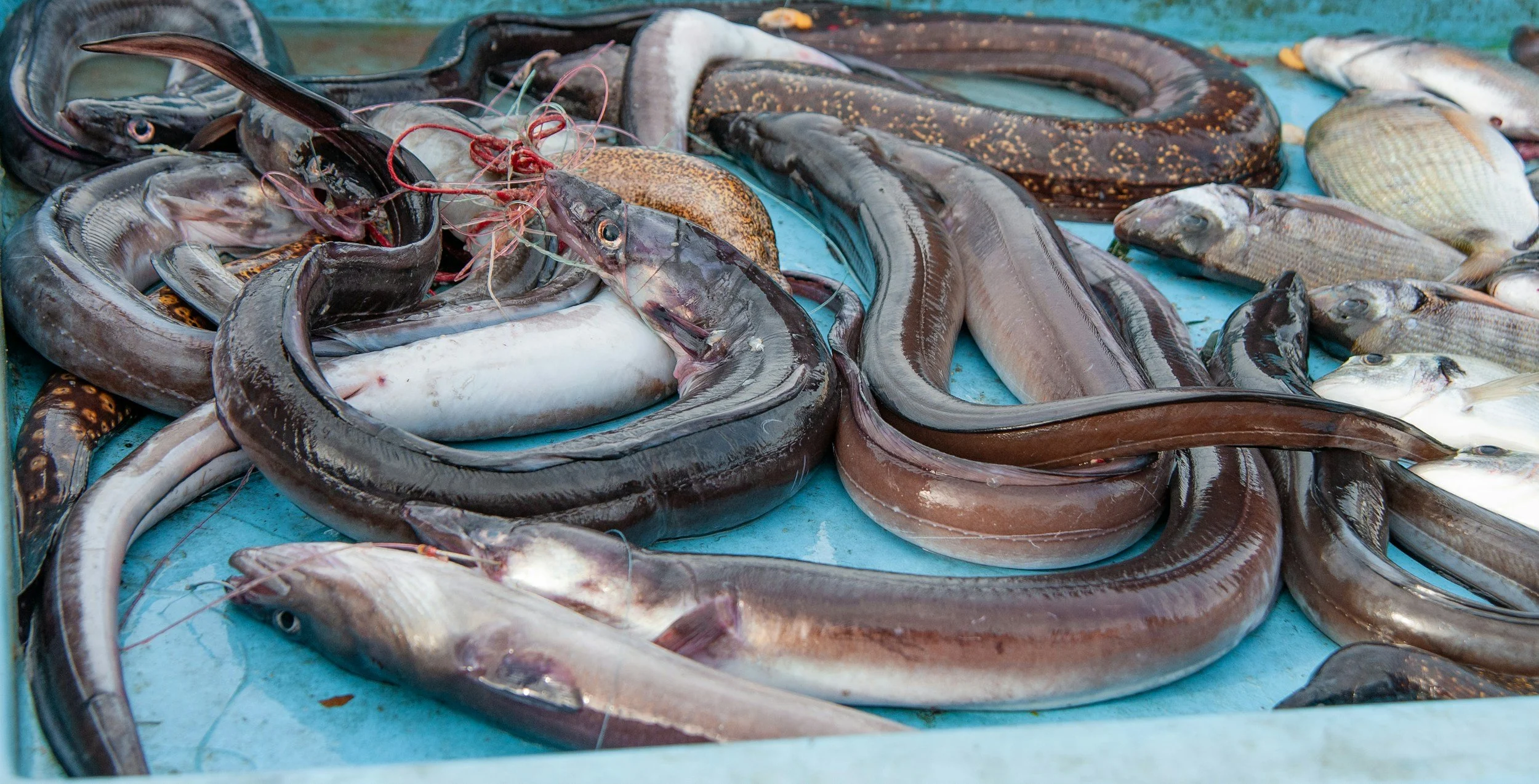
The Domesday Book records numerous payments assessed in eels,
Eels deserve particular attention because they were so important in medieval England.
They were plentiful in rivers, marshes and wetlands, especially in areas such as the Fens. They could be caught in traps and weirs, and they were easily preserved by smoking.
They were also valuable enough to be used to pay rent. The Domesday Book records numerous payments assessed in eels, sometimes in their thousands. Landholders might owe a fixed number each year for the use of land, a mill or fishing rights.
It seems an extraordinary arrangement to us, but it made sense in an economy where payments were frequently made in goods rather than money. A landlord who received eels could consume them, supply a household or sell them.
They also provided a welcome alternative to salt herring. Medieval cooks prepared eels in pies, stews and sauces, and their rich flesh made them particularly suitable for more substantial meals.
Have you tried eel? They sound disgusting, but they’re actually really nice.
Of course, then there are lampreys… I’ll cover that sometime in a future blog.
How did fish reach people living inland?
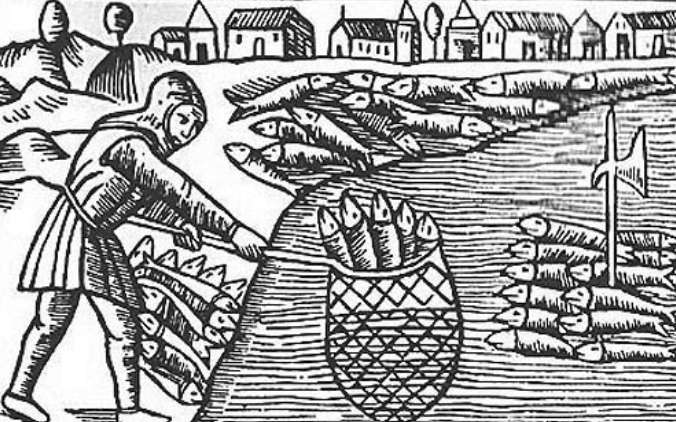
Medieval herring fishing
The Church's restrictions on meat helped sustain a trade that stretched far beyond England. Fishing communities along the North Sea and Baltic coasts supplied enormous quantities of preserved fish. Herring and stockfish could be transported over long distances, passing through ports, markets and merchants' hands before reaching inland towns.
England had its own important fisheries, but fish was also imported. The trade linked fishing ports with monasteries, castles, towns and villages whose inhabitants needed a reliable supply throughout the year.
Preservation was what made this possible. Salting, smoking and drying allowed fish to be stored and transported, although the results were not always particularly appetising by modern standards.
Fresh fish was a different matter. If a noble household wanted sea fish delivered inland, speed mattered. The cost of transport helped make certain varieties a luxury.
Demand also fluctuated with the religious calendar. Lent, in particular, created a predictable period when fish was needed in large quantities.
For fishermen, merchants, salters and fishmongers, the Church's fasting rules were therefore good for business.
Was fish considered healthy?
Medieval ideas about food were also influenced by medicine.
Physicians believed that good health depended on maintaining a balance between the body's four humours. Foods were classified according to qualities such as heat, coldness, moisture and dryness, and fish was generally considered cold and moist. So fish could be healthy, or unhealthy, according not just to the type of fish, if it were fresh, but also the constitution of the person eating it.
Sounds sensible? Maybe, except that the humoral theory was a load of old bull, and the physicians couldn’t agree which fish were best anyway.
But one thing is for sure: monks ate a lot of fish, and monks lived longer than most. Okay, they didn’t do heavy work either, probably weren’t at much risk of workplace accidents (unless you’ve read Dissolution by Shardlake), so maybe it’s not just about the fish.
And what happened during Advent?
Next week, I'll be looking more closely at Advent itself, and why the medieval preparation for Christmas was so different from our own.